

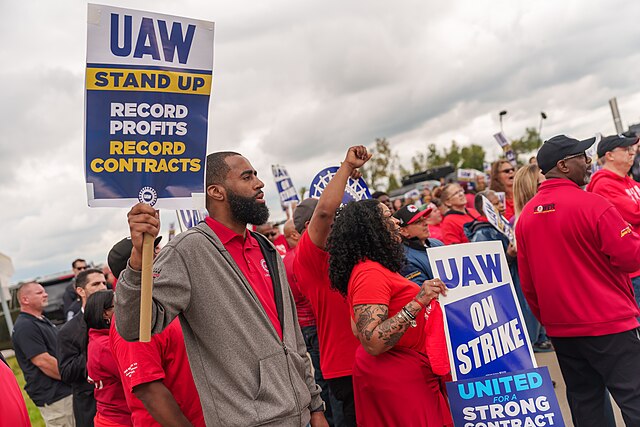
Gary Cunningham remembers sitting at the dining room table as a boy, listening to his father relate stories about his work as a union grievance chairman.
One especially resonates with him today.
A woman, sexually harassed by a manager, appealed to the union for help. Cunningham’s dad took careful note of her pain and distress. And then he unleashed the fury of the union on management, securing his coworker the safe, dignified work environment she deserved.
It’s that deep concern for others, forged elbow-to-elbow on the shop floor and often handed down from generation to generation, that most distinguishes union members from the Jeffrey Epstein class of billionaires and other bullies who prey on the vulnerable.
Cunningham, who followed his father into the labor movement and blazed a decades-long career as a United Steelworkers (USW) activist, knows that unions remain the staunchest bulwark against the 1 percenters who are dividing America into a land of haves and have-nots.
“They just don’t care,” Cunningham, now vice president of the Steelworkers Organization of Active Retirees (SOAR) chapter in Albany, New York, said of Epstein and others of his ilk.
Epstein, a one-time money manager who committed suicide in 2019, spent decades trafficking women and teenage girls to the nation’s wealthy and powerful.
As revelations of his crimes stirred revulsion among ordinary Americans, Epstein also came to symbolize something more—a broader system that’s rigged for the rich and engineered to exploit everyone else.
The betrayal starts at the very top, observed Cunningham, noting that Donald Trump, a billionaire, is building a $350 million ballroom with the help of rich friends while Americans stagger every day under the affordability crisis he fueled.
“He was born with a silver spoon in his mouth,” Cunningham observed of Trump. “He had everything handed to him. His priorities are with the rich. He doesn’t care about the middle class or even the poor.”
Millions of Americans work two or more jobs yet still struggle to make ends meet because employers like Jeff Bezos, the billionaire founder of Amazon, and Brian Niccol, the multimillionaire CEO of Starbucks, refuse to pay fair wages.
But the exploitation of working people goes far beyond the workplace.
Parents strain to feed their families amid price gouging by food manufacturers and grocery chains. Because there’s no sating their craving for more of everything, the wealthy also snap up houses as investment properties, driving up prices and denying working people the satisfaction of homeownership.
Working people even resort to rationing expensive medications. Sadly, drug company executives prefer to ravage communities with illegal opioids—and make a killing fostering people’s addictions—than focus on fixing a broken health care system.
“There are so many people in need,” said Cunningham, who helps to operate a drive-through food pantry in the Albany area, noting some clients arrive in vehicles so run down that “you wonder how they got there.”
There’s no reason for Americans to put up with any of this.
In stark contrast to the Epstein class are stalwart union members, who stand up to injustice and look out for others, especially those most at risk.
Union workers advocate for good jobs, family-sustaining wages, affordable health care, and retirement security, all of which are essential to building the middle class and sustaining a vibrant democracy.
In addition, unions fight for the paid leave benefits that help domestic violence survivors get away from their abusers. They embrace empowerment efforts, such as the USW’s Women of Steel and Veterans of Steel initiatives, to ensure a path forward for everyone. And union members negotiate the contract language essential for protecting one another from mistreatment and holding management accountable.
The uber wealthy who use people and throw them away will never understand the bond among union members, who earn every penny they put in their pockets. Having struggled, they gladly sacrifice to help others get ahead.
For example, Cunningham’s father grew up poor, in a house without central heating, and felt so embarrassed by his circumstances that he hesitated to let his future wife visit when they started dating.
But a good union job enabled him both to build a better life for his own family and to help pave the way for others. He stood with his coworkers, leveraging the power of the union to give everyone a fair share and a seat at the table.
“My dad completely understood where the working class was coming from,” Cunningham explained.
Cunningham emulated his father’s example, serving as a Local 9265 negotiator, as a frequent presence at rallies and picket lines, and as an activist promoting pro-worker legislation through USW’s Rapid Response advocacy team.
Among many other examples, union activists in recent years successfully fought to provide paid sick leave to workers in Colorado, to make workers’ rights a constitutional amendment in Illinois, and to save the pensions of more than a million Americans across the country.
This union counterbalance against the Epstein class is more essential than ever.
Billionaires are hoarding wealth and fueling unprecedented levels of economic inequality as they attempt to foreclose on the American dream.
It’s no coincidence that some of the best seats at Trump’s inauguration went to Bezos and other billionaires. Trump went on to stock his administration with a record 13 billionaires. This coterie boasts a combined worth of $450 billion, bigger than the economies of many nations.
The nation’s median household income hovers around $83,730, even as the cost of living soars.
Yet the spending bill Trump signed in 2025 cuts Medicaid, food assistance, and other lifelines while giving more tax breaks to the wealthy. Trump even mocked struggling Americans just a few days ago, calling the affordability crisis a “hoax.”
Fortunately, activists like Cunningham stand in the breach. They’ll continue to fight the conniving rich and harness union power for shared prosperity.
“It’s what gave me a better upbringing than my dad,” Cunningham said.
This article was produced by the Independent Media Institute.
ZNetwork is funded solely through the generosity of its readers.
Donate




