


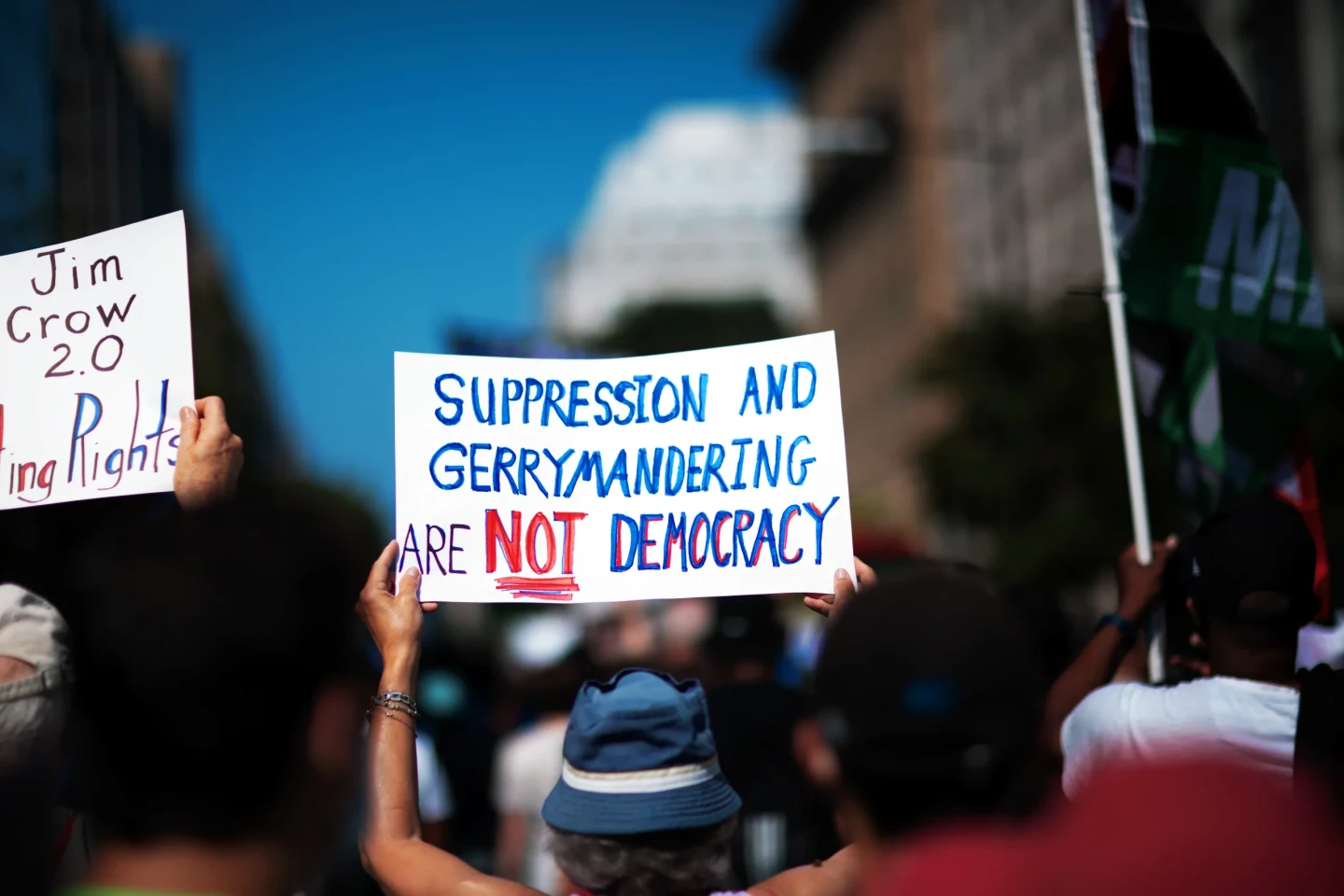
“Gerrymandering” is the historic term for politicians picking their voters by manipulating congressional and state electoral districts. Redistricting usually happens every 10 years. It is fair to say that most voters don’t want politicians rigging the system to help one party win elections.
Both the Republican and Democratic parties have played this partisan gerrymandering game for years. Recently, the Republicans have become more ruthlessly partisan and have outpaced the Democrats. That is why, for example, in Pennsylvania, Democrats substantially outvote the Republicans but have fewer seats in the House of Representatives.
In the past year, the gerrymandering race has run amok. It was ignited by Tyrant Trump, who told his buddy Texas Gov. Greg Abbott to break with the decennial tradition and get the GOP legislature this year to redistrict Texas to knock out four or five Democrats who are now in Congress.
Then came the tit for tat race. California Gov. Gavin Newsom led a voter referendum that authorized a redistricting that could gain the ruling Democrats an extra four or five seats now held by Republicans. Then more “red states” jumped in along with more “blue states.” The latter mostly did it by voter referendum, such as in Virginia, while the Republicans preferred to do it through GOP-dominated legislatures. Florida’s GOP even disregarded a 2010 state referendum that would have prohibited their recent actions.
In Virginia, the state Supreme Court ruled 4 to 3 that the recent redistricting referendum was unconstitutional. The biggest blow came from the six gerrymandering Injustices of the US Supreme Court in the case of Louisiana v. Callais, further gutting the 1965 Voting Rights Act. Their ruling, in effect, outlawed districts drawn to give minority voters a chance to have Black representatives in Congress and in state legislatures. Political pundits are predicting a dramatic decline, as soon as this November’s midterm elections, in the number of Black representatives in the House, presently 59, and Hispanic Representatives, presently 48.
They reflect empirically under-nourished certitude. A couple of them are declaring that the Democrats could win the House of Representatives popular vote by four percentage points and still lose the House to the Republicans in November!
I think these pompous predictors are wrong because they are ignoring too many factors.
First, they are not weighing the prospects of greater voter turnout by minorities due to the indignation they are expressing against the Supreme Court decision and the follow-up by red state legislatures. Many Black voters agree with their leaders that this decision, and others earlier by an unelected court, may drive them back to the Jim Crow years. A 10-20% greater turnout by Black voters could, however, make up for these redrawn districts that favor greater white majorities in the House and state legislatures.
The Hispanic vote was trending toward President Donald Trump because many Hispanic voters believed his lies and fake promises during the 2024 campaign (read the front-page article in The Washington Post, May 11, 2026, by Teo Armus titled “New Congressional Map Draws Ire Among Puerto Rican Voters in Florida.”) There are, however, millions of Latinos in central Florida alone. Many are expressing their anger by saying, “Our voice shouldn’t get diluted” or that their “community is being torn apart.”
Second, the pundits rarely talk about candidates and supporters highlighting long-overdue, highly-popular reforms, agendas, and social safety nets that improve the lives and livelihoods of all voters where they live, work, and raise their families. Mobilizing voters from the right and left around “common ground” advances, such as raising the minimum wage and unfreezing Social Security benefits or providing adequate child tax credits, could break millions of voters out of their knee-jerk attachment to political labels. I’m circulating, for example, a “Winning Compact for America” of 10 proposals backed by a majority of voters, in some cases, a huge majority of left-right voters.
The Winning Compact for America includes:
- Raising the federal minimum wage from $7.25 per hour to at least $15 per hour, benefiting 25 million workers.
- Raising all the Social Security benefits, frozen for over 45 years, and paying for it by increasing the Social Security tax on the wealthy, benefiting over 60 million elderly. This was supported by about 200 House Democrats in 2022 but was blocked by the Democratic Speaker from going to the floor. Rep. John Larson (D-Conn.), the bill’s champion, can provide additional details.
- Establishing a children’s tax credit, cutting child poverty in half, with over 60 million children benefiting. Very popular with parents regardless of their political party affiliations.
- Instituting Medicare for All, safer, more efficient, and much less stressful than our current approach to healthcare.
- Repealing Trump’s cuts in Medicaid and Supplemental Nutrition Assistance Program programs that were benefiting tens of millions of Americans.
- Cracking down on corporate crooks stealing consumer dollars, wages, and worker pensions.
- Adopting social safety nets for families, long available in Western Europe and Canada.
- Passing labor law and campaign finance reforms put forth decades ago.
- Investing in crumbling public services and infrastructures.
- Paying for the above by restoring taxes on the very under-taxed super rich and large corporations (85% approval) and by ending huge corporate welfare giveaways and debloating the runaway, unaudited military budget.
Perhaps the pundits ignore these appealing agendas because the Democratic Party has contracted out too much of their campaigns to corporate-conflicted consultants who subdue such progressive manifestos or “Compacts for America” to avoid upsetting corporate campaign donors.
Another understated factor hails from Trump himself, who every day fuels outrage even among many of his supporters who feel betrayed. The other day, Treacherous Trump emitted this turnoff, “I don’t care about the financial situations of Americans,” as he continues to use the White House to corruptly enrich himself, his family, and cronies. Moreover, going after Pope Leo twice with street language isn’t endearing him to many Catholics. Trump can’t control his fevered mind and mouth.
This entire madness of mega gerrymandering could be ended if members of the House ran at large from their state. Let’s say a state has 10 members of the House. They would run at large, and the top 10 vote-getters would be elected to the House. That is how the first woman elected to Congress in 1916, the great Jeanette Rankin from Montana, won her seat. The two House members ran statewide, and she came in second. Some cities have citywide or at-large elections.
Political scholar Lee Drutman called for Congress to enact a form of proportional representation, which is inherently race-neutral and is operational within other democracies in Western Europe. (See his Substack piece titled, “The Supreme Court Killed Voting Rights and Escalated the Gerrymandering Wars. Here’s What Congress Needs to Do in Response.” May 1, 2026). PR also helps to “break the two-party doom loop that’s driving our insane political death spiral,” he writes.
A more modest existing reform comes from states that have adopted non-partisan electoral commissions, e.g., Iowa and Michigan, by referendum. Voters like this approach better than the politicians’ slicing and dicing their voters to make districts safe for only one party.
Landslide elections—such as Ronald Reagan over Jimmy Carter in 1980—overwhelmed many gerrymandered districts. If the Democrats wake up, fire their profiteering consultants, and run on a specific “Compact for America,” they could landslide the Trumpitized GOP this November.


Nader is opposed to big insurance companies, "corporate welfare," and the "dangerous convergence of corporate and government power." While consumer advocate/environmentalist Ralph Nader has virtually no chance of winning the White House, he has been taken quite seriously on the campaign trail.Indeed, he poses the greatest threat to Sen. John Kerry. Democrats fear that Nader will be a spoiler, as he was in the 2000 election, when he took more than 97,000 votes in Florida. Bush won Florida by just 537 votes. The win gave Bush the election. Nader, an independent candidate, who also ran in 1992 and 1996, is on the ballot in 33 states, including Florida, Ohio, Wisconsin, and New Mexico—tough battleground states. Kerry stands a chance of losing those vital states if Nader siphons away the votes of Democrats. President Bush and Kerry have been in a statistical dead heat in nationwide polls, and votes for Nader could well tip the balance in favor of Bush.Many Kerry supporters contend that a vote for Nader is in reality a vote for Bush and have made concerted efforts to persuade Nader to throw his support behind the Democratic candidate. Nader, however, has held fast to his convictions that the two candidates are nearly indistinguishable and are pawns of big business.Designing Cars for Everything but SafetyNader was born in Winsted, Connecticut, on Feb. 27, 1934 to Lebanese immigrants Nathra and Rose Nader. Nathra ran a bakery and restaurant. As a child, Ralph played with David Halberstam, who\'s now a highly regarded journalist.Nader with Democratic nominee Jimmy Carter outside of Jimmy Carter\'s home on August 7, 1976, discussing Consumer Protection. (Source/AP) Nader graduated magna cum laude from Princeton in 1955 and from Harvard Law School in 1958. As a student at Harvard, Nader first researched the design of automobiles. In an article titled "The Safe Car You Can\'t Buy," which appeared in the Nation in 1959, he concluded, "It is clear Detroit today is designing automobiles for style, cost, performance, and calculated obsolescence, but not—despite the 5,000,000 reported accidents, nearly 40,000 fatalities, 110,000 permanent disabilities, and 1,500,000 injuries yearly—for safety."Early Years as a Consumer AdvocateAfter a stint working as a lawyer in Hartford, Connecticut, Nader headed for Washington, where he began his career as a consumer advocate. He worked for Daniel Patrick Moynihan in the Department of Labor and volunteered as an adviser to a Senate subcommittee that was studying automobile safety.In 1965, he published Unsafe at Any Speed, a best-selling indictment of the auto industry and its poor safety standards. He specifically targeted General Motors\' Corvair. Largely because of his influence, Congress passed the 1966 National Traffic and Motor Vehicle Safety Act. Nader was also influential in the passage of 1967\'s Wholesome Meat Act, which called for federal inspections of beef and poultry and imposed standards on slaughterhouses, as well as the Clean Air Act and the Freedom of Information Act."Nader\'s Raiders" and Modern Consumer MovementNader\'s crusade caught on, and swarms of activists, called "Nader\'s Raiders," joined his modern consumer movement. They pressed for protections for workers, taxpayers, and the environment and fought to stem the power of large corporations.In 1969 Nader established the Center for the Study of Responsive Law, which exposed corporate irresponsibility and the federal government\'s failure to enforce regulation of business. He founded Public Citizen and U.S. Public Interest Research Group in 1971, an umbrella for many other such groups.A prolific writer, Nader\'s books include Corporate Power in America (1973), Who\'s Poisoning America (1981), and Winning the Insurance Game (1990).
ZNetwork is funded solely through the generosity of its readers.
Donate





1 Comment
These are great ideas to gain a slight improvement.
But I think the truth is, liberal democracy and capitalism can’t co-exist in the long term. Either we find a way to create a new, global democracy from below, that can overcome capitalism itself, or capitalism will gradually extinguish ALL democracy.
Here’s an idea: https://www.greensocialthought.org/thinking-politically/united-we-stand/