

“Deep canvassing” offers a model for how anti-racist Americans can practice what they preach and work to promote racial justice narratives.
The visionary writer and activist James Baldwin once said, “We can disagree and still love each other, unless your disagreement is rooted in my oppression and denial of my humanity and right to exist.” I have often thought about this powerful sentiment and worn it as an armor to protect myself from racial trauma. But I come back again and again—perhaps because of an unfortunate optimism—to the idea that we can’t give up on millions of people as hopelessly lost to racist narratives.
“Conflict is a part of life,” says Nolan Higdon, a lecturer at Merrill College and in the education department at University of California, Santa Cruz. Higdon, who is an expert on digital culture, co-wrote a book with Mickey Huff called Let’s Agree to Disagree: A Critical Thinking Guide to Communication, Conflict Management, and Critical Media Literacy.
“Conflict, when addressed correctly, can be constructive,” says Higdon. “We know there are these hateful ideologies out there.” He adds, “We’re not asking people to get comfortable with a white supremacist” and their views. What he and Huff are advocating for instead is to take a “solutions-oriented” approach to conflict. “In a democracy, typically, the best ideas win the day when we engage in dialogue and try and change minds.”
He says people “are not born with” racist attitudes. These are “learned behaviors.”
“What we’re advocating is for people to figure out how to go about these conversations,” says Higdon. According to him, there are certain conditions that must be met. First, “you can’t begin to enter the process of constructive dialogue unless you have reciprocity.” One example of this is for both parties to agree upon what sources of information are considered reliable. If people disagree on what constitutes a fact, there’s little hope for dialogue.
Second, the venue for discussion is also important, and social media platforms are not appropriate for fostering constructive dialogue. In-person interactions in social settings are more conducive, instead, at family gatherings during the holidays, for instance.
Third, “rather than lampooning people or trying to own them, simply asking questions” can be effective, says Higdon. He offers the example of how conversing with a vaccine skeptic might be best met with questions like “Are you opposed to all vaccines, or are you just opposed to vaccine mandates?”
It turns out that such an approach has been scientifically tested and found to work rather well.
Deep Canvassing
While Robin DiAngelo’s book White Fragility hints that there may be no hope for white people who have internalized racist narratives, new research on a technique called “deep canvassing” shows that it is indeed possible to change minds with one-on-one conversations.
In 2016, two social scientists undertook a promising study about ways to reduce or eradicate prejudice against transgender people. According to results published in the journal Science, David Broockman and Joshua Kalla found that “a single approximately 10-minute conversation encouraging actively taking the perspective of others can markedly reduce prejudice for at least 3 months.” They recruited 56 “canvassers” to go door to door in Miami, Florida, and have 10-minute conversations about backing anti-discrimination legislation with voters on their doorsteps.
The effects of the deep conversations created a positive change durable enough to move people to vote for laws protecting transgender people, even when they were exposed to counter-arguments. What’s even more heartening is that the results were the same whether or not the canvassers were themselves transgender.
In 2020, the political activist organization People’s Action partnered with the New Conversation Initiative and scientists Broockman and Kalla to see how effective such a method could be to change the minds of voters who were tempted to vote to reelect Trump.
New Conversation Initiative explained that canvassers must aim to have conversations with two priorities:
- Nonjudgmentally inviting a voter to open up about their real, conflicted feelings on an issue.
- Sharing vulnerably about their own lives, and asking curious questions about the voter’s life (especially the experiences that have shaped how they each feel about the issue).
As Congresswoman Alexandria Ocasio-Cortez (D-NY) has said, “the most powerful and persuasive things a person can say on any given issue is sharing their personal experience and personal story.”
According to New Conversation Initiative, “when we take this approach, people’s experience leads them away from prejudice, stigma, or fear, and towards empathy and a willingness to consider progressive solutions.” The organization said deep canvassing is “the only tactic scientifically proven to be able to lastingly reduce prejudice, inoculate people against right-wing fear-messaging, and change hearts and minds on many of our society’s toughest, most divisive issues.”
Based on this, People’s Action conducted what it called the “first-ever deep canvassing political persuasion experiment” to change voters’ minds about Trump and found that it was, “estimated to be 102 times more effective per person than the average presidential persuasion program.”
Brooke Adams, the director of Movement Politics at People’s Action, explains that the program was “built to cut through the noise of the propaganda that people are hearing on Fox News,” including “racist fear-driven messaging” and disinformation that “creates mass confusion.”
Instead of using slick approaches crafted by Washington, D.C.–based political strategists, Adams says People’s Action trained canvassers on “how to listen, how to ask questions, how to engage with curiosity, and ultimately how to build a one-to-one relationship with people.” The results are surprisingly effective in helping people see their common humanity.
Although deep canvassing has yet to be applied specifically to racial justice narrative-changing efforts in an organized and large-scale manner, it offers a model for how anti-racist Americans can practice what they preach and work to promote racial justice narratives.
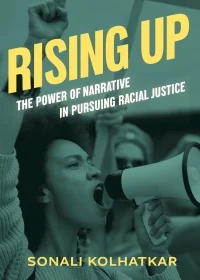
This excerpt of Chapter 6 from Rising Up: The Power of Narrative in Pursuing Racial Justice, by Sonali Kolhatkar, is reprinted with the permission of City Lights Books. Copyright © 2023 by Sonali Kolhatkar.
ZNetwork is funded solely through the generosity of its readers.
Donate