

The first time I really knew about Palestine Action was in 2019, several months before their official launch, when I followed their co-founder Richard Barnard and other activists into the Instro Precision factory in Kent.
After dozens of staff had been escorted out, the factory, a subsidiary of Israeli weapons manufacture Elbit Systems, was closed and the building was graffitied. A very polite policeman asked the activists when they were intending to leave, reassuring them that they would not be arrested.
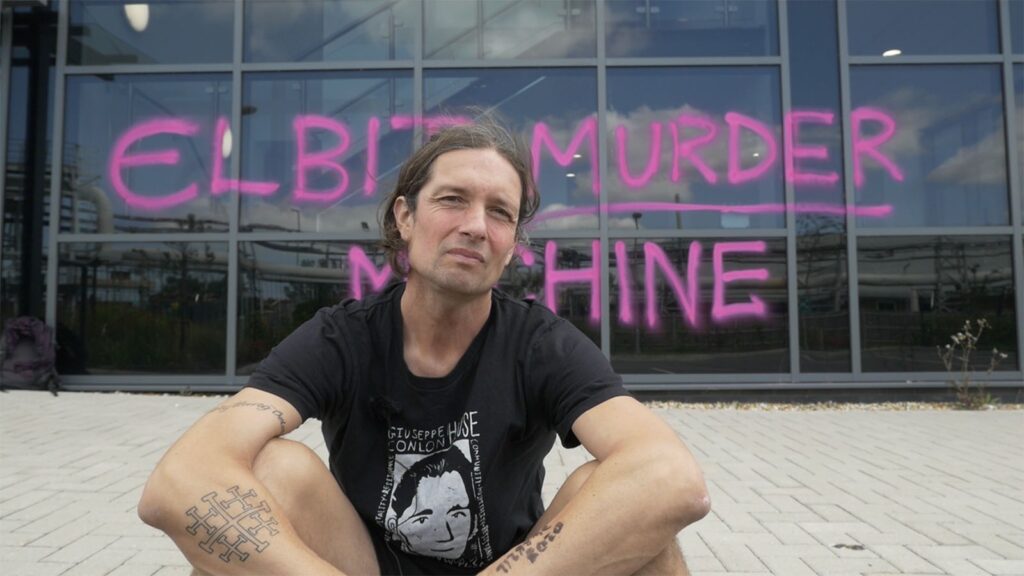
Sitting in front of the slogan “Elbit Murder Machine”, sprayed on the glass front of the building, Barnard asked how people could shut down a factory that was supposedly “law-abiding” and yet not be arrested. Around the same time, an Elbit factory in Oldham was closed by an occupation for two days, and again no one was charged.
In those days, activists facing trial could demand disclosure of weapons export licences and other information. The argument was that Elbit had to prove that the factory’s activities were lawful, before any disruption could be found to be unlawful. Possibly as a result, Elbit regularly backed away from pressing charges, even in cases of serious damage and major disruption. Back then, Elbit never responded to requests for comment.
New legal rulings, like then-attorney general Suella Braverman’s referral of the Colston Statue case to the Court of Appeal in 2022, have made it much harder for climate or arms-trade activists to defend themselves in court. Acts of criminal damage on private property now have no human rights protections, and arguing that action is necessary to prevent greater crimes – what’s called lawful excuse – is now rarely available as a valid legal defence anymore.
Co-founder Huda Ammori, who has just won her judicial review over Yvette Cooper’s proscription of Palestine Action, told me that in the six years of the group’s direct action activities, even among those actually taken to trial, around half have been found not guilty, or the jury failed to reach unanimous verdicts. So even though it is getting more and more difficult to offer any sort of lawful defence, wins are still possible as the recent trial of the Filton 6 has shown.
The Trial
In August 2024, six members of Palestine Action broke into Elbit’s UK headquarters in Filton, near Bristol. They were arrested and denied bail, which meant they would be kept in prison until the case went to trial in November 2025.
Although initially held under counter-terrorism powers, they were only charged with lesser offences, ranging from criminal damage to more serious allegations of aggravated burglary, which potentially carries the penalty of life imprisonment.
I observed every day of the Filton trial, from jury selection on 17 November until verdicts on 4 February. The six defendants, all young people with no previous criminal convictions or cautions, and each with glowing character references, had already been imprisoned for 15 months. Since the proscription of Palestine Action (PA) last July, they reported even harsher treatment within the prison system.
Claims of extra time confined to cells, withholding of mail, and reduced contact and visits eventually led to hunger strikes by several other Filton defendants who face further long remand times until their trials are heard.
On trial days, defendants were routinely woken at 5am, normally missing breakfast while security checks were done. They were loaded onto the prison vans operated by Serco, the company which runs prison escorts and custody services, and could spend hours on a circuitous route to the court.
Although vegan prisoners might be given packed lunches by the prison, there is a Kafkaesque rule that prevents these being eaten at the court, and the Woolwich Crown Court kitchen often runs out or only has very limited and unhealthy vegan options.
At one point, the judge ordered that a banana be given to one of the defendants, Fatema Zainab Rajwani, before she gave evidence. It took 40 minutes to resolve the issue. Another day, the judge, Mr Justice Johnson, requested the same for another defendant, Zoe Rogers, when she was feeling faint while giving her evidence, but Serco staff said they had got into trouble before and they refused.
It’s worth noting that Serco reportedly went into partnership with Elbit Systems recently to bid for a UK armed forces training contract worth £2 billion, although it was subsequently awarded to Raytheon.
Tired, hungry defendants find it hard to follow complex legal arguments and prosecution evidence, and then have little time for consultation with their lawyers. Day after day, prisoners arrived too late at court to have any facetime with their legal representatives. At the end of the day, Serco insisted on vans leaving as soon as possible, although again it could be hours before a prisoner returned to their cell and hopefully received some food before bed.
The Elbit-sized elephant in the room
Throughout the first weeks of trial, defence lawyers repeatedly highlighted these issues of access, but Mr Justice Johnson, while expressing sympathy, cited case management and an urgent need to make progress as taking precedent.
The issue came to a head at the start of the defence evidence. While the jury were out, one of the defence barristers made a submission with reference to the case of R v Cordingley, in which a verdict was quashed on appeal on the basis it wasn’t a fair trial due to the behaviour of the trial judge. The barrister said that due process and the right to a fair trial must trump using every spare minute of court time.
Moreover, lead defence counsel Rajiv Menon KC consistently sought to pursue lines of questioning which brought the issues of Elbit and Gaza into the courtroom, pushing against procedural constraints placed in his path.
He revisited these issues in his closing speech to the jury, pointing out that while a judge is entitled to make rulings as to what areas of evidence are relevant and which are not, the result of that in this case had been that the jury heard very limited information about Elbit. No witness from Elbit took the stand, and the security guards themselves were employed by an outsourced company, Minerva Elite, founded by former UK Special Forces officers and personnel.
As Menon put it, “Elbit remains in the shadows, hidden and protected, but not, ladies and gentlemen, in the corridors of power, where no doubt they are welcomed, wined, and dined”.
The missing footage
Elbit was not even called to give evidence about their apparently unfit-for-purpose security surveillance system. Remember this is a high-tech company that provides sophisticated surveillance systems for border walls, but more than a year after the incident, it came to light during the trial that the map of CCTV cameras given to the defence team had several missing including those in areas of the factory where disputed incidents had taken place.
Testimony from police witnesses, and in particular the CCTV recovery officer working for the police’s National Digital Exploitation Service, revealed for the first time various issues with camera footage, none of which had been in her original written statement. In the afternoon at the start of the trial’s third week when the jury was not in the court, Menon said that the defence had been kept in the dark about these issues, and only by pressing harder during the trial had they finally been given unredacted body-worn footage including the moment security guard Angelo Volante entered the factory wielding a whip.
Another clip showing Volante moving towards someone while holding a sledgehammer triggered a wider request on 18 November, and the defence team were then drip fed around 300 pages of further evidence including email traffic between the police and an anonymised senior Elbit employee known as “Witness Alpha”.
On 2 December, defence barristers were cross-examining a police officer, PC Sarah Grant. Menon asked Grant if Elbit had sole control and access to the CCTV system for two days. She replied yes. He then quoted an email she had sent to “Witness Alpha” in which she wrote: “There’s a huge opportunity for the defence counsel to use the gaps and jumps to their advantage”. Menon then questioned why among the correspondence revealed in the hundreds of pages of new evidence, police appeared to be “chatting with Israel’s largest arms manufacturer about what the defence counsel might do”.
Corporate and state media coverage
On 25 November, on what would have been the first day of the PA judicial review hearing, prosecution evidence was given to the press. This comprised video footage of the incident, carefully edited over a period of months by the police’s Forensic Audio and Visual Unit (FAVU), under guidance from Detective Constable Matthew Hammersley, a counter-terrorism police officer.
The footage or stills were widely shared, alongside lurid headlines, only lightly sprinkled with the word “allegedly”, that described one of the defendants, Samuel Corner, “wearing a keffiyeh”, attacking a “screaming” police woman with a sledgehammer, and “breaking” her spine. Social media blew up, and it was a field day for the followers of pro-Israel accounts, who described the incident as attempted murder, proving that Palestine Action were terrorists, and calling for capital punishment. I sent a few screenshots of what I perceived to be clear examples of contempt of court to Mr Justice Johnson, and received a polite reply thanking me.
The media accounts quoted police and security guards, with no context or accurate reporting of the actual live evidence which included shifting accounts under cross-examination.
One example was PC Aaron Buxton, a police officer at the incident. In his witness statement, Buxton said he saw one of the defendants, Jordan Devlin, holding a sledgehammer. When shown footage, he admitted Devlin was unarmed, but that Volante was the one with the sledgehammer. The media was not told about the alleged two serious assaults by Volante against Devlin, we hadn’t seen the newly disclosed footage of him entering the building with whip in hand, and we hadn’t heard that a disorientated Samuel Corner had just been sprayed in his eyes with PAVA liquid, a prohibited substance used under licence by police which causes extreme pain and leaves people disoriented and unable to see clearly for several minutes.
The verdict and potential retrial
Despite all the above, a jury made up of twelve randomly-selected local residents eligible to vote could not convict a single person accused of these serious crimes. On 4 February, a clear ‘not guilty’ verdict was returned for all six on the charge of aggravated burglary. The jury was not satisfied that the protesters entered the Elbit factory carrying items with the intention to cause injury.
Three were also acquitted of violent disorder. The jury could not reach a verdict on the remaining three defendants on this particular charge, nor on any of the possible lesser offences they might have found Corner guilty of, not even on the basic charge of criminal damage.
Tomorrow the judge will hear submissions on whether and on what basis a retrial will go ahead. During the past week, press articles have suggested, without evidence, that the jury had been tampered with.
Among the many high-profile public reactions to the verdict, Conservative party leader Kemi Badenoch expressed her disgust that someone could “break the spine” of a police officer and “get away with it”, shadow home secretary Chris Philp wrote to the Director of Public Prosecutions (DPP) demanding a retrial. The Police Federation made public their letter to the DPP, and former government advisor Lord Walney also expressed his deep disappointment at the verdict.
Many other similar public observations led to a tsunami of outrage across social media, effectively damning the jury’s decision and dismissing the eight weeks of evidence they all sat through attentively. It is hard to see how such wide-scale commentary could not be prejudicial to a future retrial.
Samuel Corner remains on remand without bail in Belmarsh Prison despite no conviction, while the other five defendants have been released under very strict bail conditions. Their futures are all still on hold, while seemingly the state awaits the ‘right’ result.
ZNetwork is funded solely through the generosity of its readers.
Donate