

In response to the intensifying attack on democracy by Donald Trump and MAGA, millions of people in thousands of locations have joined actions to oppose his juggernaut. While the Democratic Party is providing only paltry resistance, a wide coalition has formed in civil society to defend democracy and those who are under attack. How can such a diverse collection of forces, involving hundreds of different organizations, coordinate their action? And how can they effectively counter the attack on democracy when there is little effective opposition in Congress or the courts?
Four years ago, President Trump organized a coup and attempted to remain President. His attempted coup was defeated primarily by a little-recognized coalition of social movements anchored outside the electoral arena. That coalition was coordinated by an unpublicized, informal, but nonetheless effective network. While Trump’s current assault on democracy and the emerging fight against it are different in many ways from those of 2020, the movement-based opposition to his first coup can illuminate both the power of a non-electoral opposition and how it can be coordinated in the absence of formal organizational structures.
Defending Democracy
As the 2020 elections approached, the evidence grew that Donald Trump was planning to overturn the results if he lost. While the Democratic Party campaigned for Joe Biden, a Democracy Defense Coalition gradually assembled over 200 groups to prevent or overturn an anticipated Trump coup.
In September 2020, four activist experts on civil resistance issued a manual called Hold the Line: A Guide to Defending Democracy. Reminiscent of the Indivisible manual that helped launch the resistance to Trump in 2016, it presented a detailed plan for locally based resistance to a Trump coup. It laid out various scenarios in which Trump refused to leave office. It called for forming community-based “election protection” groups. These could start immediately with meetings by a small core group to develop a response plan and recruit others to participate in it. These groups would “hold the line” that all votes must be counted; all irregularities must be investigated impartially and remedied; and election results must be respected, regardless of who wins. Public officials could be called on in advance to state their commitment to these principles. Violation of these “red lines” by Trump or others would trigger these groups into action.
The guide provided sample meeting agendas, templates for “power maps” of forces to influence, “brainstorming sheets” for tactics, and other planning tools. It outlined targeted action to “undermine the pillars of support” for an illegal Trump regime. It called for mass popular mobilization based on disciplined nonviolence because “violence will backfire badly against the side that uses it.” It discussed tactics including displaying symbols of protest; engaging in demonstrations, marches, and nonviolent blockades; strikes of all kinds; deliberate work slowdowns; boycotts; divestment; tax refusal; and targeted disruption.
Trade unionists Bill Fletcher, Jr. and Jose La Luz made a related proposal for organized labor to establish “pro-democracy volunteer brigades” in preparation for the election.
We need volunteers who will assist with voter registration; mobilize in large numbers should law enforcement and right-wing militias show up at polling places in order to intimidate voters; block the right-wing from challenging legitimate voters and ballots; and lay the groundwork for massive civil disobedience should the Trump administration attempt to forestall the elections and/or refuse to recognize the results.
After his defeat in the 2020 election, Trump indeed attempted a violent but unsuccessful coup. Soon after its defeat, an article by Time journalist Molly Ball gave a detailed account of “The Secret History of the Shadow Campaign That Saved the 2020 Election.” It described a “vast, cross-partisan campaign to protect the election–an extraordinary shadow effort dedicated not to winning the vote but to ensuring it would be free and fair, credible and uncorrupted.” It was “separate from the Biden campaign and crossed ideological lines, with crucial contributions by nonpartisan and conservative actors.”
While no one individual or organization led the effort to ensure a free and fair election, informal coordination emerged. The Fight Back Table, a coalition of “resistance” organizations, gathered activists at the local and national level into a Democracy Defense Coalition. In April Mike Podhorzer, senior adviser to the president of the AFL-CIO, began hosting a weekly 2½-hour Zoom call. That became the center for “a constellation of operatives across the left who shared overlapping goals but didn’t usually work in concert.” The group had “no name, no leaders and no hierarchy,” but it kept its disparate participants in sync.
According to Ball, the effort “drew energy from the summer’s racial-justice protests,” many of whose leaders were a key part of the alliance. They wanted to “harness its momentum for the election without allowing it to be co-opted by politicians.” Their focus became to protect people’s ability to vote in the midst of the COVID pandemic. In Philadelphia, for example, advocates distributed “voting safety kits” containing masks, hand sanitizer, and informational brochures. “We had to get the message out that this is safe, reliable, and you can trust it,” said Hannah Fried of All Voting Is Local. Elsewhere activists recruited “election defenders” who were trained to use de-escalation techniques rather than calling the police. They surrounded lines of voters at urban polling places with a “joy to the polls” message that turned voting into a street party. Black organizers recruited thousands of poll workers to ensure polling places could stay open.
Black Lives Matter had shown that “people power could have a massive impact.” Activists prepared to revive that summer’s street demonstrations if Trump tried to steal the election. More than 150 groups, including the Women’s March, the Sierra Club, Color of Change, Democrats.com, and Democratic Socialists of America joined the “Protect the Results” coalition. The group’s website had a map listing 400 planned postelection demonstrations, to be activated via text message as soon as needed after the election.
Non-partisan election protection was not limited to the left. 22 Democrats and 22 Republicans formed the National Council on Election Integrity, met on Zoom once a week, and produced op eds, letters to the editor, and advertisements in battleground states and warned local officials about potential voting problems. Fearing “the potential for economy-disrupting civil disorder” in the wake of Black Lives Matter, The Chamber of Commerce, the Business Roundtable, other trade associations, the AFL-CIO, the National Association of Evangelicals, the National African American Clergy Network, and many other groups issued an election-day statement calling for election officials be given time to “count every vote in accordance with applicable law” without violence or intimidation.
When it became clear on election night that Trump would lose the election, Protect the Results announced it would “not be activating the entire national mobilization network today, but remains ready to activate if necessary.” Protect the Results then transformed the anticipated protests into a weekend of public celebration.
After the election came the count, the certification, the Electoral College, and the presidential transition. Again, movement-based popular action played a critical role in blocking Trump’s attempt at an electoral coup. In Michigan, for example, on election night a busload of Republican “election observers” arrived at Detroit’s TCF Center where votes were being counted. They crowded the vote-counting tables, refused to wear anti-COVID masks, and heckled the mostly Black workers. Within 45 minutes racial justice activists from Detroit Will Breathe, suburban women from Fems for Dems, and local elected officials arrived to protect the count.
As the election-certification process proceeded, Michigan election protectors flooded the Wayne County canvassing board’s certification meeting and testified at length on the right to vote; even the Republican board members voted to certify Detroit’s votes. When two Republican legislative leaders flew to Washington to meet with Trump to discuss having the Michigan legislature declaring him the winner, activists tracked down their flights and demonstrated at the airports to call attention to this devious plot. After the meeting, the legislators announced they’d pressed the President to deliver COVID relief for their constituents and informed him they saw no role for the legislature in the election process. When the state canvassing board met for the final step in certification, they were met by hours of testimony while Twitter and other media were flooded with thousands of messages with the hashtag “alleyesonmi.” Both Democrats and one Republican voted to certify; the other Republican abstained.
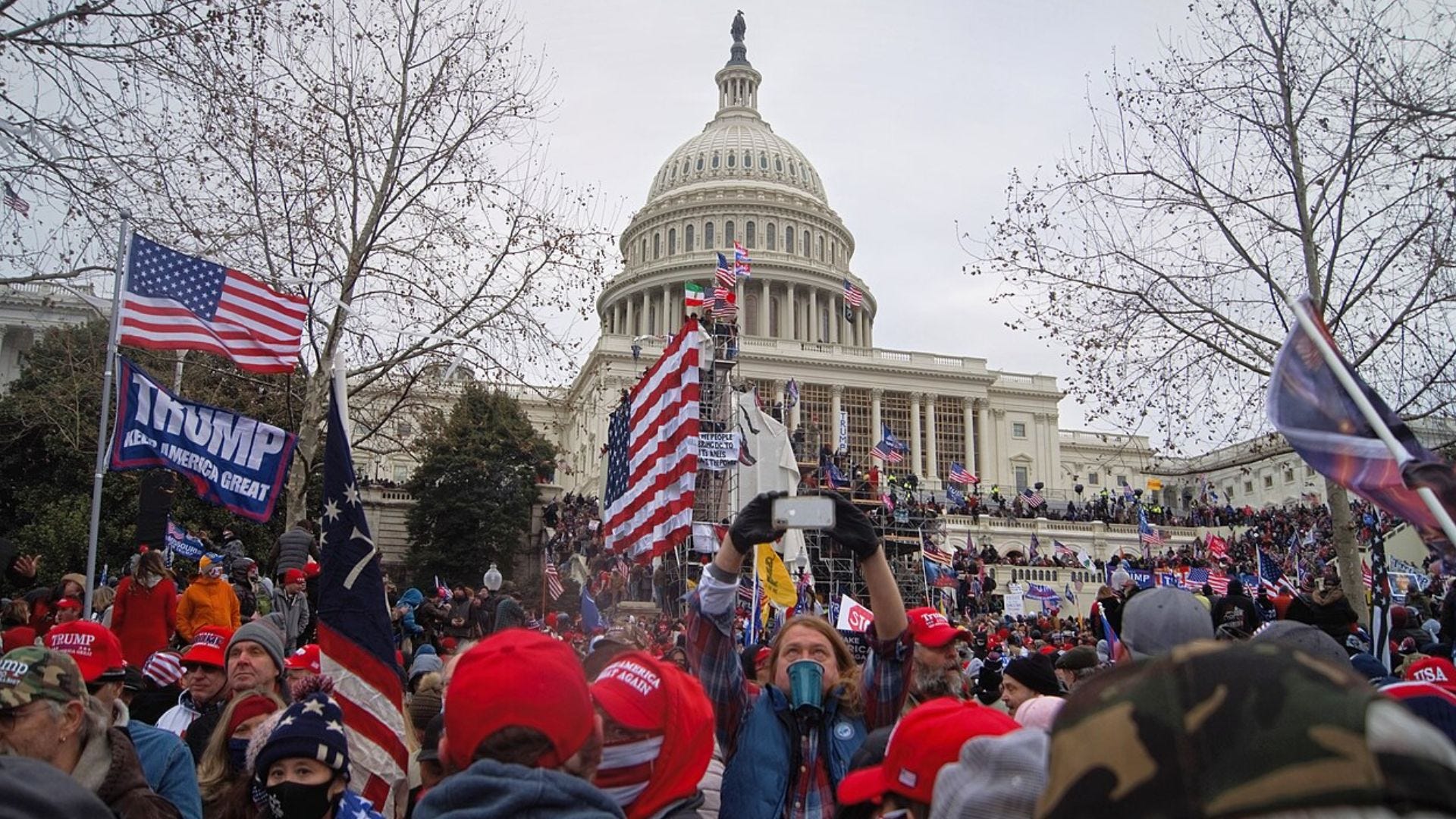
When on the morning of January 6 Trump supporters stormed the US Capitol, the “activist left” was “strenuously discouraging counter activity.” Instead of a battle between Trump’s coup army and leftist militants, Trump was allowed to paint a picture of himself and his supporters as the pathetic perpetrators of a failed coup, fighting not the left but democracy itself.
According to Ian Bassin, co-founder of Protect Democracy, in the end “every attempt to interfere with the proper outcome of the election was defeated.” While the particular strategy and tactics of this successful defense of democracy were adapted to the particular threat faced then and there, this experience shows that a movement-based opposition can indeed protect society against threats to democracy. It also shows that an informal network of organizations and movements dedicated to a common purpose can resist authoritarian rule without a tightly organized centralized leadership.
The defeat of the first Trump coup is not an off-the-shelf model for resisting his current and future authoritarian power grabs. The specific dynamics of Trump’s current “executive usurpation” are very different. So must be the tactics necessary to overcome it. But it shows that popular resistance in civil society can be significant, even when political parties and Congress conduct only tepid resistance.
ZNetwork is funded solely through the generosity of its readers.
Donate
1 Comment
Trump’s current coup is far, far more significant and devastating than Jan 6 and requires IMMEDIATE mobilization and resistance. Partisan politics are irrelevant here, as is waiting to see if he might cancel the mid-terms. He is ALREADY the dictator. While the corporate media allows some criticism of Trump’s individual abuses of government, society and institutions, they will not put those together to describe the terrible coup that is ongoing daily.
We must help the people wake up and resist!