
On Thursday, Tymmony Keegan stood on a picket line in front of Cleveland STEM High School in Seattle, where public school teachers had begun a strike the previous day on what would have been the start of the school year.
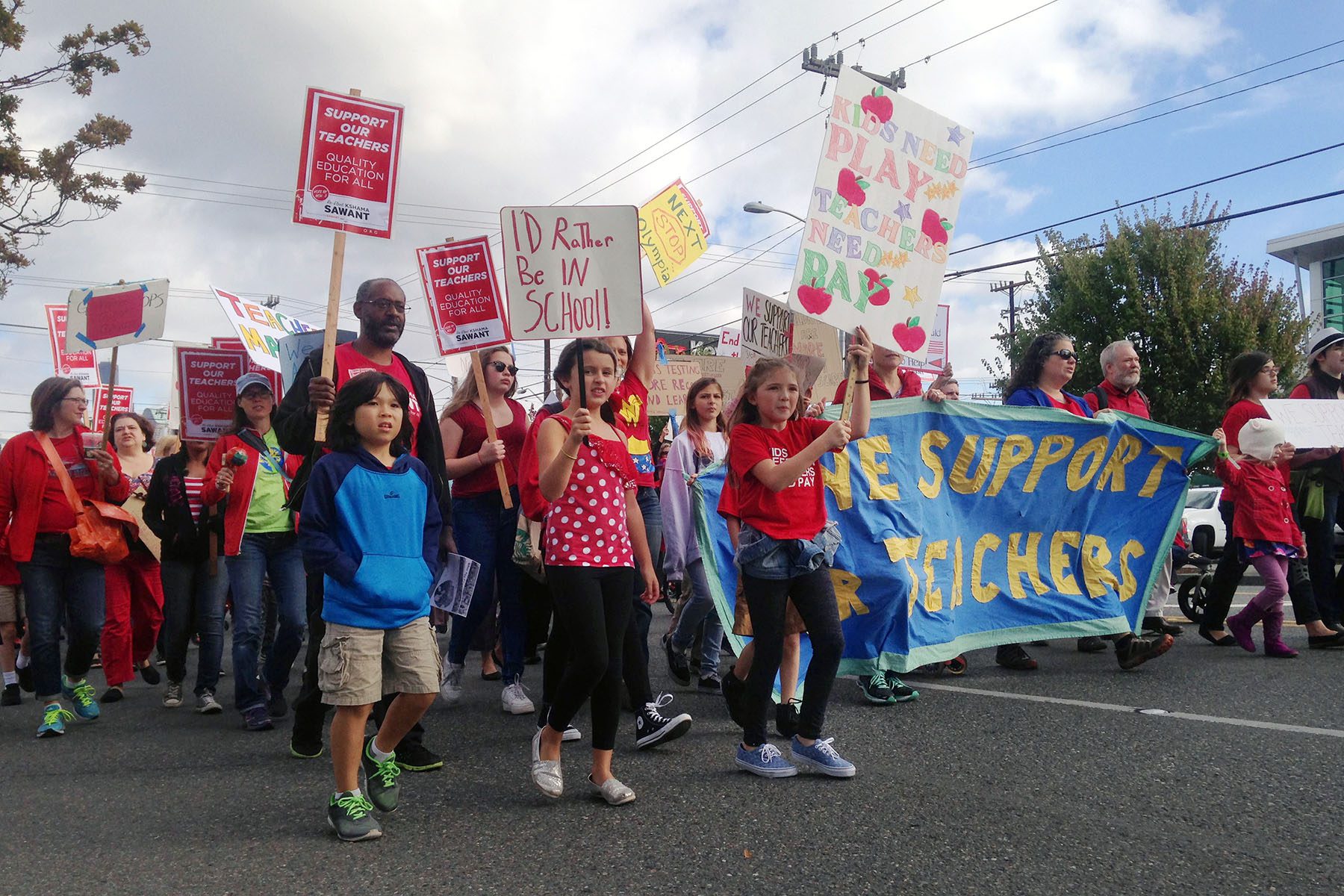
Her colleagues held signs stating, “Listen to educators! Fund our kids’ dreams! A nurse in every school!” It was her twin boys’ 4th birthday, a milestone they celebrated by temporarily joining the picket line. Cars and trucks honked their support for educators as they drove past the closed school.
“All of us who are out here on the picket line believe in what we’re doing, and we believe that schools have the capacity to be a much better place for students and staff,” said Keegan, an eight-year veteran who teaches Black studies at Cleveland.
The 6,000 teachers, paraprofessionals, office professionals, substitutes and other personnel who make up the Seattle Education Association are part of a wave of teacher strikes that have occurred in big and small districts alike nationwide this year, reviving a movement of labor activism in education that took place prior to the pandemic. Only now, a national teacher shortage gives workers in this woman-dominated profession even more leverage to demand better pay, benefits and working conditions.
“One of the factors that go into how much power the union has in the bargaining negotiations is the demand for teachers,” said Bradley D. Marianno, an assistant professor of educational policy and leadership and director of the Center for Research, Evaluation, and Assessment at the University of Nevada, Las Vegas. “So if districts are finding difficulty attracting and retaining teachers, that allows the union who represent educators to place stronger demands in their bargaining negotiations.”
The National Education Association estimates that the nation is short 300,000 teachers. Nationwide, teacher morale has dropped amid the COVID-19 pandemic and a political climate that’s led to attacks on public education, but ongoing concerns about salaries and class sizes have also raised tensions, experts and educators say.
In Seattle, educators are asking their school district for a two-year annual wage increase above the 5.5 percent cost-of-living adjustment funded by the state. Their demands also include class size caps and workload relief for school nurses along with better support for social-emotional learning, special education and multilingual education. Seattle Public Schools serve over 50,000 students.
And they are not the only Washington teachers to walk out during the crisis. Teachers in the Ridgefield School District, near Portland, started a strike Friday. Teachers in the Kent School District, 20 miles away from Seattle, wrapped up their strike Wednesday after walking out in late August. Seattle, though, stands out as the second big city union to announce a strike in recent weeks, with Columbus, Ohio, educators in August briefly striking for the first time in nearly 50 years. In the spring, teachers in large districts such as Minneapolis and Sacramento also went on strike.
The work stoppages come as surveys of educators have found that they are suffering from acute stress and burnout that make them more likely to consider leaving the profession. Before the pandemic, teachers were demanding more from districts, walking out of schools nationwide during the strike movement known as #RedForEd that took place during the 2018-19 school year.
In 2022, teachers are striking as politicians sow division about the curriculum while leaving students and schools without basic resources, said Becky Pringle, president of the National Education Association, in a statement to The 19th. Every student, she said, deserves a great public school with high-quality educators who have the time, resources and support to inspire their students.
“I’m endlessly proud that our educators are taking action on behalf of every student to ensure they have the resources they need to succeed and a school that attracts and retains the highest-quality educators with professional compensation,” Pringle said. “The #RedForEd movement, followed by the COVID-19 pandemic and now a crisis-level national teacher shortage, have made clear that ‘back to normal’ isn’t good enough.”
Seattle teachers last went on strike in 2015 with demands about their salaries, evaluations and work hours, among others. Seven years later, their wages remain a sticking point. Paraprofessionals make a starting salary of about $19 per hour, while teachers make a starting salary of about $63,000. For Keegan, a single parent who finished their second school year for Seattle Public Schools in the spring, it can be a struggle to balance their salary and bills related to child care and student loans. She resides in a house in nearby Renton, Washington, that their late mother purchased before dying of Parkinson’s disease.
“If it was not for that, I am not sure how I would be paying rent given what it costs,” they said. “So that’s been a huge financial burden removed from me, thanks to my mom, but I do have a roommate. That is also something that helps me financially, and I’m grateful that I have some elders in my life that help to care for my kids.”
Laurie Johnson, the registrar at Franklin High School in Seattle’s Mount Baker neighborhood, said that she could not afford to live in the community where she works. “Everybody wants a chance to own their home,” she said. “Everybody should live with a decent wage. And that’s all we want. I’m not asking to get rich. I’m in the wrong field if I want to get rich.”
In a statement posted on its website Thursday, Seattle Public Schools said that it continues to negotiate with the Seattle Education Association, even though it has yet to reach an agreement with the union.
“We continue to bargain in good faith and are making every effort to return students to classrooms,” the statement said. “We understand the challenges placed on students and families when schools are closed.”
The district did not respond to The 19th’s request for comment before publication.
Marianno said that real compensation for educators is stagnant. Their wages don’t reflect the level of inflation occurring now. A new study from the Economic Policy Institute found that teacher wages have been flat since 1996 and both women and men pay a wage penalty for choosing education as a profession. Overall, teachers earn 23.5 percent less than comparable college graduates, the study found.
Economist Stephanie Seguino argues that one reason educator salaries are lower than others that require teaching’s level of expertise is because women constitute the majority of people in the field. Almost 80 percent of the National Education Association’s 3 million members are women.
“The fact that it is women is what is holding down salaries,” Seguino told The 19th in spring. “And that has to do with, really, what we live in is a gender caste system. Amongst economists, I would call it stratification, where there’s a gender hierarchy, just like there is a racial hierarchy.”
Teaching requires far more than simple educational skills but tremendous socioemotional skills, too, Seguino said. “In any other occupation, we would reward people for their special skills,” she added. “But for women, we assume it’s natural, and therefore does not need to be rewarded. The great tragedy of this is that this work is fundamentally important to the economy as a whole. Educating children is one of the most important investments we make in any country. So what we’re doing essentially is failing to reimburse those people who are pivotal in ensuring the productivity of a country like the United States.”
Pay is just one reason Seattle educators are striking. Johnson said she’s also concerned that the district isn’t directing the necessary resources to its special education and multilingual programs. She said that her husband, who was diagnosed with dyslexia, was a special education student but received the academic assistance needed to graduate from Franklin High and go on to college.
“He beat all the odds because of the funding and the people that supported him,” Johnson said.
Keegan wants the district to ensure that schools have good student-to-staff ratios so youth get the education they deserve. By giving educators suitable workloads and caseloads, the district can help educators better serve students, she said. “Control over our work allows us to be able to provide those supports in the ways that are meaningful for students,” they added.
As Seattle Public Schools works to end its teacher strike, Marianno expects more large urban school districts to walk out in the near future. Teachers in the Los Angeles Unified School District are negotiating new contracts and have already hit snags in the bargaining process, he said. Los Angeles teachers last went on strike in January 2019.
Keegan said the walkouts teachers are engaging in across the country stem from districts asking too much of them for little in return.
Schools “can’t just keep asking us to do more and more and more and expect that people are going to want to stay in the teaching profession,” she said. “We’ve seen people leaving in droves in the last couple of years in particular. In the eight years that I’ve been in education as a classroom teacher, I have been like, ‘I really am not sure that this is something that I can sustain year after year.’ But I believe in what we’re doing.”
ZNetwork is funded solely through the generosity of its readers.
Donate