

One of the reasons for photographing and filming at protests is to document police brutality when it predictably comes.
At the end of summer I found myself on the floor surrounded by 15 German police officers. I was presented with an ultimatum, either I would give my phone to the police willingly or they would call a “lawyer or a judge” to see if they could take it from me forcibly. I was not detained for any crime, I was told, but I had potentially witnessed one.
Which was true. For the past hour I had been filming the controlling of one man by five police officers on the accusation of holding a political meeting. He was holding a Palestinian flag and was riding an e-scooter at the time of his arrest. I started filming because it was understood that this was the pretext for racial harassment. I watched as the officers surrounded and provoked him.
“We don’t try to be violent in any way,” a police officer tells me, “but if he … we are checking if we are right … if there is a problem. OK, what’s the law in Germany? He is not allowed. We get the info, we tell him and we are standing for the law at this moment. If a person still says no, I am in the right then we have a problem.”
“And then maybe,” the police officer continues, “if a person still says no, I am not doing anything … we have to do it with, how do you call it? With force. And grabbing him by the arm … do you understand why we do it?” he asks.
“No,” I reply.
“No, OK. Then we have a problem,” the police officer says to me.
I continued filming when I was repeatedly told to move away. I watched through the lens of my phone as the man was put in handcuffs and slammed against the wall. I watched him collapse to the ground and continued to film as he was held up by both arms for a ‘medical examination.’ It was at this point that the police approached me.
“So the point is, he is detained now because of resisting against the law and just because you are filming it, so you could help him. With the video …”
“Sure, he has requested the video?” I ask. “So I give the video to this man here?”
“No the video you will send it to us, so we can look is it true or not,” the police officer says. “It’s evidence so we have to do it for him and also against him, you know?”
As you can guess the police were lying to me. What they were demanding was that I surrender my mobile phone. I had filmed the interaction and instead of footage of the man resisting, I have footage of racial harassment by a police force who clearly did not know the law before enforcing it.
Realising that it takes at least two people to form a political assembly, they appeared to retroactively arrest him on resisting his own arrest.
My reasons for filming his arrest are simple. For the past two years, there has been an escalation of State-sanctioned violence towards the Palestine solidarity movement in Germany that supports the repressive silencing of academia, arts and culture, public speaking and the criminalisation of social media posts by successive ministers in Germany’s changing political system.
This violence is exposed by activists, journalists, film-makers, and photographers on a daily basis.
Yet there is a deadly silence across German society and its mainstream media outlets. One of the reasons for photographing and filming at protests is to document police brutality when it predictably comes, as a record that goes against what always comes next: direct reporting from police sources, followed by zero fact checking and an almost religious suspicion of an account or source from the protests themselves.
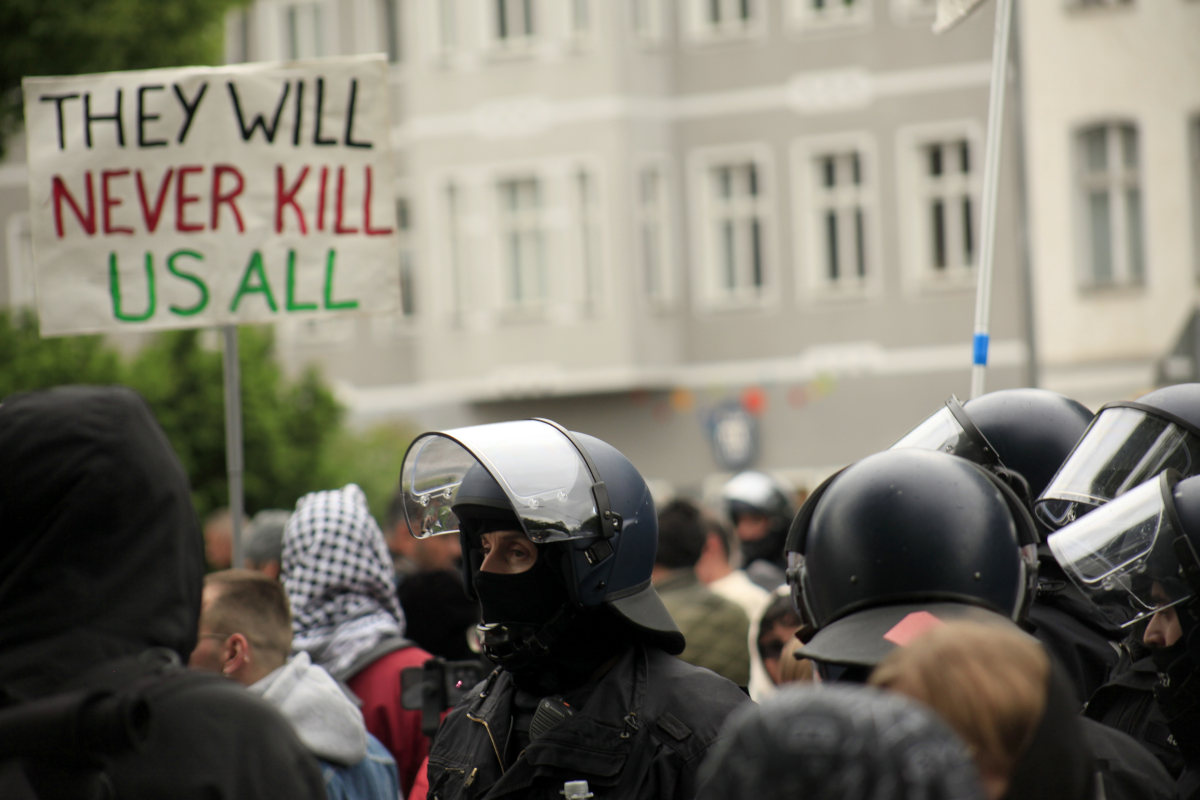
Following the 77th Nakba commemoration protests in Berlin, the media were doomed to repeat the testimony of one Berlin police officer who claimed he was “dragged into the crowd,” “deliberately attacked,” “knocked to the ground” and “repeatedly kicked” by protesters. Due to the large number of cameras present at the protest, it was possible to see that in fact he enters the crowd voluntarily and repeatedly punches protesters in the head before pinning another protester to the ground.
Groups such as Counter Investigations and Forensis / Forensic Architecture have pulled together multiple sources within the demonstration to prove the crimes of this police officer, supporting the European Legal Support Centre (ELSC) with filing a criminal complaint on the basis of police violence and false testimony. The damage was done, however, as five people found their apartments searched following the Nakba protests in May. None of those involved were alleged to have assaulted the officer.
Forensic Architecture has also been involved in a trial of six Syrian youth asylum seekers who were accused of setting fire to the Moria refugee camp in Greece. Due to their vulnerabilities with age, asylum status, legal support, and language, it seemed to be an easy case for the Greek State to bring against these six youths. Through videos captured on the night of the fire, researchers were able to piece together the movement and scale of the fire, heavily contradicting the one witness statement that had led to their arrest.
And yet! This little computer in my pocket is a Judas for any two-bit law enforcement outfit or teenage hacker who wants to intercept my personal data. The technological advantages of being able to film the police on the fly comes with the added problems of having a device that can be used to manipulate video, audio, communications and location for the purposes of political repression.
The European Council is debating the expansion of protocols that would lead to service providers of encrypted end-to-end messaging like Signal and Telegram scanning all text, photos and videos for ‘abusive material’ through what is known as client-side scanning. Known as “chat control”, the protocol functions primarily by having access to all material through the indiscriminate monitoring of communications.
This widespread surveillance network has only one exception. In a letter to the law enforcement working group, the European Council has made it clear that “detection does not apply to accounts used by the State for national security purposes, maintaining law and order or military,” according to Article 7 of the document. Yet such widespread surveillance through scanning has its ultimate cost: the error rate of a ‘false positive’ is 50-75%.
The UK government is also attempting to break meaningful end-to-end encryption through the Technical Capability Notice (TCN) of the Investigatory Powers Act, which demands that Apple, in this case, create a backdoor to its encrypted backup services. This comes with further surveillance proposed by the Labour government to create a digital ID card scheme under the guise of preventing what they call ‘illegal migration’, that has been noted to contribute to coercive behavior, domestic violence and the marginalisation of elderly, disabled or vulnerable people.
Why does this matter? Once I have filmed police racial harassment or brutality – for everyone’s safety – communication with lawyers, journalists and activists must be protected and private.
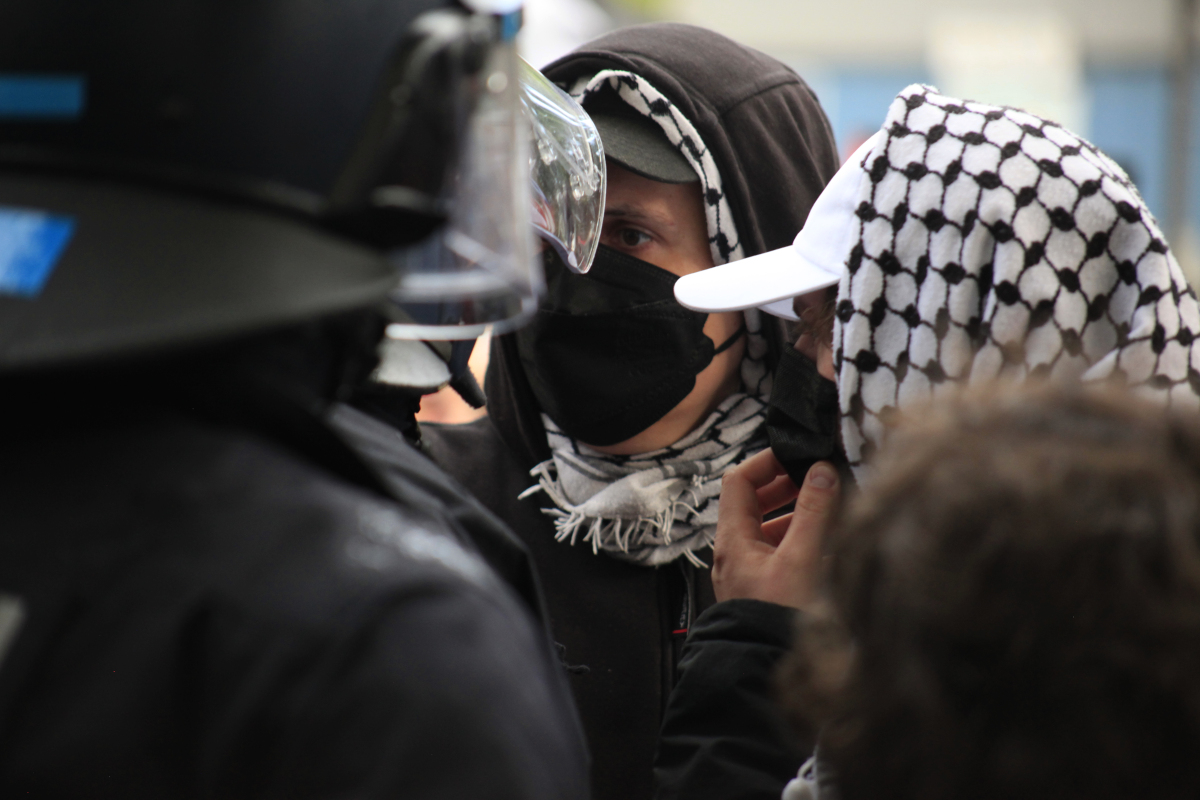
In Germany, there is a law that protects police officers from accountability while being filmed. It is called Verletzung der vertraulichtkeit des wortes, or “privately spoken words” and can be extended to filming an interaction between police officers. The law does not concern filming, rather the publication of conversations between the police. The only exception to this is whether the footage is in the public interest.
Of course, you never know if unaccountable police violence in the pursuit of political repression and racial harassment would be in the public interest. This is largely due to an atmosphere of fear within German society and the media over the acknowledgment of Germany’s active role in Israel’s genocide of the Palestinian people. Reading the news, you would be mistaken for believing that the most violent aspect of German society is the Palestinian people themselves, and by extension any migrant group.
German police have a proven track record of systemic racial harassment, obscene levels of brutality and a long record of deaths in custody, with 287 documented deaths in police custody of racially oppressed individuals since 1990. Recently, hundreds of police officers raided squatted social centre Rigear94 in preparation for an upcoming court case. Officers violently attacked residents and destroyed their homes for their stated purpose of identifying those living within the housing project.
It is with open eyes that we confront the State and those within our own communities who have chosen to represent its repressive structures against their own neighbours. So, against all advice to make it easy on myself, I published an account of my interaction with the police as the violence predictably turned against me. I was detained as a witness, my health was used against me as an act of torture and my seizures were triggered as punishment for not handing over my phone.
Unpublished is a project that helps to ‘fill the void’ of a silence left by the mainstream media on police violence and Palestine solidarity. The project also exposed the police assault on Kitty, an Irish activist who was demanding an end to the targeted killing of Palestinian journalists in Gaza. The Berlin police punched her three times in the face and broke her wrist.
Through the work of committed activists and journalists, we are able to expose the systematic violence and protect those in our own communities from this abuse of power.
“You don’t fucking scare us!” Kitty screamed back at police.
ZNetwork is funded solely through the generosity of its readers.
Donate