
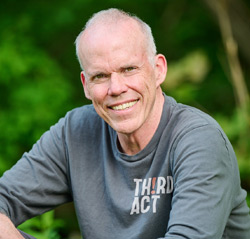
As Democracy Now! heads to the U.N. Climate Change Conference in Bonn, Germany, we speak with 350.org’s Bill McKibben. Several U.S. delegations are scheduled to attend despite the fact that President Donald Trump says he is pulling the U.S. out of the landmark 2015 Paris climate accord. The Trump administration is sending officials to push coal, gas and nuclear power during a presentation at the U.N. climate summit. Meanwhile, a coalition of U.S. cities, companies, universities and faith groups have opened a 2,500-square-meter pavilion outside the U.N. climate conference called “We are Still In”—an effort to persuade other countries that wide swaths of the United States are still committed to the landmark 2015 Paris climate accord. McKibben also discusses his newly published first novel, “Radio Free Vermont: A Fable of Resistance.”
AMY GOODMAN: This is Democracy Now! I’m Amy Goodman. We end today’s show by looking at the U.N. climate summit in Bonn, Germany. Democracy Now! is headed to the summit today. We’ll be broadcasting all next week from Bonn. There will be a number of U.S. delegations, despite the fact President Trump says that he is pulling the U.S. out of the landmark 2015 Paris climate accord. The Trump administration is sending officials to push coal, gas and nuclear power during a presentation at the summit. The presentation Monday is entitled “The Role of Cleaner and More Efficient Fossil Fuels and Nuclear Power in Climate Mitigation.” It will feature speakers from coal company Peabody Energy, nuclear engineering firm NuScale Power and a liquefied natural gas exporter.
Meanwhile, a coalition of U.S. cities, companies, universities and faith groups have open a 2,500-square-meter pavilion outside the U.N. climate summit called We are Still In, an effort to persuade other countries that wide swaths of the United States are still committed to the landmark 2015 Paris climate accord.
This comes as Syria’s government said Tuesday it will sign on to the Paris Agreement on climate change. This means that if the U.S. pulls out of the Paris deal as Trump has vowed, the U.S. will be the only country on Earth that’s not a part of the landmark 2015 agreement.
For more, we’re joined by Bill McKibben, co-founder of 350.org. In 2014, Bill won the Right Livelihood prize, sometimes called the Alternative Nobel, for his work in environmental activism, author of a number of books about the climate. But he has a most recent book, why he’s in New York right now. I saw him at Strand Bookstore, the legendary independent bookstore, last night, reading from his book, his first novel, and it’s called Radio Free Vermont: A Fable of Resistance.
Bill, we’re going to get to that. But first, let’s talk about these latest developments. Syria followed Nicaragua. Nicaragua had said they weren’t going to sign because it wasn’t effective enough. But now Syria and Nicaragua joining the Paris climate accord leaves the U.S. alone in the world?
BILL McKIBBEN: Which is, if you think about it, particularly remarkable, because what country has poured more carbon into the atmosphere than any other in the long history of burning coal, gas, oil? Our almost unbelievable decision to back away, even from this quite modest Paris accord, is probably the most dramatic act of American diplomacy almost ever. I mean, we’re literally saying, “We know more than everybody else in the world about the biggest problem the planet’s ever faced.”
AMY GOODMAN: So talk about what is going to happen at this U.N. climate summit. It is the first one—I mean, last year, when we were in Marrakech, President Trump had just been elected. I mean, the place was just buzzing with the fact that a climate—proud climate denier was now going to be the president of the United States. But now he’s pulling the U.S. out. What does it mean? And talk about the different formations that will be there.
BILL McKIBBEN: So, the U.S. is still sending a delegation. We want it both ways, where, having rejected the Paris accord, we now want to screw up any efforts to keep it going forward by other countries. You know, it’s like—I don’t know what it’s like. It’s like breaking off your engagement but saying here’s what you want the children named, you know, 10 years in the future. So, we’ll be there, officially, saying, “Burn more coal.” That’s our message that we’re sending over a panel of coal executives to say.
There’s a group of mayors and governors and things, who are saying, “For our states and cities, we’re still in. We’re going to try to keep the Paris accords.” And then, probably most importantly, there’s the kind of movement-based group, this U.S. People’s Delegation, that’s emerging—many people that you’ve had on over the years—Dallas Goldtooth from the Indigenous Environmental Network, Varshini Prakash, others—who are reminding us that even if we had carried out every promise that everybody made in the Paris climate accords, the planet would still warm more quickly than we can possibly deal with. They’re the ones saying the whole world needs to be moving toward 100 percent renewable energy quickly, and it needs to be keeping fossil fuel in the ground. So—
AMY GOODMAN: And that formation is called?
BILL McKIBBEN: The People’s Delegation. And my guess is, they’ll have the most in common with people around the world, other delegations trying hard to move this process forward. The way to just imagine official American position is, we’re not the caboose on the train; we’re tossing an anchor off the caboose, trying to bring the whole show to a halt.
AMY GOODMAN: So, a lot has been made, in this first year since Donald Trump was elected, that he has not passed any significant legislation. But doesn’t this obscure the fact, especially in the area of the environment, they are moving full speed ahead?
BILL McKIBBEN: Absolutely. The environment is the place where, arguably, he’s done the most damage. And in a sense, it’s not really Trump in this case. This would have happened with almost any Republican, because this is the Koch brothers’ agenda. This is what they’ve wanted forever. Scott Pruitt is their man. And they’re dismantling—
AMY GOODMAN: The head of the EPA.
BILL McKIBBEN: Yeah. They’re dismantling 30 years’ worth of environmental regulation in the course of a few months. It’s a slaughter on the environment. And, of course, the reason that that’s so dangerous is, with climate change, in particular, this is the one time-limited problem the world has ever faced. We’re not going to have a chance to repair the damage, because by the time the Trump administration is over, we’re going to be further—much further along in the process of melting ice caps, acidifying oceans, breeding storms. That’s what’s happening now. We’re losing, above all, time, desperately needed time.
AMY GOODMAN: Talk about what happened in India, in New Delhi, this week.
BILL McKIBBEN: New Delhi closed 4,000 schools, because the air is so bad. Our machines, our instruments that measure small particulates in the atmosphere, go up to 999 parts per million. The machines stopped working a few days ago because the levels were way above that. Nine hundred and ninety-nine parts per million is 30 times the safe level. We’re someplace—they say that the equivalent of just breathing the air in Delhi at the moment is smoking 50 cigarettes a day. I’ve been there in the last couple of years, and it wasn’t as bad as it is today, but it was so bad that you did not want to be outdoors at all.
AMY GOODMAN: And we just reported on Puerto Rico, once again. We just came back from Puerto Rico, hit by Hurricane Maria. Now, I mean, I think something in the range of 80-something percent of the people do not have electricity once again. It’s going backwards?
BILL McKIBBEN: Amy, I wrote the first book on climate change 30 years ago. Back then, it was abstract. We knew what was coming, but we didn’t know exactly what it was going to look like. By this point, every single issue of your broadcast is a kind of gazetteer of the destruction wrought by what we’ve done to the environment.
AMY GOODMAN: The fires of Marin, where we were just—I mean, in Napa and Santa Rosa—
BILL McKIBBEN: Sonoma, mm-hmm.
AMY GOODMAN: —absolutely horrifying, the devastation we saw there. The flooding of Houston, the heart of the petrochemical industry, and of Florida?
BILL McKIBBEN: The U.S.—the U.S. covers 2 percent of the world’s surface. So, in the last 60 days, on that 2 percent of the planet, we’ve seen the largest rainstorm in American history with Hurricane Harvey, the longest extreme wind storm in the planet’s history with Hurricane Irma. We saw Puerto Rico knocked back 30 years in its development. And then we saw those fires in Napa and Sonoma. If there’s any place in the world that kind of stands for the good life, there you are in beautiful California terrain surrounded by big vats of wine, you know? And yet there were people fleeing for their lives, and some people not able to flee fast enough.
AMY GOODMAN: Many people died, perished in the fires. We only have a minute, and then we’re going to do a post-show interview, a web exclusive. But, so are you calling for secession for your state?
BILL McKIBBEN: No, I don’t think Vermont is going to secede. But the point of Radio Free Vermont is to kind of try and write a love letter to this resistance. You know, I’ve spent the last 10 or 15 years trying to play my small part around the environment, and I’ve loved watching in the last year as this widespread resistance has sprung up to Donald Trump. This book, my first attempt at fiction, is an attempt to be a little humorous and a little loving, because that resistance needs to keep spreading, and it needs to be as creative as it possibly could. Bernie Sanders said, on the back, he said, “We don’t need to secede, but Vermont has a long tradition of standing up to power.” Boy, we need it now more than ever.
AMY GOODMAN: And in just a brief summary, tell us what Radio Free Vermont: A Fable of Resistance is about.
BILL McKIBBEN: Well, it’s about a small band of Vermonters, led by a septuagenarian radio host, who decide that the place that they love, this local, small, strange little state, is just being eroded by the forces of bigness and national consumer culture. And so they begin to take steps in defense of the place they love. They end up nonviolent fugitives from the law, and they have a series of adventures that conclude not only with what may be the only cross-country ski chase scene in American literature, but consuming an inordinate amount of Vermont’s great product, the micro-brewed beer, in which we lead the world in production.
AMY GOODMAN: Well, we’ll do a web exclusive—you can check it out at democracynow.org—about Radio Free Vermont: A Fable of Resistance. It’s the first novel of our guest, the founder of 350.org, Bill McKibben, a proud Vermonter himself.
ZNetwork is funded solely through the generosity of its readers.
Donate