
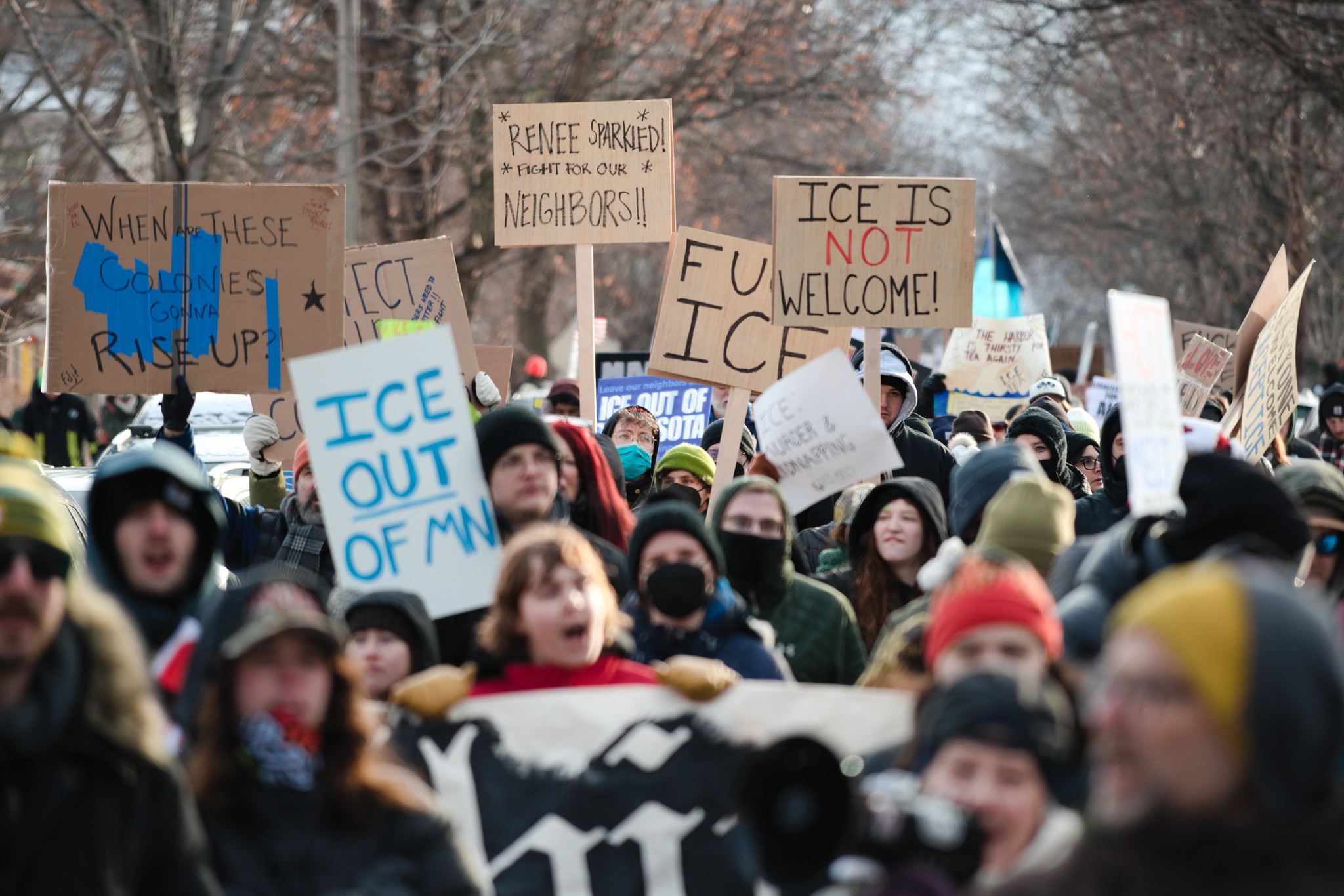
The killing this January of unarmed Minnesota woman Renee Nicole Good in her car by an ICE agent has sparked nationwide alarm and civil protest. It marks the latest escalation in the political violence risk environment in the United States, which in just the last year has seen high-profile political assassinations, a rise in death threats against elected officials and community leaders, an increase in federal overreach through domestic military deployments, and state abuses targeting broad communities such as immigrants and refugees. The day after ICE agents shot and killed Good in Minneapolis, federal agents from US Customs and Border Protection (CBP) shot and injured two people in a car in Portland, OR.
These trends pose a danger not just to individuals but also to organizations, movements, civil society, and the health of our democracy. In response, local communities have aligned with elected officials to call for independent, transparent investigations and peaceful mobilization. Across the country, communities are finding new ways to effectively de-escalate potential violence and keep their communities safe, energized, and resilient in the face of growing threats from both state and nonstate actors.
New participatory research from the Bridging Divides Initiative (BDI) at Princeton University finds that the ecosystem of community safety and de-escalation practitioners is evolving to meet what some have described as a steady 10-year increase in demand for training and support. Around the country, local leaders and everyday people are coming together in broad coalitions that aim to foster resilience and stand up to threats to their communities.
Drawing on BDI’s research as well as decades of on-the-ground organizing experience of Western States Center (WSC), it is possible to map the current risk environment for state violence and explore strategies for de-escalation, civil resistance, and community safety efforts in response.
In a recent article, Daniel Altschuler, managing director of the Freedom Together Foundation; and Javier Corrales, a political scientist at Amherst College, recapped the global authoritarian playbook and warned that “communities will need to be trained not just to organize, but also to engage in strategic nonviolence—maintaining the discipline not to be provoked into violence while bearing witness and taking action.”
Community Safety and De-escalation: Trends and Patterns
Political violence in the United States is not new. Back in 1968, in the aftermath of the assassination of Senator Robert F. Kennedy, historian Arthur M. Schlesinger asserted that “we can no longer regard hatred and violence as accidents, as nightmares, which will pass away when we awake. We must see them as organic in our national past.”
That assessment has been borne out in the decades since. But the level and nature of political violence in America are neither constant nor consistent. Over time and across contexts, communities have initiated and implemented diverse forms of response to adapt and keep themselves safe. As threats of violence emanate from both nonstate and state actors, spreading community knowledge of how to resist violent forces and de-escalate conflict is critical.
As local communities face growing risks of abuse by ICE agents, CBP units, and other federal authorities, responses centering community safety and de-escalation efforts are expanding rapidly in both quantity and quality. Analysis from BDI and WSC identifies some key trends:
- There is wide variety in levels of organization. Some activities are largely organic and spontaneous (such as people’s efforts to monitor ICE movements as they go about their day), and some are carefully planned by specialized groups and led by trained professionals.
- Some approaches are focused on triage and in-the-moment de-escalation strategies, including methodologies like CLARA (Calm, Listen, Affirm, Respond, Add), CALM (Communicate, Assess, Listen, Mediate), and The Four Ds (Distract, Delegate, Direct, Delay). Others focus on long-term community engagement, preparedness, resilience, and infrastructure building. The rise in the number and variety of entities engaged in de-escalation work—and increased demand facing long-standing organizations—reflects the fact that state violence (and other types of political violence) is now targeting entire communities and threatening to disrupt the normal functioning of education, healthcare, sports and recreation, industry, and elections.
- Community safety and de-escalation efforts can help build bridges across ideological lines by creating opportunities for civil dialogue and trust building. At the same time, practitioners and organizers must often develop approaches that can navigate these opportunities for outreach while advancing their core commitments to issues like antiracism, immigrant rights, and LGBTQ+ rights.
- Security and safety for the people carrying out community safety and de-escalation work is an increasing priority. Volunteers report feelings of fear and concern about hostility from both state and nonstate actors. While no strategy will completely eliminate the risk of government retaliation, for example, additional security, safety, and legal steps can be taken to prepare. Such measures include online vetting, confidential in-person meeting locations, explicit commitments to rest and stress relief, whistle alert systems, and other emergency protocols.
- Real-time monitoring, early warning, and rapid response protocols using encrypted messaging apps like Signal and WhatsApp or whistle protocols have improved efforts to track and respond to state violence.
- Local efforts have benefited from growing communication and relationship building among impacted communities across localities, as well as access to resources and information from media coverage, emerging communities of practice, and national organizers. In addition to BDI and WSC, other national and regional hubs include the National Association for Community Mediation, the Horizons Project, the TRUST Network, Vision Change Win, and others. Additional national and local groups can be found in BDI’s state-by-state directory.
Broad, pro-democracy coalitions [reject] the state’s legitimization of violence against any community.
Lessons Learned in 2025
In 2025, as federal agents and National Guard troops were deployed in places such as Portland, OR; Chicago, IL; Washington, DC; New Orleans, LA; and Los Angeles, CA, communities have learned in real time how to respond to the risk of state violence. Among these lessons are the following:
- Broad coalitions are essential. The logic of authoritarian violence is to initially victimize the most socially marginalized groups, expand to broader targets as resistance diminishes, and ultimately promote a zero-sum mindset across society. Broad, pro-democracy coalitions undercut this strategy by rejecting the state’s legitimization of violence against any community. Leaders in Oregon recognized that state violence in Portland was a threat to all Oregonians and created a statewide coalition to counter the administration’s military policing of communities. In Portland, Chicago, and Washington, DC, community representatives have partnered with business leaders to make the case that federal deployments threaten the entire population.
- Concerned communities will show up, but they need somewhere to go. The increasing intensity and visibility of state violence has spurred waves of concerned actors to ask, “What can I do?” As one organizer in Washington, DC, recommended: “Give clear instructions for involvement.” Create events and opportunities that are accessible to a diverse range of people who want to make their voices heard and stay engaged through training. For example, groups like Hands Off NYC are seeing huge demand for their trainings in nonviolent community protection, led by a diverse coalition of faith groups, unions, and others.
- Local officials and representatives have a powerful voice. Communities are outraged and fearful—and looking for leadership to represent them. What governors, mayors, city council members, sheriffs, and police chiefs do—and what they fail to do—sends a message. Leaders in Portland struggled to have an aligned response to bigoted and anti-democracy protests on the streets in the early years of President Donald Trump’s first administration, but by 2019 were proactively rejecting activity by hateful actors. Earlier this year, after Trump posted on social media that he would be sending troops to Portland, elected leaders across Oregon issued a letter within 24 hours rejecting the call for deployment.
- Anyone can be impacted. By mid-October, at least 170 US citizens had been detained by immigration authorities, many held for hours or days without being allowed to prove their citizenship or contact their family. The government has reversed longstanding policy on “sensitive places” and begun enforcement activities at sacred and protected spaces like churches and educational facilities. Over 75,000 people without a criminal record have been arrested by ICE. Checkpoints were installed on major thoroughfares across Washington, DC, to stop drivers who had phones in their hands, over-tinted windows, or broken headlights. Communities and institutions across sectors—from schools to cultural centers—need to engage in training and preparation.
- State violence risks elevating nonstate violence. Multiple concerning actors are activating in response to federal operations, contributing to the risk of violence. White nationalists have posted ICE Tip Line numbers in public, while pardoned January 6 defendant and Proud Boy Enrique Tarrio claimed to be developing an app to pay citizens in cryptocurrency to report immigrants. A cadre of influencers has traveled across the country following major deployments, streaming and filming federal law enforcement to create frequently misleading content for the administration to justify its activities. Reporting has revealed that landlords and other community members have leveraged state power to threaten immigrants, often driven by personal motives. Activists, residents, and local officials should be prepared for such bad-faith interactions and provocation.
- Resonant messages include shared values, joy, and even a bit of absurdist or political theater. Messaging should center impacted communities, drawing on shared values that speak directly to intended audiences. A man in Washington, DC, for example, walked behind National Guard members playing “The Imperial March” from Star Wars, calling attention to the absurdity of their deployment. Activists in Portland have effectively countered the administration’s narrative of their city as “war ravaged” by deploying silly costumes and clips of residents and elected officials facetiously pointing out the “threats” of their calm and peaceful city. Organizers in DC promptly condemned the fatal attacks on two National Guard members in their city, reaffirming shared values while still calling for an end to an unnecessary deployment.
Recommendations
Community safety and de-escalation practitioners on the ground right now, working to keep pace with expanding political and state violence, say they need the following three things:
While [political] violence has a long history in this country, so too does nonviolent organizing for dignity and justice.
now, working to keep pace with expanding political and state violence, say they need the following three things:
- Increasingly broad coalitions: Leading trainers and organizations tell BDI that a multisector consortium of practitioners could expand the collective infrastructure necessary for sharing information and best practices to socialize the core principles and practices of community safety and de-escalation. For example, WSC has long brought together faith, business, and other community leaders who can speak to a wide range of audiences. While many other coalitions are already emergent, the broader the engagement and the greater the support, the more effective the effort.
- Effective and specific public communication from and around law enforcement: Residents need regular updates from public officials as to the status and role of different law enforcement and federal agencies active in their communities. Members of the National Guard, ICE, CBP, Homeland Security, the FBI, local police, and even the Marines have been active in different combinations. Residents need to know who is in their communities and what their rights are.
- Funding: Practitioners describe an urgent need for program funding to keep up with growing violence risks and a very real threat of burnout. Funders should invest in smaller, frontline organizations led by Black residents, residents of color, and other targeted communities. Funders will also need to educate themselves and trust organizing practitioners. An affinity group of community safety and de-escalation funders would facilitate this process, help recruit new funders, and contribute to field building.
Political violence, and increasing state violence in particular, is a serious threat to US civil society and democratic practice. While that violence has a long history in this country, so too does nonviolent organizing for dignity and justice—the roots of modern community safety and de-escalation work.
Most people in the United States reject political violence and want to live in a country that’s safe for themselves and their families. As knowledge of de-escalation and prevention strategies expands, and regular people come together to protect their communities, there is reason to be hopeful for a brighter future that moves beyond the echoes of our darkest past. We need to learn these lessons and help build the foundation for that future today.
ZNetwork is funded solely through the generosity of its readers.
Donate