
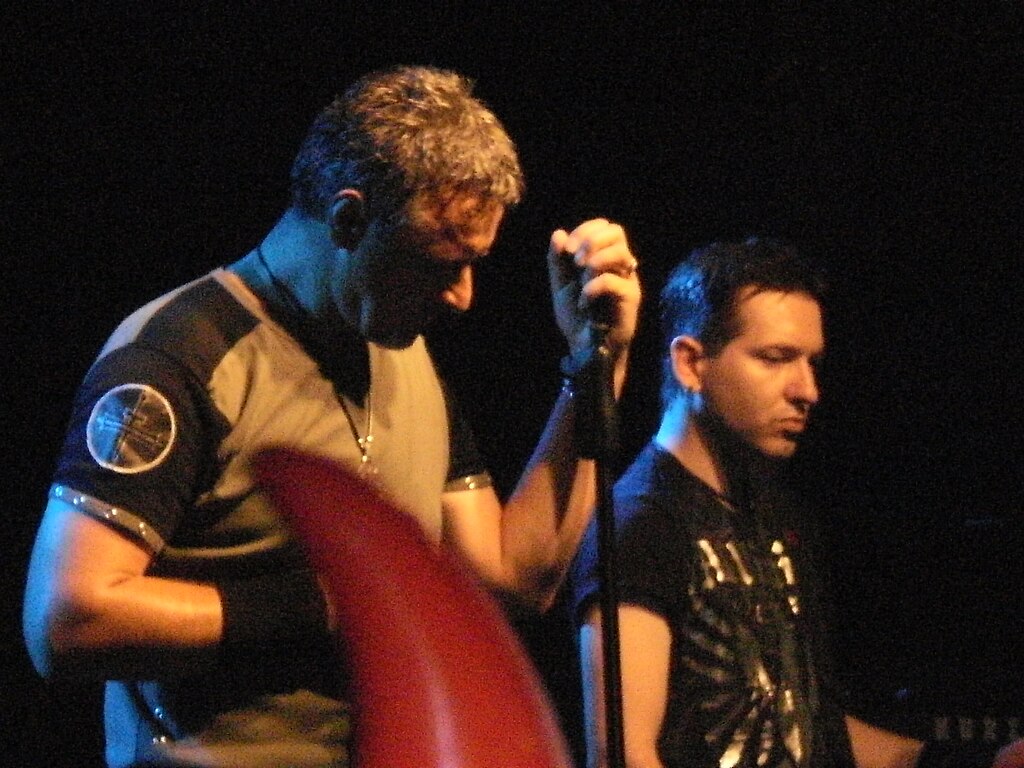
The concert held by Croatian far-right pop singer Marko Perković – Thompson on July 5 at the Zagreb Hippodrome, which gathered approximately half a million people who, at the singer’s urging, chanted the Croatian fascist salute “Za dom spremni” (“Ready for the Homeland”), came as no surprise to researchers tracking the trends not only within Croatian far-right circles, but also within the Croatian episcopate. This pattern traces back not only to the infamous Nazi puppet state, the Independent State of Croatia (NDH), but also through the era of socialist Yugoslavia.
The term “Croatian Silence” was coined by far-right Croatian intellectuals to describe the period between the suppression of the Croatian Spring in 1971—when Josip Broz Tito politically dismantled the leadership of Savka Dabčević-Kučar, Miko Tripalo, and the rest of the Croatian communist leadership who had flirted almost openly with radical nationalists, separatists, and even elements of the croatian nazi Ustaša émigré community—and the founding of the right wing Croatian Democratic Union in 1989.
This was preceded by a campaign led by the so-called heirs of the Croatian nationally conscious Marxist tradition and intellectuals from Matica hrvatska, built not on concrete evidence, but on speculative claims that the concept of a strong Yugoslav federation masked a hidden agenda of Greater Serbian ideology.
Although the key figures of the mass movement claimed they sought only reforms aimed at improving the federation and strengthening the brotherhood and unity of the peoples and nationalities of Croatia and Yugoslavia, Savka Dabčević-Kučar would later, at the launch of her book in 1998, proudly declare that the Spring activists had proven—twenty years before the fall of the Berlin Wall and the breakup of Yugoslavia—that Yugoslavia was an impossible construct and that, at least as far as Croatia was concerned, it was already over. Not to mention her admission that the Croatian leadership had been speaking in “Aesopian language”, and that their criticisms of “Croatian chauvinism” and their glorification of “brotherhood and unity” were nothing more than politically necessary phrases in the context of attacking “Belgrade unitarism.”
There is much about the Croatian Spring that warrants a dedicated study, but let us highlight just two key points:
a) How Marshal Josip Broz Tito slipped on his own doctrine of self-management and the “withering away of the state” — choosing, over the integrally Yugoslav Miloš Žanko, the covert secessionists Savka Dabčević and Miko Tripalo, only to then “cut off their heads,” branding them Ustašas while continuing to advocate for reforms that would lead to the adoption of the 1974 Yugoslav Constitution — a confederal charter. This led Croatia’s most prominent leftist intellectual and writer, Miroslav Krleža, to mock Tito in the backrooms, saying: “The old gentleman has tailored himself a tight suit.”
b) Why Miroslav Krleža supported the 1967 Declaration on the Name and Status of the Croatian Literary Language, which openly rejected the concept of a shared Croatian-Serbian language and is widely regarded as the ideological prelude to the Croatian Spring. And why he meticulously worked on reviving the figure and legacy of Ante Starčević, the 19th-century Croatian “Father of the Homeland,” notorious for his rigidly racist worldview — not only toward Serbs but also toward Yugoslav-oriented Croats. Historian Stanko Lasić insightfully observed that Starčević’s tendency to accumulate derogatory and caustic expressions, particularly the term “Slavoserbism”, laid bare a worldview fundamentally divided between two extremes — between which there could be neither transition nor reconciliation. It goes without saying that Starčević was the most revered ideologue of the Nazi-aligned Ustaša regime.
Regarding Krleža, a prominent leftist and anti-fascist, his affirmative stance toward Ante Starčević also raised concern in the diary of Rodoljub Čolaković, a veteran partisan fighter and steadfast advocate of brotherhood and unity among the peoples of the Socialist Republic of Bosnia and Herzegovina:
„I just remembered something related to yesterday’s discussion — what Marko Ristić (artist, chief ideologue of Serbian surrealism) told me in 1961 on Brioni about Krleža:
- March 27 was pure adventurism (coup by Yugoslav officers against the government that had signed the pact with Nazi Germany editor’s note). Had we stayed in the pact, there would have been neither Ustašas nor Chetniks;
- The Home Guard (domobrani – the official army of the Nazi-aligned Independent State of Croatia) were a reserve force of the revolution — it was from them that the Partisans got their weapons;
- It would be better for Hitler to win than Stalin — because Hitler is Europe, and will eventually have to liberalize, whereas Stalin is Asia, darkness, tyranny.
I could hardly believe my ears, but Marko gave me his word of honor that what he recounted was true. Later, in another conversation, I said to Marko Ristić: “I can’t understand how Krleža drifted into nationalist waters.” To which Marko replied: “But he was always a Croatian nationalist.”
But let us return to the main subject. When the political project of Croatian independence collapsed in 1971, a period known as the “Croatian Silence” ensued. Yet, in truth, there was no silence at all — rather, the “Aesopian language” began to be used in new ways and by a slightly different set of actors. One of the clearest descriptions of these developments was offered by the current Archbishop of Zadar, Monsignor Želimir Puljić:
“When, after the suppression of the ‘Croatian Spring’ (1971), every free word fell silent, the Church gathered itself and began to speak in its own time-tested way — to awaken the people spiritually, help them rediscover their history, and recognize the faith-based roots of their identity. By divine providence, at that time the Croatian episcopate was led by the Servant of God, Cardinal Franjo Kuharić, a great admirer and successor of the Blessed Alojzije Stepinac (formerly the vicar of the Nazi military of the Independent State of Croatia, whose correspondence with Pope Pius XII revealed his delight at the prospect that soon there would be no more schismatics — that is, Serbs — left in Croatia, editor’s note). Cardinal Stepinac had planned to commemorate in 1941 the 1300th anniversary of the first ties between the Croats and the Holy See (641–1941). Though his plan was halted by war, it was never truly abandoned. His successor, Cardinal Kuharić, some thirty years later — within the highly unfriendly socio-political structure of a communist and atheist state — quietly and wisely prepared both the people and the Church in Croatia for major religious gatherings. These events would play a crucial role in reviving awareness of the nation’s religious and historical heritage and help Croats recognize the roots of both their faith and national identity. After decades of “erasure of the Catholic and Croatian name” during the communist era, it became imperative to help the people reconnect with their Christian heritage and the trunk of their national identity. Thus began a series of mass gatherings: starting in Solin (1976), where pilgrims reflected on the gift of baptism by the river Jadro at Our Lady of the Island; then to Biskupija near Knin (1978); and finally to Nin (1979), where participants recalled the ties between Croatian rulers and the Holy See — particularly Pope John VIII, who on Ascension Day in the year 879 raised his hands to heaven and blessed Duke Branimir, the Croatian people, and all his lands. The culmination of this nine-year spiritual revival came at the Eucharistic Congress in Marija Bistrica in 1984, where more than half a million people gathered. It was a peaceful national awakening — a people not calling for arms, but instead praying and fingering the beads of the rosary.
The Archbishop also frequently emphasizes that it was precisely these gatherings that laid the foundation for the movement toward an independent Republic of Croatia — namely, its secession from the Socialist Federal Republic of Yugoslavia in 1991. The trajectory is, therefore, quite clear: where Croatian nationalists — disguised as communists and internationalists — left off, the Roman Catholic nationalist episcopate continued, under the guise of a years-long celebration of Christian jubilees: 1300 years of Christianity among the Croats, an initiative originally conceived by Alojzije Stepinac.
This was not merely a demonstration of the Church’s influence among Croats on the eve of the global collapse of communism, but also a strategic step toward the rehabilitation of the Archbishop of Zagreb, who had served as vicar to the armed forces of the Nazi-aligned Independent State of Croatia (NDH). That effort also entailed the beginning of an erasure of the cultural memory surrounding the criminal nature of the NDH, a process that would enable Franjo Tuđman (former general of the Yugoslav People’s Army, historian and leftist who transformed into a nationalist, a close friend of Miroslav Krleža), as the political heir of the Spring movement, to tap into the resources of the Croatian émigré community at precisely the right moment.
All in all, the so-called “Croatian Silence” was, in reality, a period of preparation — paving the way for the founding of the Croatian Democratic Union (HDZ) and for the Croatian nationalist renaissance of the 1990s, which would culminate not only in its desired outcome: the reduction of Serbs from a constituent people in the Socialist Republic of Croatia to a national minority in the Republic of Croatia, along with ethnic cleansing during the 1991–1995 war, effectively concluded by Operation Storm — but also in the enshrinement of Stepinac as a spiritual pillar of post-socialist Croatian national identity.
His second, secular pillar would undoubtedly become Franjo Tuđman after his death in 1999 — but not without complications. The early 2000s marked a resurgence of the Croatian left, which viewed with deep unease the gradual rehabilitation of the Ustaša regime and the historical revisionism targeting the antifascist struggle of a significant portion of the Croatian people during World War II. In this context, the left coined the now-famous term “de-Tuđmanization.”
While many across the region welcomed this shift — particularly the anti-fascist and anti-Tuđman rhetoric of the new Croatian president and former Tuđman loyalist, Stjepan Mesić — it was evident to the discerning eye that this marked the beginning of what could now be called a second era of “Croatian Silence.” A silence behind which, once again, the Catholic Church in Croatia emerged as a key actor — not in silence per se, but in advancing radical right-wing revisionism.
A group of obscure revisionists, whose “methodology” closely resembles that of neo-Nazi Holocaust deniers, began gaining traction. Figures such as:
- Vladimir Horvat and Vladimir Mrkoci, The Naked Lie of the Jasenovac Camp
- Josip Jurčević, The Birth of the Jasenovac Myth
- Mladen Ivezić, Jasenovac: The Numbers and Tito’s Jasenovac
- Tomislav Vuković, A Different History
- Josip Pečarić, The Serbian Myth of Jasenovac
- Igor Vukić, The Jasenovac Labor Camp and Jasenovac Day by Day
These authors found platforms in Catholic publications, including Glas Koncila, the official bulletin of the Archdiocese of Zagreb. Furthermore, Catholic parish halls across Croatia became venues for conferences organized by the Society for Research of the Triple Jasenovac Camp — a hub of revisionist activity seeking to rewrite the legacy of one of the darkest chapters in Croatian and Yugoslav history.
In this sense, the mega-spectacular concert of Marko Perković Thompson at the Zagreb Hippodrome — opened with a bishop’s prayer, drenched in dominant Roman Catholic iconography, and accompanied by masses in churches across Croatia to commemorate the alleged coronation of King Tomislav in 925 — was nothing less than a reprise of the National Eucharistic Congress in Marija Bistrica in 1984.
Just like back then, a mass show of force — nearly half a million people gathered — was carefully timed for maximum impact. In 1984, the chosen moment was the anticipated collapse of the USSR and the Warsaw Pact. Today, it’s America and Europe, increasingly dominated — or soon to be — by so-called “Christian nationalists” or outright neo-Nazis, as seen in Ukraine.
Back in 1984, the entire spectacle was still shrouded in the rhetoric of feigned Christian mercy and forgiveness, aimed at the harshness of rigid communism. But today, it takes the form of open chanting of the Ustaša salute “Za dom spremni” (“For the Homeland — Ready”) in front of a crowd of half a million.
This is not merely a terrifying signal to the remaining Serbs in Croatia, but above all a warning to anyone within Croatia who dares to think or speak differently — and such people, despite everything, still exist in significant numbers.
After Franjo Tuđman was firmly established as the second foundational pillar of Croatian post-Yugoslav identity, the terminal phase of the Croatian Spring affirmed a third — Marko Perković Thompson, along with everything he represents.
At the concert in Zagreb — which must be described without any euphemism as a rally bearing the hallmarks of a Ustaša gathering — the audience enthusiastically embraced the performance of the song “Geni kameni”, in which Thompson mourns the fall of the Independent State of Croatia (NDH). One of the verses proclaims: “’45 was a bad year — it scattered us across the world…”.
In the composition Blajburške slike (Images of Bleiburg), the author equates Ustaša fighters with the Croatian army. The song Moj Ivane (My Ivan) is dedicated to Ustaša units that fought against the yugoslav communist partisans in the 1942 Battle of Kupres. In Reci mi, brate (Tell Me, Brother), Thompson openly glorifies Ante Pavelić, the leader of the NDH, evoking 1941 and the horrors of the Ustaša genocidal regime:
“But God forbid they need us again,
The thick fog will once more descend.”
In this sense, within the symbolic architecture of Croatia’s post-Yugoslav identity — as shaped by the Catholic Church in Croatia and its allied far-right political parties — the three pillars of Stepinac, Tuđman, and Thompson represent not only figures of historical continuity in the dismantling of Yugoslavia and the spearhead of re-colonization of the South Slavic states. They also mark stages of deep historical revisionism, a radical ideological re-sacralization, and institutional legitimization of nationalist extremism, all cloaked in the language of culture, Christian spirituality, and music.
From the whispered Aesopian rhetoric of the early 1970s to the thunderous chanting of “Za dom spremni” (“For the Homeland – Ready”) before crowds of half a million; from solemn Eucharistic congresses to concert-rallies, Croatia has followed a long and dangerously systematized path — from so-called political silence to a symphony of revisionism, now being officially promoted as the only acceptable tune for Croatian ears.
That symphony, however, has not yet reached its final crescendo. And thus, this is a clarion call to all who believe that truth, justice, and memory are not relative categories, subject to the open neo-Nazi instrumentalization of daily politics.
The newly established third pillar of Croatian identity does not merely carry the musical notes of an ideology — it is, in fact, exactly what it proclaims to be in its own toxic, cheap lyrics: a dense fog. A fog not only of Ustaša-era fascism, but of its ideological predecessor — Starčevićism. From the monstrous 19th-century tirades about “impure blood,” “enslaved breeds,” “trash among nations,” “domestic traitors,” and calls for the eradication of all deemed unworthy for the purity of the Croatian national body, there has yet to emerge any widespread or meaningful repudiation.Apart from the so-called “Aesopian language,” which has long served as a smokescreen, after a crowd of half a million in Zagreb chanting openly, no one should be naïve enough to continue taking any of it at face value.
ZNetwork is funded solely through the generosity of its readers.
Donate
1 Comment
Autoru ovog teksta mogu samo reći da je obično lažljivo govno koje namjerno izvrće povijest i širi mržnju. Njegova manipulacija činjenicama i histerična demonizacija hrvatskih nacionalnih simbola, uključujući Thompsonove koncerte i masovna okupljanja Hrvata, samo pokazuje duboku antihrvatsku agendu.
Umjesto da objektivno analizira povijesne procese, on revizionistički preinačuje događaje, izjednačujući hrvatski patriotski pokret s ustaškim zločinima, što je ne samo neistinito već i zlonamjerno. Hrvatska borba za neovisnost i suverenitet nije bila “nacionalistički ekstremizam”, nego opravdana težnja naroda koji je želio slobodu od jugokomunističkog terora.
Ako netko ovdje promiče neonacističku ideologiju, onda su to upravo takvi autori koji relativiziraju jugoslavenske zločine i pokušavaju rehabilitirati unitarističku represiju. “Za dom spremni” nije ustaški pozdrav, nego izraz hrvatske borbenosti kroz stoljeća – od antiosmanske do antikomunističke borbe.
Dakle, autoru ovog teksta poručujem: Nosite se svojim lažima i mržnjom negdje drugdje. Hrvatska neće biti obezvređivana od strane jugonostalgičara i zlobnih manipulatora.