

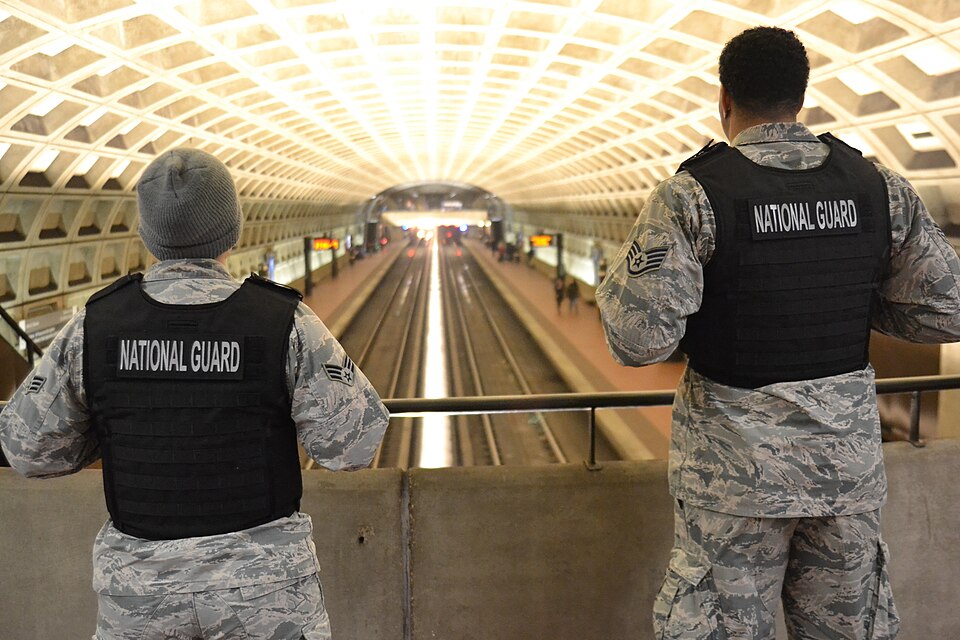
On August 11, 2025, Donald Trump ordered the secretary of defense to mobilize the D.C. National Guard to combat what he claimed was “an epidemic of crime in our Nation’s capital,” even though earlier that year, the D.C. United States Attorney’s office had announced that crime there was at a 30-year low.
According to the Metropolitan Police Department, violent crime in the city had declined by 26% during the previous year. Although the Supreme Court upheld a lower court decision holding that the President lacked the authority to deploy National Guard troops in Chicago over the objections of the state’s governor, D.C. is different because, unlike states, it does not have a governor in charge of the state’s National Guard. Instead, the President has control.
The basic rule in the United States is that unlike the leaders of countries that employ the military as an instrument of domestic control, the President cannot use it as a police force. According to the Supreme Court in Laird v. Tatum (1972), there is “a traditional and strong resistance of Americans to any military intrusion into civilian affairs” that has “deep roots in our history.”
Passed in 1878, the Posse Comitatus Act forbids the military from enforcing laws within the United States without express congressional or constitutional authority. However, because Donald Trump is essentially the governor of Washington DC, unlike the rest of the country, it is exempt from the Act.
The unique status of DC means that Congress has the final say over its governance. Until the 1973 Home Rule Act, federally appointed commissioners and Congress, none of whom were elected by the city’s residents, controlled the laws and budget. That law, while not giving local citizens the opportunity to elect members of Congress, did allow them to elect a government to run the district’s day-to-day affairs although Congress retained the power to overrule that government’s decisions.
Because soldiers are not trained in law enforcement, the duties of the National Guard troops in DC, according to the Defense department, are “administrative and logistical support,” as well as “providing a physical presence in support of law enforcement.” They cannot make arrests, carry out searches, or investigate crimes–but they have been used to visibly patrol the streets and even temporarily detain people until the police arrive. This sounds to many like intimidation, especially of protesters and the most vulnerable. If it leads to violence, that could provide an excuse for a crackdown.
In essence, the National Guard troops have roamed the streets like an occupying army for nearly a year despite the fact that the original declaration of a “crime emergency” only lasted for a month. The members of the Guard have been deputized as specialized police by the U.S. Marshal’s Service and issued firearms. A “summer surge” has increased the number of troops to nearly five thousand.
The administration has now extended the deployment through the end of Trump’s term in January 2029 even though the President’s (false) statement that the city “has almost no crime anymore” would seem to undermine the justification of a “crime emergency.” The nonpartisan watchdog group, Project on Government Oversight, estimates that the deployment will eventually cost more than two and a half billion dollars.
As Ankit Jain, one of the district’s two nonvoting U.S. Senators told NPR, sending troops to a city without even notifying its elected representatives, “you would never see that happen in any other place in the United States of America.”
It is long past time to end the military occupation of the capital city of the United States, yet it is hardly likely that Congress will vote to send the troops home. The national media is giving this issue almost no attention and the lack of congressional representation for the residents of Washington D.C. deprives them of the voice that 50 states have.
The real solution may be to admit Washington as the 51st state. That is something they, unlike Canadians, actually want.
This article is syndicated by PeaceVoice.
ZNetwork is funded solely through the generosity of its readers.
Donate




