

There is ample talk, particularly of late, about the threats posed by social media to democracy and political discourse. Yet one of the primary ways that democracy is degraded by platforms such as Facebook and Twitter is, for obvious reasons, typically ignored in such discussions: the way they are used by American journalists to endorse factually false claims that quickly spread and become viral, entrenched into narratives, and thus, can never be adequately corrected.
The design of Twitter, where many political journalists spend their time, is in large part responsible for this damage. Its space constraints mean that tweeted headlines or tiny summaries of reporting are often assumed to be true with no critical analysis of their accuracy and are easily spread. Claims from journalists that people want to believe are shared like wildfire, while less popular subsequent corrections or nuanced debunking are easily ignored. Whatever one’s views are on the actual impact of Twitter Russian bots, surely the propensity of journalistic falsehoods to spread far and wide is at least as significant.
Just in the last week alone, there have been four major factually false claims that have gone viral because journalists on Twitter endorsed and spread them: three about the controversy involving Donna Brazile and the Democratic National Committee, and one about documents and emails published by WikiLeaks during the 2016 campaign. It’s well worth examining them, both to document what the actual truth is, as well as to understand how often and easily this online journalistic misleading occurs.
Viral Falsehood #1
The Clinton/DNC agreement cited by Brazile only applied to the general election, not the primary.
On Wednesday, Politico published a blockbuster accusation from Brazile’s new book: that the DNC had “rigged” the 2016 primary election for Hillary Clinton through an agreement that gave Clinton control over key aspects of the DNC, a claim that Sen. Elizabeth Warren, D-Mass., endorsed on CNN. The Clinton camp refused to comment publicly but instead contacted their favorite reporters to publish their response as news.
The following day, NBC published an article by Alex Seitz-Wald that recited and endorsed the Clinton camp’s primary defense: Brazile was wrong because the agreement in question (a copy of which they provided to Seitz-Wald) applied “only to preparations for the general election” and had nothing to do with the primary season. That defense, if true, would be fatal to Brazile’s claims, and so DNC-loyal journalists all over Twitter instantly declared it to be true, thus pronouncing Brazile’s accusation to have been fully debunked. This post documents how quickly this claim was endorsed on Twitter by journalists and Democratic operatives, and how far and wide it therefore spread.
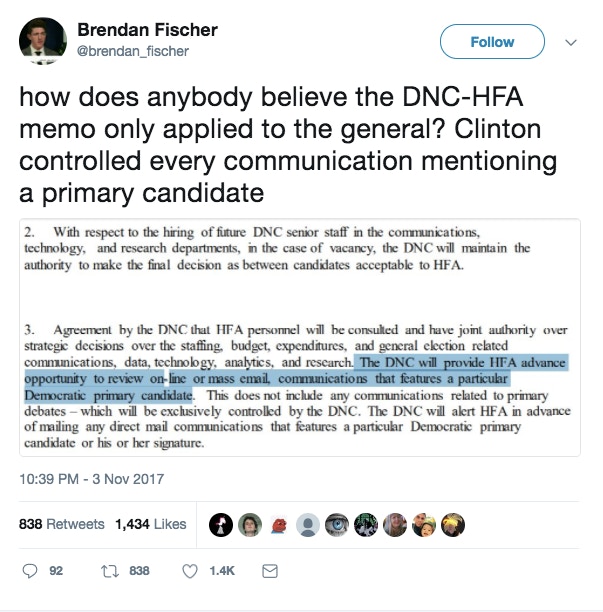
The problem with this claim is that it is blatantly and obviously false. All one has to do to know this is read the agreement. Unlike the journalists spreading this DNC defense, Campaign Legal Center’s Brendan Fischer bothered to read it, and immediately saw and documented how obviously false this claim is:
The NBC article that was originally used to spread this claim now includes what amounts to a serious walk-back, if not outright retraction, of the DNC’s principal defense:
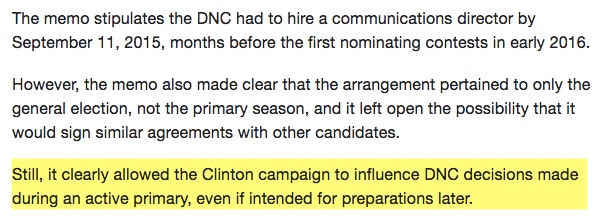
DNC and Clinton allies pointed to the fact that the agreement contained self-justifying lawyer language claiming that it is “focused exclusively on preparations for the General,” but, as Fischer noted, that passage “is contradicted by the rest of the agreement.” This would be like creating a contract to explicitly bribe an elected official (“A will pay Politician B to vote YES on Bill X”), then adding a throwaway paragraph with a legalistic disclaimer that “nothing in this agreement is intended to constitute a bribe,” and then have journalists cite that paragraph to proclaim that no bribe happened even though the agreement on its face explicitly says the opposite.
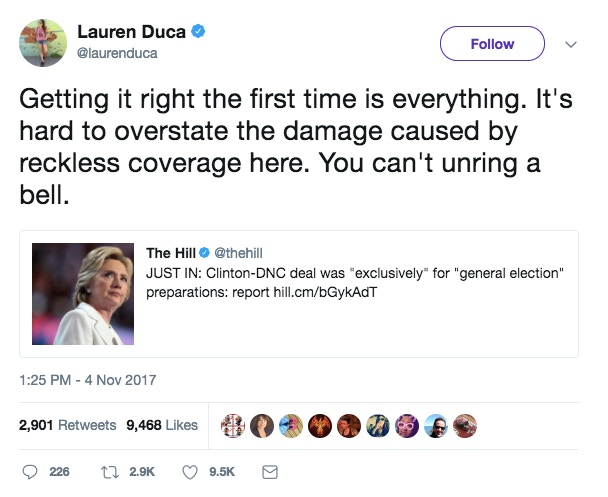
The Clinton/DNC agreement explicitly vested the Clinton campaign with control over key matters during the primary season: the exact opposite of what journalists on Twitter caused hundreds of thousands, if not millions, of people to believe. Nonetheless, DNC-loyal commentators continue to cite headlines and tweets citing the legalistic language to convince huge numbers of people that the truth is the exact opposite of what it actually is:
Viral Falsehood #2
Sanders signed the same agreement with the DNC that Clinton did.
To make the Clinton/DNC agreement appear benign and normal, the claim was quickly and widely circulated that Bernie Sanders had also signed the same agreement with the DNC as Clinton had. This, too, was false — in the most fundamental way possible.
Simply put, the agreement Sanders signed with the DNC — which the Sanders camp appears to have provided ABC News in order to debunk the claim — did not contain any of the provisions vesting control over the DNC that made the Clinton agreement cited by Brazile so controversial. As ABC News put it (emphasis added):
A joint fundraising agreement between the Bernie Sanders campaign and the Democratic National Committee — obtained Friday by ABC News and signed at the start of the primary campaign for the 2016 presidential election — does not include any language about coordinating on strategic decisions over hiring or budget, unlike a fundraising memo between the Hillary Clinton team and the DNC.
It’s possible that had Sanders wanted to invoke his funding arrangement with the DNC, and then signed a second agreement, it might have included similar control provisions. But it’s also possible that it would not have. We’ll never know, because it never happened. What we actually know for certain — what exists in reality — is that Sanders never signed any agreement with the DNC that contained the control provisions that were given in 2015 to the Clinton campaign. In other words, the provisions cited by Brazile in her “rigging” allegation did not exist in any contract signed with the DNC by the Sanders campaign.
Needless to say, a tiny fraction of those who were exposed to the original falsehood (Sanders signed the same agreement as Clinton) ended up seeing this fundamental reversal, because the journalists who promoted the original falsehood felt no compunction, as usual, to provide the less pleasing correction.
Viral Falsehood #3
Brazile stupidly thought she could unilaterally remove Clinton as the nominee.
Yesterday, the Washington Post published an article reporting on various claims made in Brazile’s new book. The headline, which was widely tweeted, made it seem as though Brazile delusionally believed she had a power which, obviously, she did not in fact possess: “Donna Brazile: I considered replacing Clinton with Biden as 2016 Democratic nominee.” The article said Brazile considered exercising this power after Clinton’s fainting spell made her worry that Clinton was physically debilitated, and her campaign was “anemic” and had taken on “the odor of failure.”
Brazile — as a result of her stinging criticisms and accusations of Clinton, Obama, and the DNC — is currently Public Enemy No. 1 among Democrats in the media. So they seized on this headline to pretend that she claimed the power to unilaterally remove Clinton on a whim and then used this claim to mercilessly vilify her — the chair of Al Gore’s 2000 campaign, last year’s interim head of the DNC, and a long-time Democratic Party operative — as a deluded, insane, dishonest, profiteering, ignorant fabulist who lacks all credibility.
But the entire attack on Brazile was false. She did not claim, at least according to the Post article being cited, that she had the power to unilaterally remove Clinton. The original Post article, buried deep down in the article, well after the headline, made clear that she was referencing a complicated process in the DNC charter that allowed for removal of a nominee who had become incapacitated.
The Post then amended its story to reflect that she made no such absurd claim in her book, but rather noted that “the DNC charter empowered her to initiate replacement of the nominee” and that “if a nominee became disabled, she explains, the party chair would oversee a complicated process of filling the vacancy that would include a meeting of the full DNC.” The Post then added this note to the top of the article:

Journalists on Twitter spent hours yesterday mocking, maligning, and attacking the reputation of Brazile for a claim that she simply never made — all because a tweeted headline, which they never bothered to read past or evaluate, made them think they were justified in doing so in order to malign someone who has, quickly and bizarrely, become one of the Democrats’ primary enemies.
Viral Falsehood #4
Evidence has emerged proving that the content of WikiLeaks documents and emails was doctored.
Last year, from the time WikiLeaks began publishing emails and documents from the DNC and John Podesta’s email inbox, Clinton officials and their media supporters have constantly insinuated, and sometimes outright stated, that the WikiLeaks documents were frauds because they had been altered. What was most notable about this accusation was how easily it would have been proven had it really been true. All anyone had to do was show the actual, original email that they sent or received, and then compare it to the altered WikiLeaks version, and that would have been proof that the WikiLeaks archive was unreliable.
But that never happened. Never once did any of the dozens of Democratic Party operatives who sent or received the emails published by WikiLeaks point to a single specific case of an alteration — something that, obviously, they would have eagerly done had they been able to. As Politico noted last year (emphasis added):
Clinton’s team hasn’t challenged the accuracy of even the most salacious emails released in the past four days, including those featuring aides making snarky references to Catholicism or a Bill Clinton protégé describing Chelsea Clinton as a “spoiled brat.” And numerous digital forensic firms told POLITICO that they haven’t seen any proof of tampering in the emails they’ve examined — adding that only the hacked Democrats themselves could offer that kind of conclusive evidence.
Similarly, when PolitiFact tried last year to fact-check the Clinton campaign’s claims that the documents were doctored, they noted: “The Clinton campaign, however, has yet to produce any evidence that any specific emails in the latest leak were fraudulent.”
Nonetheless, the desire to believe this persisted. And this week, Associated Press published a report that countless journalists seized upon to claim that proof finally had emerged that the WikiLeaks documents had been altered. The claim in the AP report is incredibly simple and limited. It does not involve any claim that WikiLeaks altered any documents, or that any of the emails it published were frauds; rather, the claim is that Guccifer, on one of the documents that he published, placed a “confidential” watermark that did not appear on another version:
The first document Guccifer 2.0 published on June 15 came not from the DNC as advertised but from Podesta’s inbox, according to a former DNC official who spoke on condition of anonymity because he was not authorized to speak to the press.
The official said the word “CONFIDENTIAL” was not in the original document .
Guccifer 2.0 had airbrushed it to catch reporters’ attention.
There are so many reasons to question whether this actually happened. To begin with, the fact that one version of the document is without a “confidential” watermark doesn’t mean no version has one; it’s common to add watermarks of that sort for different purposes and different recipients. Moreover, AP’s only basis is an anonymous source claiming the document had been altered, along with the version that lacks the watermark. This is very far from proof that Guccifer “airbrushed it to catch reporters’ attention.”
But let’s assume for the sake of argument that Guccifer did, in fact, add a “confidential” watermark to this document to entice journalists to view the document as more appetizing. This does not remotely justify the claim that any of the documents and emails published by WikiLeaks were materially altered and were thus unreliable.
First, Guccifer adding a watermark to a document he circulated does not mean that any of the emails published by WikiLeaks in its archive was altered. It’s long been known that Guccifer altered the documents’ metadata to hide its path, but nobody ever tried to cite that as proof that anything published by WikiLeaks was fraudulent (indeed, PolitiFact cited Guccifer’s alteration of metadata when concluding there was no evidence that the WikiLeaks documents themselves had been altered).
Second, this has no bearing on the content of the emails or documents themselves published by WikiLeaks, which, to date, nobody has demonstrated have been altered in the slightest. Third, if it were the case that any of the emails or documents published by WikiLeaks were fraudulent, it would still be incredibly easy to prove: All anyone would have to do is produce the original and show how the WikiLeaks version was altered. Why — a full year after WikiLeaks began publishing these documents — has nobody done this, despite the overwhelming incentive that exists to expose this?
In sum, evidence that the content of any of the WikiLeaks emails was altered is nonexistent, while there is overwhelming reason to believe none has been (beginning with the fact that, as easy it would be to do so, no proof has been provided after all this time). Nonetheless, as a result of journalists’ conduct on Twitter this week, the false claim that emails and documents in the WikiLeaks archive were proven to be altered is now viral and will remain fixed in people’s belief system forever:
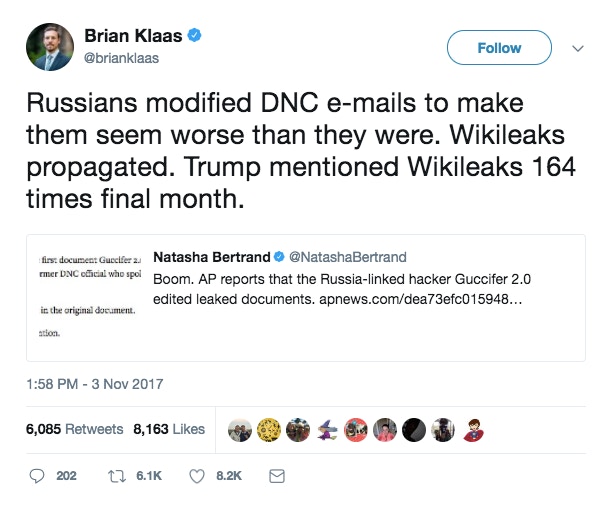
There’s no way to prove the negative, that no emails or documents published by WikiLeaks were altered. But one should demand actual evidence before affirming this claim. And despite the ease of providing that proof, and the long period of time that has elapsed, none has been provided. But, unsurprisingly, that did not stop the claim that it had been proven from going viral this week on Twitter — all based on the tenuous claim that Guccifer added a “confidential” watermark to one of the documents he circulated.
It can certainly be menacing for Russian bots to disseminate divisive messaging on Twitter. But it’s at least equally menacing if journalists with the loudest claim to authoritative credibility are using that platform constantly to entrench falsehoods in the public’s mind.
ZNetwork is funded solely through the generosity of its readers.
Donate