

Why a changing political alignment in the Horn is unnerving Abiy Ahmed and testing African and Western diplomacy
Something unusual is happening in Ethiopia and across the Horn. The alliances that made the Tigray war possible are being reversed. Between 2020 and 2022, Eritrean and Amhara forces fought alongside Ethiopia’s federal military against Tigrayan forces. Today Fano is fighting the federal government, armed opposition persists in Oromia, Addis Ababa and Asmara are increasingly hostile, and people who fought one another only a few years ago are discovering reasons to cooperate.
The Tigrinya word increasingly associated with this realignment is Tsimdo (ጽምዶ). Its agricultural meaning is more revealing than the English word “alliance.” In the farming traditions of the Eritrean and Tigrayan highlands, tsimdo evokes two oxen yoked together to plough. They remain separate animals, but for the work before them they pull together.
That is an unusually apt metaphor. Tsimdo does not mean that Eritreans and Tigrayans, or Tigrayan and Amhara actors, have forgotten their histories or resolved their profound disagreements. It implies neither a single ideology nor a permanent political union. Former enemies need only decide that their immediate conflict with Abiy Ahmed’s government matters more than some of their disagreements with one another.
This lesson carries from the EPLF and TPLF ጽምዶ that helped defeat the Derg in 1991 when they were hardly natural allies. They had serious disagreements over nationalism, ideology and strategy, yet necessity allowed them to cooperate against a common adversary. Ethiopia in 2026 is not Ethiopia in 1991, and Abiy is not Mengistu. The narrower lesson is that former enemies do not have to settle everything before discovering reasons to work together.
That possibility is dangerous for Abiy because division has been central to his political survival. His government does not need to defeat every adversary simultaneously if Amhara, Tigrayan, Oromo and Eritrean actors remain preoccupied with one another. Each can be represented as a separate problem. Governing becomes considerably harder when those supposedly separate problems begin communicating with one another.
Abiy may therefore be losing something more important than individual allies. He may be losing the political system of division.
From Team Lemma to Abiy
There is irony here because Abiy himself emerged from an alliance. Before 2018, Lemma Megersa was the nationally prominent Oromo politician, president of Oromia and the recognizable figure associated with Team Lemma. Abiy was important within that circle but considerably less known nationally.
Because Lemma was not a federal MP, he could not become prime minister under the existing parliamentary arrangement. Abiy succeeded him as OPDO chairman, became EPRDF chairman and then prime minister. The relationship did not survive Abiy’s consolidation of power. Lemma opposed the creation of the Prosperity Party, was marginalized and virtually disappeared from public political life.
The reversal was extraordinary. The better known politician helped create the opening through which the lesser known politician rose, only to be eclipsed by him.
I have written elsewhere about the almost messianic expectations surrounding Abiy’s rise in The Messiah and the Crowd. Ethiopia’s problem in 2018 was not simply whether Abiy was a good or bad man. It was whether institutions would be strong enough to restrain an extraordinarily popular leader. They were not.
The reformist image
Abiy’s early government was extraordinarily rich in symbols of change. In 2018, half his cabinet consisted of women. Aisha Mohammed became Ethiopia’s first female defence minister. Sahle-Work Zewde became its first female president. Women headed the Supreme Court and electoral board.
These women were not props. They had careers and accomplishments independent of Abiy. But gender equality was also part of the image through which a new prime minister introduced himself to Ethiopia and the world. Later reshuffles reduced female representation substantially, raising questions about how institutional the original transformation really was.
Aisha Mohammed presents another interesting issue. She is Afar and has personal connections to Assab, but Afar identity creates no Ethiopian territorial claim. Afar communities inhabit Eritrea, Ethiopia and Djibouti, and their human geography predates the boundaries separating those states.
The late John Markakis spent much of his career examining precisely this tension between centralized states and pastoral peripheries. Pastoral communities move according to water, grazing, livestock, markets and kinship rather than customs posts. The modern border divided an older human landscape; it did not make the people on opposite sides strangers.
But pastoral geography is not a sovereign title.
If ethnicity, kinship or pastoral movement created territorial ownership, scarcely a frontier in Africa would remain secure. The appropriate answer is to make borders easier for pastoralists, families and commerce to cross, not easier for armies to move.
“ዝምታ ነው መልሴ”
Sahle-Work’s departure tells another part of the story. Shortly before leaving the presidency in 2024, she invoked a song from the iconic musician Mahmoud Ahmed:
“ዝምታ ነው መልሴ” — “Silence Is My Answer.”
She added:
“ለአንድ ዓመት ሞከርኩት” — “I tried it for a year.”
The Amharic conveys more than the English. Silence here suggests what remains when speaking appears unlikely to change anything. Coming from Ethiopia’s president, however ceremonial the office, it was a remarkable message.
She was replaced by Taye Atske Selassie, who had been Abiy’s foreign minister. Now Ethiopia’s National Dialogue has moved toward an executive presidency, potentially concentrating powers presently divided between prime minister and president.
Ethiopia is not restoring its monarchy. But a country that abolished its emperor half a century ago should be cautious when a political process conducted under an already dominant incumbent concludes that what the country needs is a still more powerful presidency.
Abiy’s early years were rich in symbols of distributed power. His later years increasingly tell a story of concentrated power.
History when convenient
Abiy’s treatment of history displays similar flexibility. Emperor Yohannes IV can be invoked through historical conflicts with Amhara when that memory is politically useful. Yet when the subject turns to the Red Sea, Yohannes’s Tigrayan general Ras Alula becomes an Ethiopian national figure whose campaigns are invoked to establish historical connections to the coast.
The contradiction is only apparent. History is performing different political tasks.
As I argued in There Is No Timeless Eritrea or Ethiopia, ancient kingdoms and military campaigns are not modern title deeds. Neither Eritrea nor Ethiopia has existed eternally in its present territorial form. Both are historical constructions, and neither is less sovereign for acknowledging it.
This is where Foucault becomes useful. Political power does not always have to invent history. It can decide which history becomes relevant. At precisely the moment when former enemies are finding reasons to cooperate, memories explaining why they should remain enemies become politically valuable.
Assab: access is not ownership
The distinction is critical when discussing the Red Sea.
As a landlocked state, Ethiopia has legitimate interests and international law protections concerning access and transit. But access is not ownership. Commercial use of a port does not confer sovereignty, and economic need does not create title to another country’s coastline.
I explored this distinction at greater length in There Is No Timeless Eritrea or Ethiopia. Ports can be leased, transit arrangements negotiated and railways connected across borders. None requires territorial incorporation.
But Abiy’s rhetoric has made even an ordinary commercial discussion increasingly difficult. Ethiopian discourse has moved between access, historical entitlement and maritime sovereignty. When a much larger neighbor repeatedly describes its landlocked condition as an intolerable historical injustice, Eritrea has reason to ask where commercial access ends and territorial revisionism begins.
Trust matters in any durable transit arrangement. Abiy’s rhetoric has been consuming it.
The Afar cannot solve this problem for Ethiopia. Afar communities live across three sovereign states precisely because pastoral geography and political geography are different things. Ethiopian Afar connections to Assab do not make Assab Ethiopian.
Access can be negotiated. Sovereignty cannot.
Naming the problem
The power to frame events is not confined to Addis Ababa. In June 2026, the United States warned of tensions between “TPLF hardliners and the Ethiopian government.”
The grammar matters. One side receives a politically loaded adjective; the other is identified through institutional status. The frame begins working before the argument begins.
This does not mean everyone described as a hardliner is moderate. It means the label should follow analysis rather than replace it.
Foucault asks who gets to define the problem. Chomsky and Herman remind us that framing need not depend on falsehood. Selection and emphasis can determine which facts become central and which remain peripheral.
One can acknowledge displaced Tigrayans while making Tigrayan disarmament the urgent issue. One can acknowledge unresolved territory while treating Tigrayan rapprochement with Eritrea as the immediate danger. One can criticize Abiy while continuing to define preservation of his political order as “stability.”
Cause and consequence quietly exchange places.
The symptom becomes the cause.
Disarmament without security
This is especially important in discussions of Pretoria.
The agreement contains provisions for disarmament, demobilization and reintegration. But it also says that the modalities of disarmament must take account of “the security situation on the ground.” Disarmament was part of a larger settlement involving security, political normalization, humanitarian access, restoration of services and constitutional order.
Nearly four years later, the security environment is anything but settled. Fano remains armed and is fighting the federal government. Armed Oromo opposition persists. Eritrea is in a state of alert in reaction to the threat it faces to its sovereignty from Abiy and his minions. Federal forces possess overwhelming conventional and aerial superiority, and fighting between federal and Tigrayan forces has resumed.
Against this background, demanding complete Tigrayan disarmament is not politically neutral. It would ask a population that recently experienced catastrophic war to surrender its organized means of self defence while other armed actors retain theirs and while the government with which it fought remains in power.
For Tigray, unilateral disarmament under those conditions could reasonably look less like peacebuilding than surrender.
The relevant question is therefore not merely, Why has Tigray not disarmed?
It is also: What has been done to make it safe for Tigray to disarm?
Disarmament should follow credible security. It cannot substitute for it.
An African solution for which Africans?
The same problem affects renewed African Union mediation.
There are good reasons to prefer African led diplomacy on a continent with such a long history of outside intervention. Olusegun Obasanjo also played an important role in producing Pretoria. Western governments strongly support renewed AU mediation.
But “African solutions to African problems” can become an incantation rather than an argument. The African identity of a mediator does not automatically make a process representative of the Africans who must live with its consequences.
Tigrayans are Africans. Amhara are Africans. Oromo are Africans. Eritreans are Africans. So are displaced people, pastoralists, families divided by war and civilians living beneath drones.
African ownership cannot mean ownership by African elites alone.
A mediator can shuttle indefinitely between Addis Ababa and Mekelle. Movement between two airports is not necessarily movement toward a political solution.
The Addis advantage
This problem has a longer history.
Haile Selassie played a role in 1963 during the establishment of the Organization of African Unity. Ethiopia’s anti colonial prestige, especially the symbolism of Adwa, gave the country extraordinary Pan African standing.
The OAU established itself in Addis Ababa, and its successor, the African Union, remains there. Imperial Ethiopia, the Derg, the EPRDF and Abiy’s government have all inherited the same diplomatic geography.
Regimes changed. Geography did not.
For most African governments, lobbying the African Union means conducting diplomacy in another country’s capital. Ethiopia does it at home.
That does not mean Ethiopia controls the AU. Influence rarely needs to operate so crudely. Generations of diplomats have lived in Addis, formed professional and social relationships and become accustomed to seeing African politics from a capital that is simultaneously Ethiopia’s political center.
Proximity creates familiarity, and familiarity can become an influence.
The institutional memory is visible on the AU grounds themselves. In 2019, the organization unveiled a statue of Haile Selassie honoring his contribution to African unity. Yet while Haile Selassie was playing a role in the creation of the OAU, Eritreans were already fighting his government.
A 1978 U.S. government assessment records that the OAU had not even given Eritrean liberation movements a hearing. It also notes Haile Selassie’s standing as an OAU founding father as one reason African governments were reluctant to listen to his opponents.
More than half a century later, his statue stands at the headquarters of the successor organization to the OAU that would not hear them.
The juxtaposition needs little embellishment.
It is already standing there in stone.
Institutions do not merely preserve memory. They organize it.
Which border counted?
I have argued in There Is No Timeless Eritrea or Ethiopia that Africa should be extremely cautious about reopening inherited borders. Colonial borders were often arbitrary. That arbitrariness is one reason they cannot safely be renegotiated every time a government discovers a preferable historical map.
Eritrea presents an important historical complication. It had been a distinct Italian colonial territory, was administered by Britain, entered a UN established federation with Ethiopia and was later annexed after that federation was dismantled. Independence in 1993 substantially restored an existing territorial unit.
The question was therefore never simply whether African borders should be preserved.
It was also which border counted.
Western Sahara provides an instructive comparison. The OAU eventually admitted the Sahrawi Arab Democratic Republic, while Eritrean liberation movements received no comparable institutional recognition.
Had the OAU spent its institutional life in Rabat rather than Addis Ababa, would Western Sahara have entered its political imagination in precisely the same way? Had the organization been headquartered in Accra, Lagos, Algiers or Dar es Salaam, would Eritrean liberation movements really have fought for three decades without obtaining even a hearing?
We cannot know.
Institutional geography is not destiny. Neither is it neutral.
Borders that held, wars that did not
The borders the OAU defended have proved legally durable but politically porous.
Pastoralists cross them. Refugees cross them. Families cross them. Armed movements, money, weapons and political alliances cross them. Increasingly, drones cross them.
The Afar illustrate why two principles must be defended simultaneously. Their human geography crosses Eritrea, Ethiopia and Djibouti. That should encourage pastoral mobility, trade and family contact. It does not require transferring territory.
The same applies to Tigrinya speakers across Eritrea and Ethiopia and Somalis across several sovereign states.
Recognizing these realities should make borders more humane.
It should not make sovereignty negotiable.
As I argued in There Is No Timeless Eritrea or Ethiopia, there is no neutral historical map waiting beneath the present one. There are many possible maps corresponding to different kingdoms, empires, migrations and centuries. History is not a property registry.
When the monopoly of violence fractures
Ethiopia’s internal development has made this regionalization more dangerous.
Under the EPRDF, regional states developed increasingly powerful security forces. The Somali Region’s Liyu Police emerged during the conflict with the ONLF, and other regions subsequently developed substantial special forces.
What initially strengthened the center eventually created autonomous coercive power in the regions.
Max Weber associated the modern state with the monopoly of legitimate physical force. Ethiopia increasingly resembled a federation in which several constituent units possessed forces approaching armies. Abiy’s attempt to dismantle and integrate the regional special forces produced particularly severe resistance in Amhara and contributed to the political environment from which the present confrontation with Fano emerged.
The Ethiopian state has not disappeared but its Weberian monopoly has fractured.
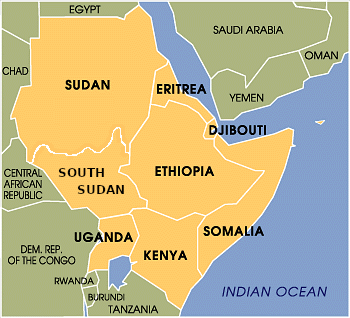
An Ethiopian conflict can now rapidly acquire Eritrean, Sudanese, Egyptian or Gulf dimensions. An internal war may be internal only at the moment it begins. The map shows separate sovereign states. The security system increasingly behaves as an interconnected region.
No heroes required
None of this requires romanticizing Abiy’s opponents. Opposition to Abiy does not confer democratic virtue. No heroes are required for this argument. What is required is consistency.
If disarmament matters, credible security must precede it. If borders matter, they cannot be defended in one context and reopened when Ethiopia wants Assab. If ethnic nationalism is dangerous, nineteenth century grievances should not be resurrected selectively. If African ownership matters, Africans outside presidential palaces and diplomatic compounds must count as owners too.
And if stability matters, it cannot simply mean preserving whoever presently occupies the state.
Look at the field
This brings us back to Tsimdo. The emerging relationships among Abiy’s opponents do not mean their old grievances have disappeared. Eritrean and Tigrayan actors carry memories of a horrific recent war. Amhara and Tigrayan forces have profound disputes over territory, displacement and atrocities. Oromo, Amhara and Tigrayan political projects are hardly interchangeable.
That is precisely why their cooperation matters. People who agree about everything require little explanation for working together. People who recently fought one another do.
In 2020, Abiy benefited enormously from division. Eritrea fought alongside him. Amhara forces fought alongside him. Tigray was isolated. Oromo opposition was fragmented.
Today Eritrea is an adversary. Fano fights the federal government. Armed Oromo opposition persists. Tigrayan actors are reconsidering relationships with people they recently fought.
The international response should therefore not begin by asking how to separate these actors again.
It should ask why they came together.
Tsimdo may be less the cause of instability than a symptom of something deeper: declining confidence in the political order centered on Abiy Ahmed. I made a related argument about the dangers of investing democratic transition in a charismatic individual rather than durable institutions in The Messiah and the Crowd.
This is where the agricultural meaning of Tsimdo becomes especially useful.
Two oxen are not yoked because they have become the same animal. They remain separate and may sometimes pull unequally. They accept the yoke because there is a field before them and, for the work immediately at hand, each is more useful to the other than it was before.
A diplomat looking only at the yoke may conclude that the solution is to separate the oxen. A better diplomat would first look at the field.
Africa’s founders feared that changing borders would unleash conflicts they could not contain. The borders largely survived. Yet the wars found ways around them, through them and increasingly above them.
The wiser response is not to reopen borders but to rethink the politics occurring inside and across them: political inclusion rather than permanent exclusion, cross border mobility rather than irredentism, commercial cooperation rather than territorial acquisition, mediation rather than diplomatic choreography, and credible security rather than unilateral disarmament.
Abiy’s greatest danger may not be one overwhelmingly powerful enemy. it may be something simpler. His enemies are becoming less divided.
Before African and Western mediators decide that the emerging relationships among Abiy’s opponents must be weakened in the name of peace, they should ask a more fundamental question:
What changed in the field that persuaded former enemies to pull the plough together?
ZNetwork is funded solely through the generosity of its readers.
Donate




