

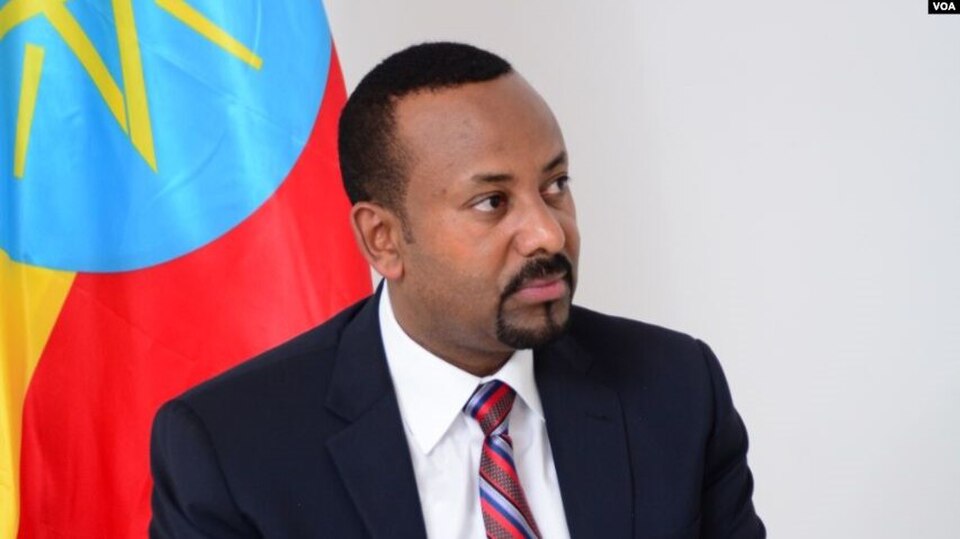
When Abiy Ahmed came to power in 2018, the reaction among many Ethiopians, especially in the diaspora, was extraordinary. There was understandable hope, but there was also projection. People saw in him what they desperately wanted to see: a democrat, a reconciler, a modernizer and, in some circles, almost a savior.
When he came to Washington in July 2018, the atmosphere was euphoric. The Washington Post captured that extraordinary diaspora reception, with people travelling from across the United States to see him and speaking about him with something close to adoration.
I remember the debate over whether Ethiopia needed a transitional government. Abiy rejected the idea. The substance of what I remember him saying was essentially this: you do not need a separate transitional government because I will transition you. Contemporary discussion at the time confirms that the question of a transitional government was being raised directly during his American visit.
People applauded.
That moment stayed with me.
Later, it reminded me of Monty Python’s Life of Brian. Brian is an ordinary man whom the crowd insists on turning into the Messiah. The joke is ultimately less about Brian than about the crowd’s determination to believe.
That is increasingly how I understand the Abiy phenomenon.
The interesting question is not what made Abiy extraordinary. It is why so many people needed him to be extraordinary.
I did not share that confidence, and that is not hindsight. In August 2018, while the honeymoon was still underway, I wrote Ethiopia’s Quiet Revolution: From Revolutionary Developmentalism to Neoliberal Reform. I welcomed the opening but remained concerned about whether Ethiopia was moving from personal rule toward durable democratic institutions.
Abiy, after all, had emerged from the system he was promising to transform. That did not make reform impossible. But it should have made scrutiny indispensable.
A democratic transition cannot be a man.
The man and the myth
I do not think Abiy’s extraordinary reception can be explained by political sophistication.
Whatever one thinks of Meles Zenawi, he was a sophisticated political thinker. One could disagree profoundly with him while recognizing an intellectual architecture behind his ideas about the developmental state, industrialization, state capacity and Ethiopia’s place in the world.
I do not see comparable depth in Abiy. What I see is a politician remarkably comfortable saying one thing, contradicting it later and proceeding as though yesterday never happened.
But there were early clues that something else was happening around his conception of himself.
Abiy publicly recounted the story that his mother had foretold that he would become Ethiopia’s “seventh king.” Scholars examining Abiy’s religious and political worldview have treated that story as revealing, not because anyone can verify a childhood prophecy, but because Abiy himself chose to present his political rise through the language of destiny.
That choice matters.
A politician taking office in a republic was telling a story about becoming king.
Jon Lee Anderson’s New Yorker profile of Abiy is especially worth preserving because Anderson spent substantial time observing Abiy directly rather than simply repeating the reformer image created in 2018.
Abiy told Anderson that he had provided intelligence to the United States, including to the NSA, and said, “I would fight and die for America.” Even more revealing was his suggestion that Ethiopia could be useful to Western countries because Ethiopians could fight wars that Western populations were increasingly unwilling to send their own children to fight.
That is an extraordinary way for a national leader to speak about his own people.
Read after the catastrophic war in Tigray, it is difficult to dismiss as colorful conversation.
Anderson also encountered a man with an unusually elevated sense of his own destiny. That makes the Life of Brian analogy more complicated.
Perhaps the crowd manufactured the Messiah.
But Abiy brought his own story of destiny with him.
Why people believed
Part of the explanation, I believe, lies in the extraordinary hostility toward the TPLF.
The TPLF led EPRDF had serious faults. I criticized its authoritarianism when it was in power. The repression after the 2005 election was severe. Political competition narrowed. Civil society and independent media suffered.
But comparison matters.
With all its faults, I regard the EPRDF as the most effective government modern Ethiopia has had. That does not make it democratic. The government before it was the Derg. Before that came Haile Selassie’s imperial order. What followed the EPRDF has hardly been democratic peace.
The World Bank documented substantial reductions in poverty and improvements in health, education and living standards during the EPRDF period.
So authoritarianism alone does not explain the intensity of the hostility directed specifically toward the TPLF.
There is a deeper historical dimension.
Tigray occupies an extraordinary place in Ethiopian national memory.
Aksum is in Tigray. Adwa is in Tigray.
Ethiopia reaches into Tigray for some of the most powerful symbols of its antiquity, independence and national greatness.
Yet Tigray itself has also experienced marginalization, poverty and repression by the political center. The 1943 First Woyane rebellion was crushed with British military and air support.
There is a limited but useful comparison here with Kosovo’s place in Serbian historical imagination. I am not comparing Tigray’s modern political status with Kosovo’s, nor am I comparing the conflicts. My point is much narrower.
Kosovo became a foundational landscape of Serbian national memory through medieval history and the Battle of Kosovo. Tigray occupies something of that symbolic position in Ethiopia through Aksum and Adwa.
There is something profoundly contradictory about celebrating Aksum and Adwa as pillars of Ethiopian identity while treating Tigray as peripheral, rebellious or expendable.
None of this excuses TPLF authoritarianism. Nor does it mean every opponent of the TPLF resented Tigrayans.
But I believe legitimate opposition to the TPLF became entangled, in some quarters, with resentment that people from the historically marginalized Tigrinya speaking highlands had come to dominate the Ethiopian state.
For some people, getting rid of the TPLF mattered more than constructing institutions capable of restraining whoever replaced it.
That made Abiy the perfect vessel.
The warnings
My concern did not begin with the Tigray war.
In February 2019, in Ethiopia Against the Odds, I was already writing about ethnic conflict and the strains confronting the new political order.
By November 2019, in State Formation and Disintegration in Ethiopia, I was warning about political fragmentation and the possibility of state disintegration.
This was before the Tigray war.
I was not predicting everything that followed. But the underlying danger was visible.
The political opening was becoming too personalized.
The leader was becoming the transition.
And too many people were comfortable with that.
Power attracts
Abiy has also demonstrated the remarkable ability of power to absorb yesterday’s opponents.
Political patronage does not have to mean envelopes of money. It has many currencies: office, land, business opportunities, recognition, media visibility, access and proximity to power.
For diaspora elites, relevance can itself be enormously valuable.
Alemayehu G. Mariam is a revealing example. During the Meles era, he was among the fiercest diaspora critics of the EPRDF. He also attacked the GERD, calling it a “white elephant” and a “vanity make believe project”.
In 2026, after visiting the completed GERD, he described it in radically different terms, including as the “crown of Africa.”
The river did not change.
The project did not acquire a different origin.
The ruler changed.
The GERD was not Abiy’s conception. It was overwhelmingly a Meles era project launched years before Abiy became prime minister.
I say that as someone who remains critical of the GERD. My original training was in hydrology and watershed science, and my skepticism about giant dams is environmental and developmental. I have similar concerns about Hoover, Three Gorges and other monumental projects.
My position does not depend on who occupies the palace.
That is the point.
Analysis should not become fandom.
Aregawi Berhe offers another example. A founder of the TPLF who later became one of its bitter opponents, he returned after Abiy came to power and was eventually appointed to lead public participation around the GERD.
Berhanu Nega went from imprisonment and armed opposition to serving in Abiy’s cabinet.
Getachew Reda went from being one of Abiy’s most visible wartime enemies to becoming his adviser.
Tsadkan Gebretensae troubles me even more. During the Tigray war, he presented his return to military leadership as a struggle for Tigray’s survival. In my judgment, his subsequent political trajectory represents a betrayal of the very population in whose name he claimed to fight and reflects an extraordinary appetite for political influence.
Others will disagree with that judgment.
But the broader phenomenon remains.
Power does not always destroy opponents.
Sometimes it absorbs them.
And yesterday’s opponent can be more useful than an ordinary supporter because he brings with him the credibility of having once resisted.
That is borrowed credibility.
Assab
The same political ecosystem becomes much more dangerous when the subject turns to Eritrea and the Red Sea.
Abiy discovered that Assab produces remarkably cheap political attention.
He invokes the sea. Generals repeat it. Lawyers search for theories. Intellectuals retrieve ancient maps. Media personalities turn it into debate. YouTubers supply outrage.
Eventually repetition changes the question.
Instead of asking whether Ethiopia has any sovereign entitlement to Eritrean territory, people begin asking how Ethiopia should obtain Assab.
That is propaganda’s real victory.
A practical question about commercial port access becomes confused with territorial sovereignty.
When a ruler describes another country’s territory as an existential national necessity, intellectuals have a particular responsibility.
The lawyer should ask what international law permits. The historian should challenge mythology. The political scientist should recognize irredentism. The journalist should question the premise.
Otherwise education becomes decoration for power.
Knowing when to leave
This brings me to what may be the simplest test of political leadership.
Can the ruler leave?
Africa has produced leaders who demonstrated that enormous political authority does not require possession of the state.
Julius Nyerere voluntarily left Tanzania’s presidency. Léopold Sédar Senghor relinquished the presidency of Senegal. Nelson Mandela possessed a biography from which an enormous personality cult could easily have been constructed, yet served one presidential term.
Mandela could imagine South Africa without Mandela.
Nyerere could imagine Tanzania without Nyerere.
That ability matters.
Other rulers gradually create a political system in which leaving office becomes dangerous to them personally.
Repression creates enemies. Enemies make retirement frightening. Fear produces more repression, which creates still more enemies. Eventually the ruler can no longer distinguish between “I must survive” and “the country must survive.”
Power becomes insurance.
This is why voluntary departure tells us something profound about political leadership. It is also why term limits matter. They preserve an exit before remaining in office becomes a matter of personal survival.
Abiy has not ruled for decades.
But the process does not begin in the fortieth year.
It begins when institutions become secondary to personality, when criticism becomes betrayal and when the ruler’s ambitions increasingly become synonymous with those of the country.
The crowd
I keep returning to Washington in 2018.
The cheering crowds. The certainty. The almost religious belief that the right man had finally arrived.
The early reforms were real. Political prisoners were released. Opposition figures returned. Political space opened. Relations with Eritrea changed dramatically.
That helps explain why the hope was genuine.
But hope became something else.
That is where Life of Brian keeps returning to me.
The point is not that Abiy fooled everyone through extraordinary political genius.
The point is that many people wanted to believe.
They wanted the TPLF gone. They wanted a new beginning. They wanted someone to embody that beginning.
And Abiy apparently had his own sense of destiny waiting to meet them.
The crowd found its Messiah.
The man found his crowd.
What makes this especially difficult for me is that Ethiopia had already lived through seventeen years of Mengistu Hailemariam.
Ethiopians knew the Red Terror. They knew imprisonment, disappearances, war and fear. They knew what concentrated political power could do.
I used to believe nothing worse than Mengistu would ever revisit Ethiopia.
I thought that experience had taught a permanent lesson.
Abiy proved me wrong.
I do not mean that Abiy and Mengistu are identical. They emerged from different periods and speak entirely different political languages.
My point is more unsettling.
I had assumed that suffering under one form of personal rule would make another cult of leadership impossible.
It did not.
Memory does not automatically produce wisdom.
A society can remember the pain and still reproduce some of the political habits that made the pain possible.
That is why my concern in 2018 was never simply whether Abiy was a good man or a bad man. I could criticize EPRDF authoritarianism while acknowledging its achievements. I could recognize Meles’s intellectual sophistication without admiring his government. I could criticize the GERD without pretending Abiy invented it.
The principle is simple.
Analysis should not change because the ruler changes.
Ethiopia did not need a Messiah in 2018.
It needed institutions strong enough to restrain whoever occupied the prime minister’s office, including a popular reformer surrounded by cheering crowds.
It still does.
A democratic transition cannot be a man. The danger begins when the crowd starts believing that the man is the transition.
ZNetwork is funded solely through the generosity of its readers.
Donate




