


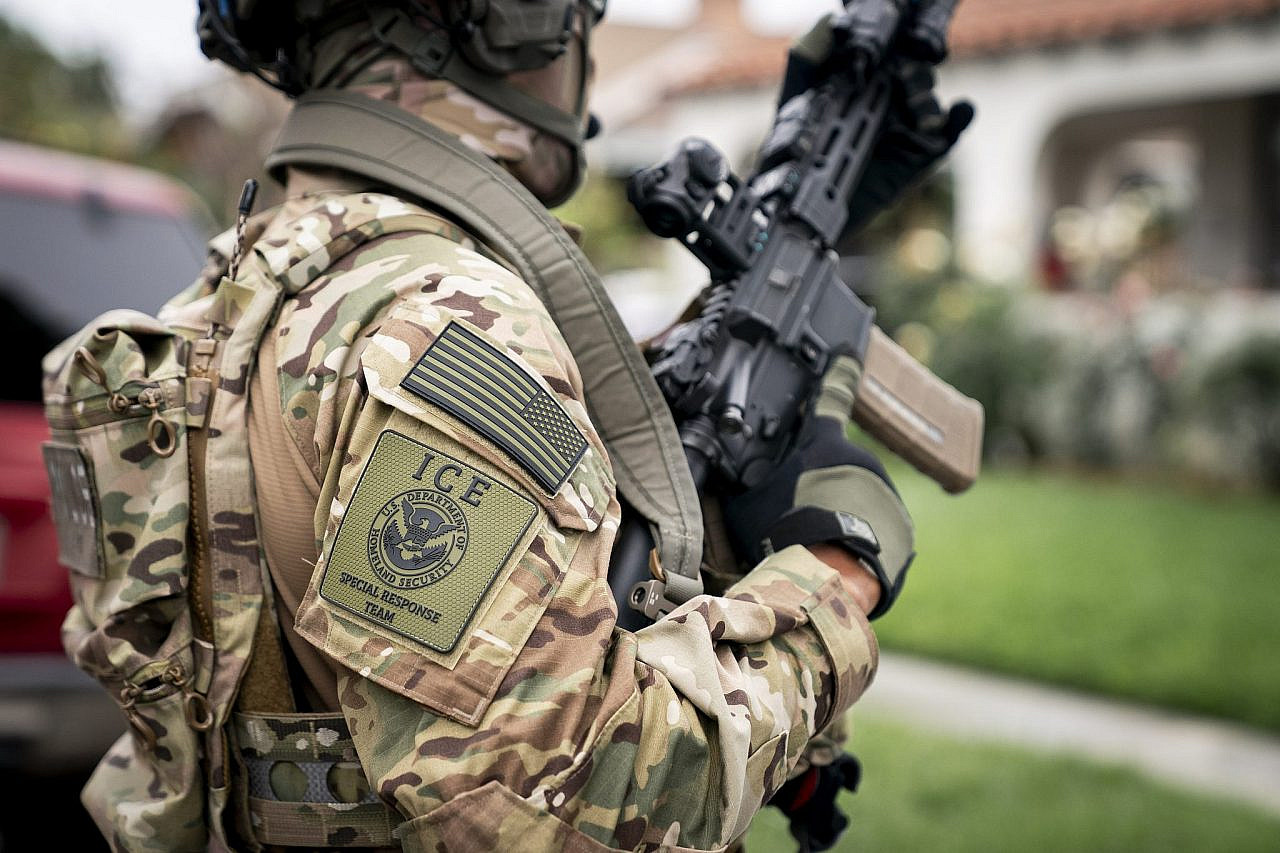
Jose Oliveres revealed in The Guardian that ICE has contracted with a security firm called MVM to hunt for undocumented people who entered the United States as unaccompanied children. “ICE says it wants to confirm the children’s location, school enrollment and overall wellness, including checking for signs of abuse or trafficking, according to the contracting document,” Oliveres reported.
If you’re thinking to yourself that MVM sounds familiar, perhaps you’re remembering its earlier incarnation from the War on Terror. Back then, it provided force protection for CIA and NSA officers in Iraq. In 2018, I reported on an earlier ICE contract with MVM, this one to ferry unaccompanied migrant children across the ICE network of warehoused-sized cages. They did so “using unmarked vehicles, commercial airlines, and makeshift detention centers,” according to a recent lawsuit Jose reports on. That lawsuit, which is ongoing, was brought by two Guatemalan fathers who allege MVM complicity in “torture, enforced disappearance and cruel, inhuman, and degrading treatment.”
If only there had been warning signs about the company’s willingness to do the dirty work of empire.
The MVM contract is one example among many—seriously, someone should write a book—of the heritage of the War on Terror manifesting within the operations of ICE, an institution that war literally created. Such examples are the subject of an excellent and insightful analysis published this morning by the Costs of War Project at Brown University. Written by Widener University Delaware Law School Professor Elizabeth Beavers, it provides a vivid, concise framework along five critical and listicle-ready areas for understanding that heritage.
“In its wide-ranging abuse of the law to support its anti-immigration agenda, the Trump administration is in part utilizing rhetoric and legal precedent borrowed from the ‘War on Terror,'” Beavers writes. She concludes: “Indisputably, administration officials are weaponizing the law in new and particularly indefensible ways to effectuate a widespread harassment and mass deportation campaign that is more akin to ethnic cleansing than routine immigration enforcement.”
I would put it slightly differently. “Routine immigration enforcement” always possessed the ethnic-cleansing gene in its DNA, though it hasn’t always been the dominant one. A hard-and-fast distinction between, say, ICE in 2026 and ICE in 2006—or between ICE and its predecessor, Immigration and Naturalization Services—risks whitewashing pre-9/11 immigration enforcement. Dan Denvir wrote an excellent book about the violence that enforcement entailed. I don’t think Beavers would disagree. And certainly, the War on Terror was the crucible for ICE’s emergence as a domestic secret police. I just want to retain some skepticism about what a phrase like “routine immigration enforcement” conceals.
Beavers’ report is out this morning. I don’t mind saying I find it validating, and not only because of all the kind things it says about my work in citation. Given how perfect its overlap is with the central preoccupations of this newsletter, the Costs of War Project gave FOREVER WARS an early look. You should read Beavers’ report on its own terms, but I’ll quickly run through her five areas of focus.
CONFLATION OF IMMIGRATION ENFORCEMENT AND COUNTERTERRORISM
Beyond simply the creation of ICE, Beavers identifies a foundation for what ICE eventually became in the FBI’s wide-ranging investigation of the 9/11 attacks, known as PENTTBOM. PENTTBOM was the umbrella and the justification for an immigration detention dragnet that resulted in the detention of at least 1200 people and likely many more. You’ll read in my forthcoming book about Majid Khan about how the FBI “investigated” the attack overseas, in places like Pakistan. Beavers insightfully notes that often the bureau didn’t rely on powers granted post-9/11, but rather on existing immigration law, which was eminently weaponizable.
“In the end,” Beavers writes, “the program did not result in the conviction of anyone actually involved in 9/11 or any other act of terrorism but instead resulted in hundreds of arrests and closed-door trials for minor, technical immigration law violations such as taking too few academic credits under a student visa.”
EXPANDED AND POLITICIZED ‘TERRORIST’ DESIGNATION LISTS
Beavers notes how poorly defined “terrorism” is as a concept within U.S. law, making it a useful authoritarian tool. To designate a group as a Foreign Terrorist Organization (FTO), an administration “must find that the group engages in ‘terrorist activity,’ with a definition that is wide-ranging enough to be regarded by at least one scholar as allowing ‘almost any group to be designated.'” Beavers focuses on the past 18 months’ steady expansion of Venezuelan gangs and the Venezuelan military itself as FTOs. The purpose has been to accustom U.S. audiences for dozens of murders of fishermen in the southern Caribbean, and then a regime-change operation. I’d only add that we should also understand this point in reference to Trump’s National Security Presidential Memo-7. A hunt for foreign connections to domestic left wing groups will unlock a whole lot of surveillance authorities, especially Section 702 of the Foreign Intelligence Surveillance Act, and they don’t have to be plausible connections.
Speaking of: I’ll be part of an online panel on Monday, May 11 at 7 p.m. talking about NSPM-7 that Defending Rights and Dissent is holding. Check their website for more information, since we’re unlikely to publish another edition before then—Sam has a reporting trip coming up—and I don’t have more details at present.
I also have to note that just yesterday, Treasury Secretary Scott Bessent actually said that China’s purchases of Iranian oil represent material support for terrorism.
DEPORTING PEOPLE AS TERRORISTS WITHOUT PROVING ACTUAL VIOLENT CONDUCT
This is the maturation phase of what’s called “material support for terrorism,” a dragnet category designed to grow like a spider’s web, expanding through threads of association. Before the 1990s, prosecuting someone for a connection to an act of terrorism required a defendant to affirmatively participate in or knowingly contribute to a specific act of violence. That’s ancient history. Only now, Beavers notes, the logic of the post-9/11 expansion of the material-support-for-terrorism now applies to deportations. Beavers highlights ICE accusing someone of links to MS-13 because they once gave up money to MS-13 gang members threatening them. She rightfully points to the ICE detentions of people who engaged in pro-Palestine speech, particularly that of Yaa’kub Ira Vijandre, who has spent nearly seven months in prison for his Instagram activity.
INDEFINITE DETENTION, TORTURE AND RENDITION OF NONCITIZENS
I’m grateful to Beavers for invoking post-9/11 renditions as a template for ICE deportations to countries, like South Sudan, far from migrants’ homes. To her, the entire unpunished legacy of CIA and military torture not only normalized such treatment but ensured it would expand to new cohorts. As you can read from yesterday’s devastating Washington Post report on 1,460 incidents of ICE force inside its cages—documents with the chilling name “Daily Detainee Assault Reports” and leaked by a whistleblower—or in my own reporting going back years, this is a proper context in which to understand the brutality of ICE.
Naturally, Beavers also traces the twin uses of Guantanamo for both counterterrorism and countermigration operations. As she notes, Camp 6 of the wartime prison has now been repurposed for “high-risk” migrants—a term that needs more journalistic attention. “As of the time of this writing, more than 700 migrants have been sent to and from Guantánamo in President Trump’s second term, detained there by ICE with support from the military,” she writes. That number is eye-opening. There have been 779 men detained as terrorists at Guantanamo in total; and now almost as many migrants.
Also, speaking of that Post report, it says without elaboration that ICE uses “restraint chairs.” That really needs urgent additional investigation. You will read in my forthcoming book about CIA black site/Guantanamo survivor Majid Khan about such a chair. The term itself is reminiscent of an infamous torture technique Israelis used on Palestinians that the Israeli Supreme Court banned in 1999.
ANTIDEMOCRATIC CONCENTRATION OF EXECUTIVE NATIONAL SECURITY POWERS
This one is bound to get the lawyers animated. It’s also one of the most underappreciated aspects of Constitutional collapse. Throughout the War on Terror, the courts, nine times out of ten, simply allow the executive branch to do as it likes, using the language and culture of judicial restraint to stop themselves from redressing abuses of power and usurpations of authority. Now the Trump administration can push even further—certainly after Trump v. United States—”without fear they will be meaningfully held accountable in court,” Beavers writes.
I wrote in REIGN OF TERROR that we should not let ourselves think we have seen the War on Terror’s final form. The use of the War on Terror for “a widespread harassment and mass deportation campaign… akin to ethnic cleansing” is a reminder that nothing short of its total abolition is a tolerable redress.

ZNetwork is funded solely through the generosity of its readers.
Donate




