
Fifty years have passed since the transition from dictatorship to democracy in Spain following the death of fascist Francisco Franco. However, the rise of parties based on the fascist legacy, described as “far-right,” in the country’s recent political developments has divided Spanish politics. The rise of the Vox party is considered a threat in Spain. The rise of fascist parties, considered far-right, is not limited to Spain but has become a phenomenon, particularly in the West.
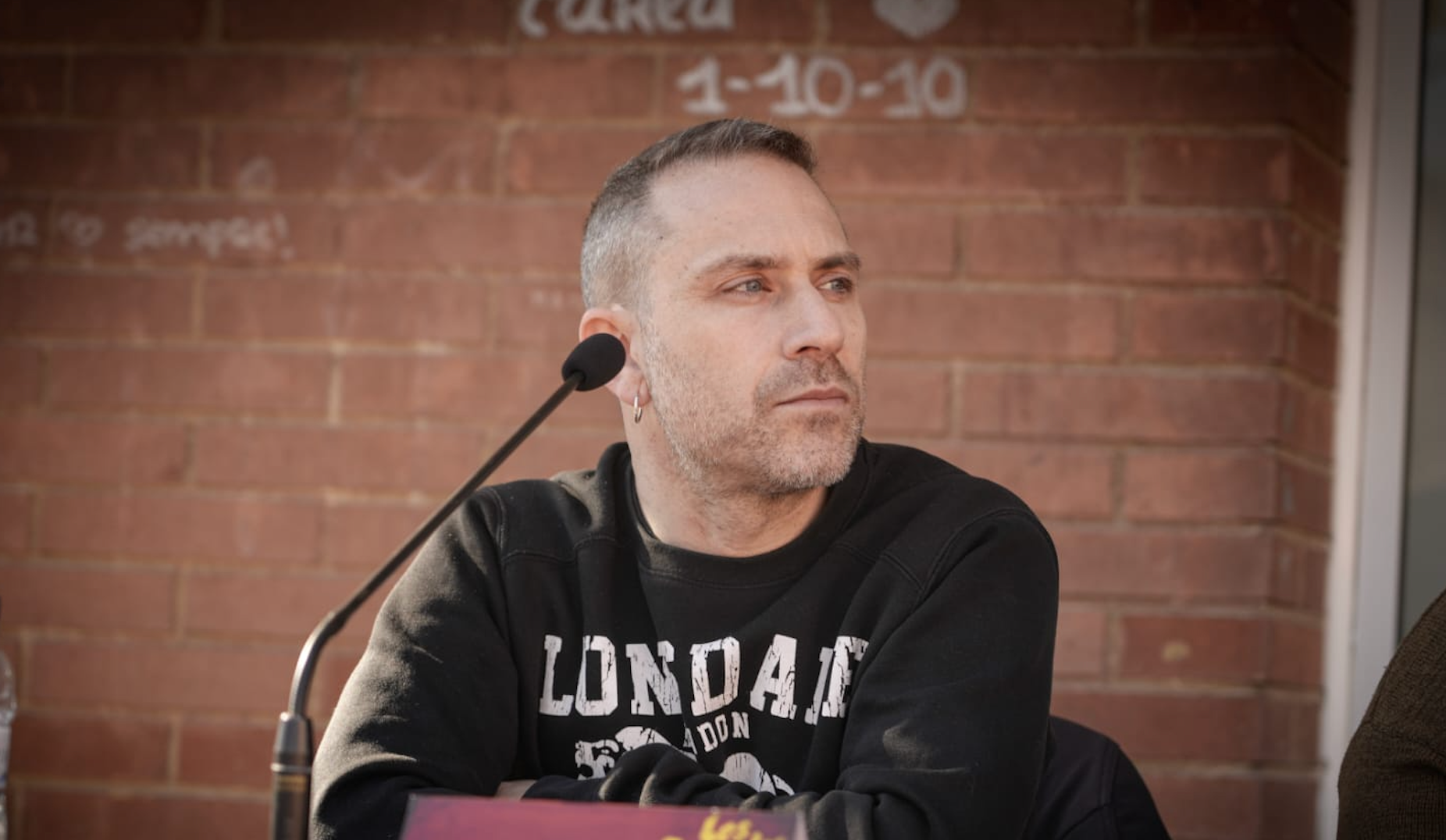
In light of his book Antifascistas, we talked with Valencian author Miquel Ramos about the rise of political parties with racist ideologies in Western Europe over the past decade, the extent to which the Spanish state has confronted the Franco era, and the declaration of groups fighting against fascism as enemies by Trump.
Miquel Ramos pointed out that fascist parties have taken on the role of capitalism’s watchdog against the possibility of social transformation. He noted that a reactionary international is taking shape worldwide today, stating, “Billionaires, big capitalists, businesspeople are financing parties, far-right actors, think tanks, and social media phenomena.”
Your book Antifascistas, published in Spanish, deals with anti-fascist groups and activities in Spain, a topic that is highly relevant in Spain and the West today. What motivated you to write it, and what is it about?
The book is a story of the different struggles against the far right in Spain from the 1990s to the present day. It is the result of many years of work documenting and writing about the far right, which I began as a teenager in the 1990s, when a series of murders by neo-Nazi groups took place. My generation had not lived through Franco’s dictatorship or the difficult years of transition, when armed fascist gangs were very active and enjoyed obvious collusion with the authorities and impunity. The police, judges and civil servants of democracy were the same as during the Franco regime. There was no purge. Although those years had passed, the official story was that fascism could not return, as it had been buried with Franco. However, our generation had to deal with the new neo-Nazi groups that emerged in the late 1980s, closely linked to football and skinhead fashion. The murder of a young anti-fascist from Valencia, Guillem Agulló, in 1993, had a profound effect on us because he was someone close to us, and from then on, I decided to become involved in anti-fascism and to investigate the far right. During those years, I began to compile information and build up a large archive that was very useful for the book, along with the accounts of various anti-fascist activists from different cities, whose interviews, together with newspaper reports from those years, form a fundamental part of my book.
20 November marks the 50th anniversary of the death of dictator Franco. Just recently, the social democratic government announced that symbols from the Franco era would be removed from public spaces. What exactly does that mean? How could this be tolerated for so long after the transition from Francoism to democracy in 1977?
The crimes of Francoism and the permanence of the regime’s structures have been taboo in Spain since the dictator’s death. Democratic reform ensured impunity for the murderers, torturers and architects of the regime, and under the excuse of supposed ‘reconciliation’, everything that had happened during the Civil War and the dictatorship was hidden. There were tens of thousands of disappeared people, but there was no interest in investigating their whereabouts. It was not until 2005 that the first Historical Memory Law was promoted by the government of José Luís Rodríguez Zapatero, and the relatives of the disappeared began to demand the truth, justice and reparation for the victims. Today, many people are still missing, despite investigations and exhumations carried out throughout the country, thanks to relatives and memory associations. Removing the symbols of the dictatorship is important, but there are other even more urgent issues that are not being addressed.
The Spanish media partly classify the VOX party as right-wing extremist. It advocates centralism, rejects the autonomy rights of regions such as the Basque Country and Catalonia, and stands for an economically liberal agenda. It also criticises Islam and migration in hostile tones and rejects multiculturalism, feminism, and women’s rights. Spain is familiar with such policies from the long-lasting Franco dictatorship (1936 to 1977). Was there no lesson to be learned from this, given that the party currently polls at over 15%?
Sociological Francoism never disappeared. The Popular Party was able to unite the entire right wing within its ranks for many years, including the fascists, but it suffered a split in 2013 that activated that sector in another party, Vox. Before that, there were other very clearly Francoist or even neo-Nazi parties, but they were very marginal and never achieved great success. Vox, however, arrives at a time when the rise of the far right is already a global phenomenon, and where it also coincides with political disaffection with the left, which had been boosted electorally after the 2018 crisis, and a turbulent situation in Catalonia, with the 2017 independence referendum. It is then that the party manages to enter the institutions. Furthermore, in Spain, the right wing has always been revisionist and denied the crimes of Francoism, maintaining to this day a sugar-coated version of the Franco period. This, coupled with the lack of anti-fascist education and the promotion of historical amnesia under the excuse of ‘not reopening wounds’ and the global context, has allowed for the normalisation of a far-right party in Spain.
In Europe, the far right is on the rise. In the Netherlands, Germany, France, Austria, and Italy, they are even in government. What is missing that allows the far right, with its fascist ideology, to grow stronger and stronger?
The triumph of the far right in various parts of the world can be explained by different factors. There is disaffection with traditional parties because they have failed to respond to the structural problems of capitalism, and this is exploited by the far right to seek scapegoats, with migrants being the main target. Islamophobia is also fundamental in explaining this supremacist identity retreat championed by the far right but which contaminates beyond its spectrum. The fears and prejudices of the Western population are accentuated by crises. And today, Islamophobia is using the same inputs that anti-Semitism used previously. Advances in rights, such as feminism or the LGTBIQ+ struggle, are also being met with a major backlash, well funded by big right-wing businessmen and religious lobbies to wage the cultural battle against supposed progressive hegemony. There is a huge financial investment in this battle and very powerful backers, as the far right poses no threat to capitalism or the elites. On the contrary, they are its life insurance, its attack dog against any revolutionary temptation. We must look beyond parties and rulers to understand that the reactionary international is much larger, and this is where big capital, billionaires and businessmen come in, who finance these parties and the campaigns of all far-right actors, from think tanks to social media influencers. Or directly, using social media for this battle, as is the case with Elon Musk and X, another tool in the cultural battle of the new fascism, which also makes obscene and repeated use of disinformation and fake news so that, as Steve Bannon said, ‘everything is flooded with shit’, so that no one believes in anything anymore.
Historically, anti-fascism in Spain has always been supported by the left—from the civil war to the present day. Basques, Catalans, and Galicians have helped shape anti-fascist traditions. If you were to whistle dance after Trump, this tradition would have to be criminalised and even fought against. What do you think about this, and how does it influence anti-fascism? How can anti-fascism be organised in a more conscious and influential way?
Anti-fascism has been criminalised for many years in Spain, placing it on the margins of politics, as something marginal and unnecessary, as there was no far-right party with institutional representation until 2018. However, the problem was there, but very few people, mainly the radical left, paid attention to it and warned that the day would come when they would return. Most people looked the other way. Today, concern about the rise of the far-right is evident in much of society, despite having accepted it as part of the democratic menu. Previous anti-fascist experiences can help us understand the phenomenon and recognise previous struggles, but today we are facing a new scenario that requires greater alliances, more commitment and, above all, a great deal of knowledge and determination to stop the reactionary infection on all fronts.
Trump plays on the cliché of marginal anti-fascism, going even further by criminalising it and accusing it of terrorism, because he has several neo-Nazis and fascists advising him. They are obsessed with neutralising anti-fascist activism because they know it has experience and social muscle, and that it brings together many different causes: feminism, anti-racism, human rights… That is why it is important for the far right to defeat it. But Trump’s entire argument is based on conjecture, as there is no global organisation called ‘Antifa’, but rather decentralised and highly diverse autonomous groups. However, the aim of this campaign of criminalisation is not so much to destroy them as to persuade all the movements that form part of anti-fascism not to raise their voices against the curtailment of rights and freedoms that the far right is seeking on its path towards an authoritarian state.
This article was originally published in Turkish for Yeni Özgür Politika and translated for publication in English for ANS.
ZNetwork is funded solely through the generosity of its readers.
Donate