
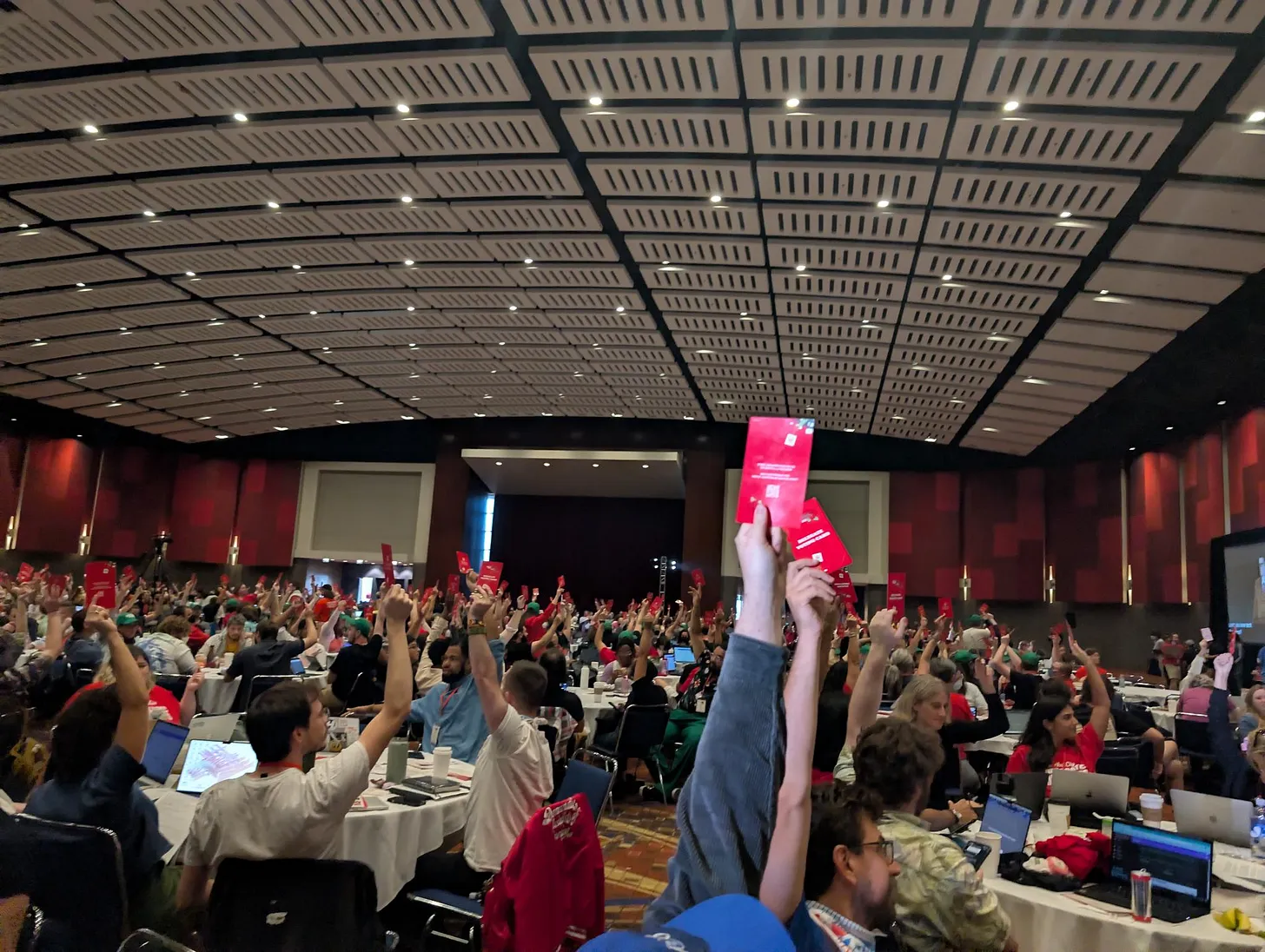
The Democratic Socialists of America (DSA) entered its 2025 National Convention at a crossroads: the largest socialist organization in the United States in generations, gathering in the midst of a rising fascist threat and a diffuse but determined wave of multiracial resistance. With nearly 1,300 delegates in attendance, the convention could have been a decisive moment to chart how DSA might “meet the moment”—to orient its chapters, campaigns, and national leadership toward building mass, working-class based power in defense of democracy and for socialism. Instead, what unfolded revealed both the organization’s enormous potential—its energy and enthusiasm, its attraction to new generations of revolutionary activists, its broad range of campaigns—as well as its deep limitations: a culture of performative factional combat, a national leadership paralyzed by electoral abstentionism and “left” sectarianism, and a gathering that too often turned inward rather than rooting itself in DSA’s own mass-based practical achievements and the urgent tasks before us.
This article reflects on that experience, drawing from both the convention floor and the lessons of earlier socialist movements, to argue that DSA now faces a stark choice: it can turn outward, grounding itself in wide-ranging mass struggle and broad coalition-building, or it can continue down the path of sectarianism and paralysis—squandering a historic opportunity to meet the political moment.
Having only been a DSA member for around 18 months, this was my first Convention; I attended not as a delegate but an observer, and I paid attention. After 40-odd years of union conventions, this was different (and not only in the politics): less staged, more youthful, more diverse in gender (if not in race), better parties, and overall more exciting. On the other hand, it was less well-organized and less well-run, largely due to an internal-facing agenda, an absence of focus on practice, an inconsistent and sometimes sectarian use of Robert’s Rules, and a complete failure of voting tech. And it was even more factional, which is saying something.
Bernie’s Garden
Today’s DSA is the house that Bernie built. It was his 2016 campaign—his open democratic socialism, his populist working-class economic program, his willingness to skewer neoliberal Democrats and Republicans alike, and his ability to win—which captured the imagination of a new generation of socialist-minded activists (some reformist, some revolutionary) and laid a new foundation in place of the somewhat decrepit Michael Harrington one. Today the house has many rooms (with a front door likely barred to Bernie), and the garden soil has proved incredibly fertile to the growth of innumerable factions, called “caucuses”—each of which, and each differently, has deep roots in U.S. and international revolutionary traditions.
In an organization dominated by factions, I of course have my own favorites. I am a lightly active member of the Socialist Majority caucus, and a sometimes fan of the Groundwork caucus (especially when they can rein in their subjectivism; see below and in the Appendix). Together they represent the self-identified “mass politics” caucuses: factions which emphasize creative outward-facing mass organizing and contestation for power on all terrains of class struggle—from the workplace to the community to the electoral. Where DSA has had impressive success building independent political organization, it is these caucuses—especially the Socialist Majority caucus—which have been largely responsible.
On the other end of the spectrum are the more “vanguardist” caucuses (they would likely say “revolutionary”) such as Red Star, Marxist Unity Group, the Communist Caucus, and Reform and Revolution. In general, they seek (in practice if not always in theory) to turn DSA from a very broad mass socialist organization with a low level of unity into a narrower vanguard party organization with a much higher and more restrictive level of unity. Some have sophisticated ideas about how that might happen and what it might achieve, while others seem more interested in posturing. On this end of the spectrum, but with somewhat more anarchist-inspired politics is the newer and smaller Springs of Revolution, as well as the venerable and annoying Libertarian Socialist Caucus, which draws explicitly from anarchist roots.
The main caucus between these two poles is Bread and Roses, which draws its inspiration from the very experienced and long-lived (since 1986) Solidarity socialist organization, from Kim Moody’s “rank and file strategy,” and from the ever-brilliant Labor Notes project. Bread and Roses’ greatest strength is its dedication to rank and file workplace organizing, including directing young DSA members with little working-class experience into lifetime working-class jobs and associated organizing projects. Its greatest weaknesses are its syndicalist fixation on a “rank and file” tactic which does not amount to a true strategy, and its ambivalence towards class struggle on the electoral terrain. (Also between the two caucus poles, but drawing from very different ideological traditions than Bread and Roses, can be found the newer and smaller Emerge caucus, largely based in NYC and still defining itself.)
I have heard it said many times that 80% of DSA members are inactive (some caucuses dismissively call them “paper members”), which if true suggests that the nearly 1300 convention delegates were there representing at most 15-20,000 active members. I’ve also heard it said that only around 10 to15% of those active members are actually caucused. But the caucuses, representing the most ideologically aligned and internally organized members, clearly dominated the delegate elections and the Convention itself. My sense is that only around 20% of the delegates were ideologically independent—that is, uncaucused and relatively unaligned. As it turned out, the spontaneous tendency among the majority of that ideological center was to lean towards the ultraleft.
Meeting the Moment
I grew up in the so-called “New Communist Movement” of +the 1970s and ‘80s. The numbers in organizations large and small were similar to the number of active DSA members. Having come out of the mass movements of the ‘60s (mainly the anti-war movement, the civil rights and Black liberation movements as well as the Chicano, Puerto Rican, Asian-American and Native American national liberation movements, the women’s movement, and a very embryonic gay liberation movement), born in the shadow of a splintered SDS and a Communist Party which seemed to have capitulated to both U.S. capital and Soviet imperialism, and witness to the murders of Civil Rights activists and revolutionary leaders such as Fred Hampton, our experience was very different from that of today’s young revolutionary socialists raised in the shadow of neoliberalism. While the racial/national composition of our movement was quite different from today’s DSA, and the factory and other industrial employment opportunities were much greater for aspiring revolutionaries, our social base was quite similar to that of DSA: petit-bourgeois middle strata, often fresh out of college. And our movement, despite its many impressive achievements in mass working-class struggles and organization-building, was ultimately wrecked by a deep-seated and wide-ranging ultraleftism. That experience cannot help but color my impressions of the DSA Convention.
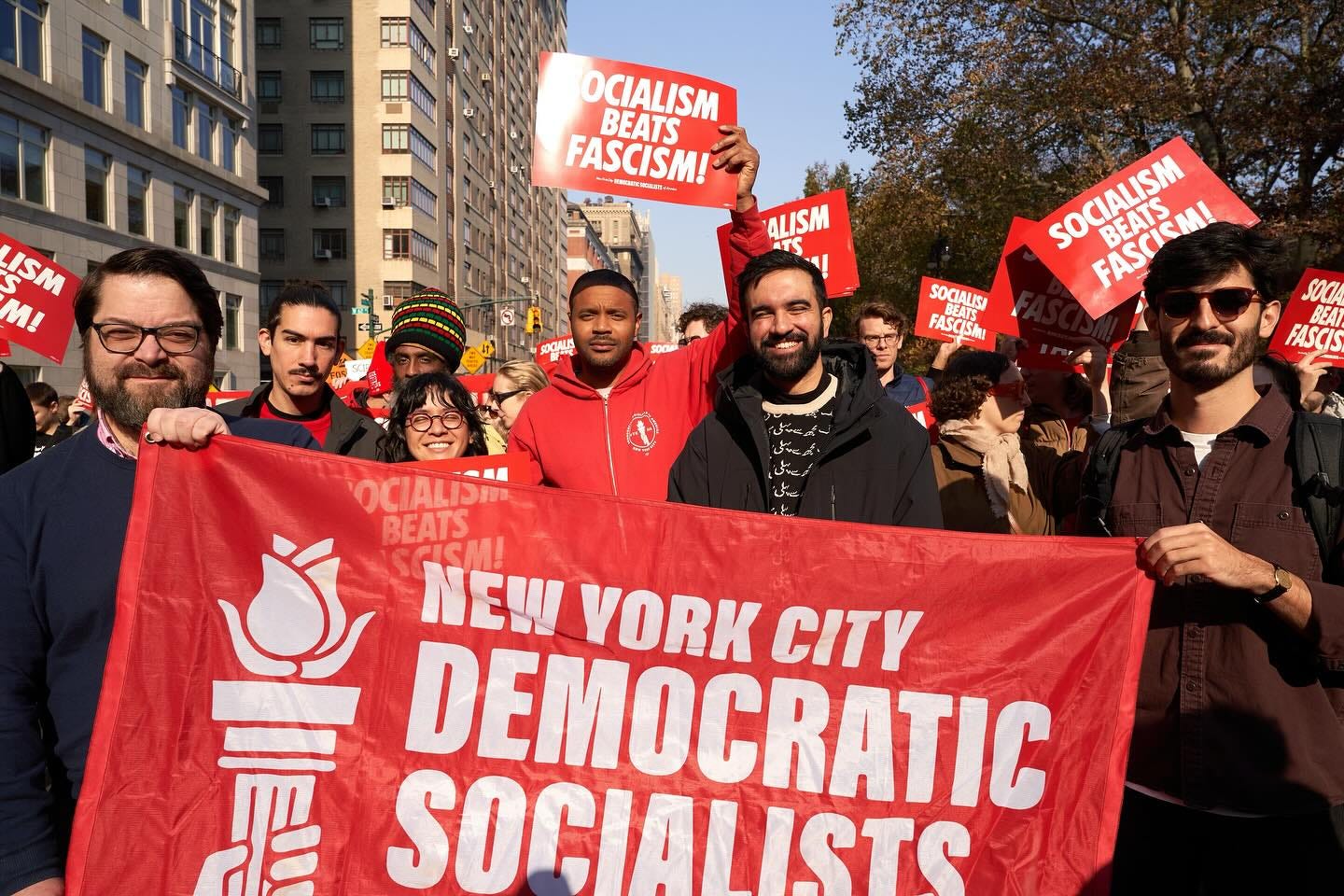
At the Convention (and in public reports since), there was much talk of “meeting the moment,” but what is “the moment”? Our “moment” today is mainly characterized by a minority but still mass-based federally led and enforced drive towards fascist autocracy; a broad, diffuse and largely uncoordinated resistance front; a labor movement and movements of oppressed nationalities all struggling to rise to the challenge; and an energetic but disunited socialist left lacking deep mass roots. And we don’t have much time: this particular moment will last only around three years, after which conditions will either improve somewhat or become much, much worse, worse in ways many of us have never experienced.
At the level of national leadership, DSA clearly failed to meet the moment throughout 2024 and up to the present date, mainly because it was afflicted with a divided and sometimes paralyzed National Political Committee with a slight majority of electoral abstentionists. One of the few national successes of DSA during 2024 was in fact the “Uncommitted” campaign, largely led by the so-called “mass politics” factions, and later denounced as a failure by sectarian abstentionists (some recently returned to leadership positions), despite its enormous positive effects on popular opinion. In 2025, the one success with national significance has been the astounding victory of Zohran Mamdani’s brilliantly-run campaign—also largely initiated and led by the “mass politics” factions. During this period overall, it seems that only strong chapters, operating independently of national guidance and encouragement, and engaged in dedicated and creative mass organizing, were able to “meet the moment.”
So what was ultimately at stake in DSA’s 2025 Convention? What does “meeting the moment” mean, not in general, but today, and not for just anyone, but for an organization as large and potentially influential as DSA? To my mind, it means turning away from sometimes overly comfortable left spaces and towards working-class communities and workplaces; it means developing campaigns on every available terrain of struggle which broaden and deepen the front against fascist autocracy while centering fights against the ethnic cleansing of immigrants, against the wiping out of the gains of the Civil Rights movement and Black Lives Matter upsurge, against the attacks on trans people, and against the genocide in Palestine; it means working closely with all left/progressive organizations and activists who are committed to developing left leadership of the front independent of establishment Democrats; and it means working closely with all socialists committed to these efforts in order to help coordinate the resistance and turn its eyes towards the future.
How did the Convention measure up to these (admittedly lofty) standards? Some reports internal to DSA show that there is an irresistible desire to look on the bright side while avoiding any negative conclusions, especially where the fate of the authors’ particular caucus is at stake. See, for example, the 8/26/25 Groundwork caucus message to supporters, entitled “🪴🌟 We Won at National Convention!” No, they didn’t: they both won and lost, like most caucuses. You’d think their supporters could be trusted with a more objective analysis; I know I can. (And by “objective,” I don’t mean “non-partisan”; after all, Marxism is both objective and partisan.) I think it’s important to acknowledge that, while mobilizing an enormous amount of enthusiasm for revolutionary politics and passing a few excellent resolutions, there were some glaring weaknesses.
Thorns
The Convention’s most glaring weaknesses can be summed up in three failures: a failure to ground itself in practice, a failure to center the fight against fascism, and a failure to build unity against ultraleft tendencies in the organization.
First, an extremely important defect of the Convention was its failure to base the proceedings in the organization’s practical successes of the previous two years; any unionist could have told the Convention Committee that. Most of the public commentary on the Convention unsurprisingly emphasizes the great significance of the Mamdani victory just prior to the meeting; what few if any mention is that there was almost no actual discussion of that campaign during the proceedings—at one point, one of the Convention chairs even warned against referring to the Mamdani campaign as being “off topic.” Why didn’t the Convention lead with video and panel discussions of practical efforts such as the Uncommitted and Mamdani campaigns—the most high-profile DSA efforts of the past two years? When there was finally a panel discussion of the successes and challenges of the Mamdani campaign—and a fascinating one, populated by organizers who really knew what they were talking about—why was it scheduled for Sunday at 9 am, when at most 2% of the delegates were in attendance?

Second, overall there was very little attention to—or even mention of—the Trump drive towards autocracy. Of course there were references here and there, but the Convention in no way centered this obvious pressing danger to the left, the working class, and the people’s movements. The one resolution which most clearly centered this danger and addressed it strategically (R24: To Defeat Trump, Turn Toward the Masses), authored by Socialist Majority caucus members from New Orleans, New York, and Boston, offered this cogent summary:
Our primary task at this moment is to defeat the far right. To do this, this resolution proposes taking a nonsectarian approach to uniting with groups that are mobilizing working people into action to protect lives and democratic rights. Even as we work together, we will contest for socialist leadership of the anti-fascist front’s strategy. DSA will demonstrate that socialist politics and organization are the best path forward for striking blows against the capitalist class and the far right.
Yet despite having received a 59.29% approval rating in the pre-convention delegate survey, this resolution, which came closer to “meeting the moment” than any of the other 100-odd proposals, was placed well down on the “overflow agenda,” ensuring that it would never reach the Convention floor. Well above it on the regular agenda were numerous internally focused items, including R08: Democratic Discipline: A Uniform Process for Electoral Censure Across DSA (48.40% approval rating) and R47: Resolution to Censure U.S. Congresswoman Alexandria Ocasio-Cortez (30.33% approval rating). Sadly, I’m pretty sure the reason is that there were those on the Convention Committee who feared that giving greater attention to this stunning organizing victory would provide sectarian advantage to the ”mass politics” factions which had the most to do with its success. And Instead of orienting outward to the urgent political struggles that define this moment, the Convention doubled down on inward-facing disputes, leaving its resolutions disconnected from the realities of mass organizing.
Underlying both of these missteps was a deep-seated ultra-leftism, which misunderstood the strategic tasks of U.S. socialists today while encouraging performative ideological combat over political debate rooted in both the perils of this moment and the DSA’s main practical achievements of the past two years.
One could also ask why there was so little attention to practice in general at the Convention—summations of actual work, grounded debates around practical experience and choices, organizing priorities and so on—and I can’t do better than paraphrase a longtime unionist friend who also attended the Convention and observed that having been attracted to the idea of socialism right out of school, rather than having been driven to it through practical organizing or life experience, a fair number of DSA delegates seemed more comfortable with performative internal combat than with the deep and dirty work of the class struggle. Shades of SDS….
Well, There’s Always the NPC Election…
It’s not hard to understand why many in DSA suggest that what really matters at Convention is the balance of power on the new National Political Committee. There’s no way even a united NPC could take the many conflicting resolutions (see the Appendix to this article for a discussion of some of these) and fashion a unified, consistent program–and with a divided leadership, it’s every chapter for itself.
Unfortunately, the new NPC, despite some improvements, will likely continue the confusion and paralysis of the previous one. It’s important to note that, while some ultraleft factions took some hits in the election, the leading vote-getter in the three-way election of co-chairs is someone who, in a rehash of the discredited but not-dead-yet 1928 Comintern “social-fascism” thesis, stated in August of 2024 that “…the primary options during this election year are Neotrad Fascism vs. Woke Fascism….” And despite having just a few years earlier been an Elizabeth Warren supporter, in an NPC Steering Committee call she is reported to have accused Zohran Mamdani of “sheepdogging” voters into the Democratic Party—much like the Green Party had called Bernie Sanders “a sheep dog for the Democrats,” reducing millions of working-class voters to “sheep.” Has this co-chair paid a price for this? Has she been asked how she, DSA members, and the masses generally are enjoying “Neotrad Fascism” today? Or whether the stunning achievements of NYC DSA members in the Mamdani campaign were all a big reformist misdirection? It doesn’t seem so, since the spontaneous drift of Convention delegates was so much to the ultraleft. Yet if anything, this NPC co-chair is in danger of “sheepdogging” DSA members into irrelevance.
For a deeper understanding of some of these underlying tendencies, I recommend reading with today’s eyes this post-election statement from the Red Star caucus, which captures well the “ultra” line on the 2024 election.
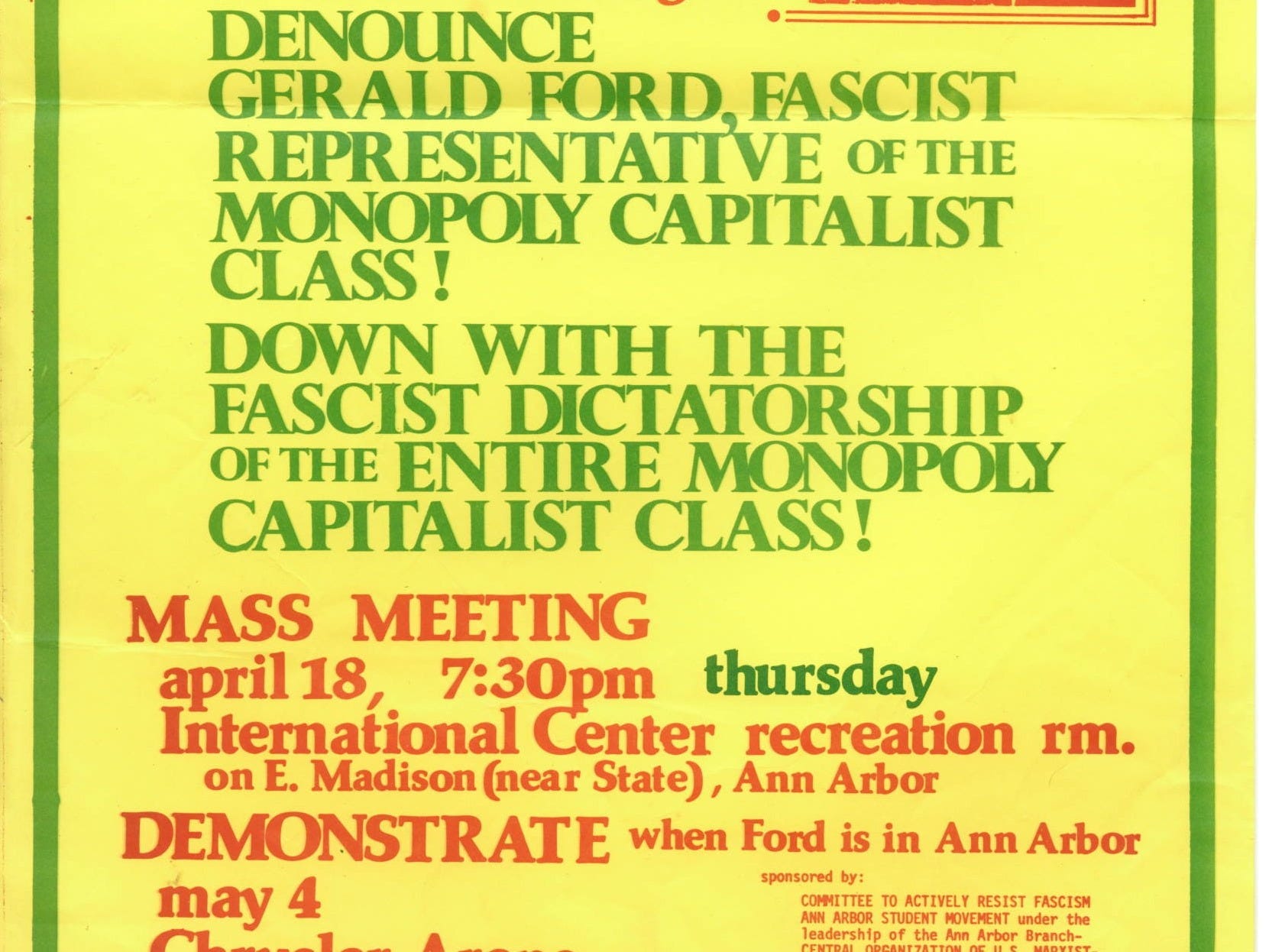
Old as I am, I can’t help but think of the many Marxist-Leninist organizations of the mid ’70s and early ‘80s that described left liberals and social-democrats as “ushering in” fascism–as if they stood at the political theater door, murmuring “Right this way, sir.” Workers Viewpoint, for example (which later became the Communist Workers Party of the infamous Greensboro Massacre), described Leon Davis, founder of 1199, this way: “Leon Davis and the 1199 misleaders help to usher in fascism in many other ways. Their support for the Equal Rights Amendment (ERA) shows this clearly” (July 1976). Aside from misunderstanding both Carter and Reagan as fronts for fascism, and aside from misunderstanding the Democratic Party as just a paper mâché cover for the Right, and aside from updating the wrongheaded Comintern “social-fascism” thesis, there was a hidden assumption common to nearly all ultraleft tendencies: that the masses are a caged beast waiting to spontaneously explode, if only they can be released (by a “hammer” perhaps) from their captors.
Sometimes class struggle works like that, but not generally, and not here and now. Leading it actually requires an understanding of complex contradictions, a ton of concrete analysis of concrete conditions, a ton of political education, and a ton of daily mass organizing on generally hostile terrain. There’s a big difference between Marxism “fusing” with the workers movement, and Marxism “releasing” the workers movement.
Red Star and similar tendencies are part of a 150-year-long tradition of dead-end ultraleftism, and as they defend and develop their line they cannot help but draw from the deep well of that semi-Marxist, semi-anarchist deviation. And if allowed to dominate DSA, they will certainly destroy it.
Living With Ultraleftism
The fact that DSA’s national leadership (despite valiant efforts of the minority) made itself irrelevant or worse in last year’s federal election, which brought fascist autocracy as close to consolidation as it is, that it has made itself largely irrelevant in the immediate aftermath, and that a national co-chair could publicly revive the disastrous “social fascism” line of the 1928 Comintern and be exalted at the next Convention–in the very teeth of autocracy–indicates what a wellspring exists in DSA today not of revolution (as one “left” caucus would have it), but of ultraleftism. Unfortunately, in the petri dish of DSA’s predominant social base (downwardly mobile college-educated activists from middle strata backgrounds), mixed with the repression people of color (immigrants and citizens alike) are already facing and the Left as a whole will soon experience, those ultraleft tendencies are likely to grow.
Key to working with these tendencies—which means uniting with them where possible, and neutralizing their influence where they threaten to undermine our mass movements and organizations—are:
- Learning more about what ultraleftism is all about, as a longstanding and destructive deviation from Marxist theory and practice;
- At the same time, focusing outward, turning “toward the masses” (as Socialist Majority put it in the resolution which was kept from the floor by the ultras), among whom comrades new to socialism and attracted to ultraleftism will often learn, develop some humility, deepen their understanding of the working class, and become socialist organizers whose revolutionary influence will grow; and
- Use the truly impressive organizing experience of the outward-facing tendencies and chapters of DSA to help orient, solidify and grow smaller chapters which may not have figured out yet how to escape the hothouse atmosphere of internal ultraleft politics and transition to a more mass politics and rank and file focus.
The risk is that what should be a minor internal contradiction as compared with that between socialists and the establishment Democrats, if unaddressed, will grow to prevent DSA from ever meeting the moment. Chapters investing in deep mass organizing (rather than posturing) will have to do more than out-organize the ultras; as that contradiction sharpens, they will have to learn to recognize, expose, isolate, and neutralize them in order to save DSA.
My sense of the result of this DSA Convention is that DSA as a national organization with enormous potential will be hamstrung by deep ideological divisions concerning the main tasks of today’s socialist left. Simply put, the new National Political Committee will be incapable of meeting the moment, no matter how much triangulation and compromise occurs within its ranks.
The good news, though, is that the NPC will be equally incapable of preventing strong chapters from rising to meet the moment. Therefore, investing in building those chapters while essentially ignoring a paralyzed leadership will be critical to broadening the antifascist front and building strategic, mass-based (and reality-based!) socialist organization within it.
Those chapters can ramp up the struggle for Palestinian liberation from Zionist occupation and genocide while broadening it to include everyone who is willing to oppose the genocide, whatever their position on the nature of the Zionist state. They can focus outward on mass struggles which challenge the fascists’ attempts to restore and restructure white privilege, whether that’s centering direct struggles against ICE, building up labor’s resistance to mass deportation, organizing against the DC, Baltimore and Chicago occupations, defending and embracing those who tell the truth about U.S. history, or running candidates who can skillfully combine a populist economic message with a clear and fearless attack on the racist mortar which cements the fascist coalition. They can build popular movements to defend trans rights and bodily autonomy, and help grow and lead the widespread mass struggle for women’s reproductive rights. They can build independent political organization in blue, purple and red states, fielding and supporting left candidates (and socialists wherever possible) who are serious about mass-based progressive governing power. They can help build union locals which embrace the rightful role of labor in the broad front against fascism. And they can build socialist organization which meets the moment.
Appendix: What Did DSA Resolve To Do?
It’s reasonable to ask whether the many Convention resolutions passed mean anything in practice, and to suggest that the only thing which actually matters is the balance of power on the National Political Committee. But the resolutions have a lot to teach us about tendencies in DSA, and when adopted they can also be used on an ad hoc basis either to legitimize and guide chapter work, or conversely, to punish chapters who balk at carrying out dumb directives. With an eye on “meeting the moment,” it’s worth taking a look at some strengths and weaknesses of some resolutions which attempted to address our strategic moment and which actually passed.
A number of resolutions which give form and content to DSA’s mixed commitment to fighting the fascist threat passed as part of the large “Consent Agenda,” which is to say with little or no discussion. Let’s first take a look at some of those.
(CA)R05 “Fight Fascism, Build Socialism” (authored mainly by the Groundwork caucus)
Here there is specific mention of Trump and the fascist threat—all to the good:
DSA can be the weapon against fascism that millions are desperately searching for. This resolution turns our ad hoc Trump response into a focused national campaign, with resources and a clear mission needed to fight the right.
Note the word “the” in the first sentence; it does a lot of work there. Imagine if instead of “the” it said “a”, injecting a note of objectivity (and even humility). (This is where some DSA leaders will say out of one side of their mouth “we are the largest socialist organization in 100 years,” and out of the other, depending on what’s being debated, “80% of our members are paper members!”) In the 1970s and ‘80s, every single self-declared “party of a new type” asserted that they were THE weapon that millions were desperately searching for, only to end up like little commie Ozymandiases.
While there is great stuff in the resolution about organizing resistance at all levels and building the “Left” to do so, it is immediately undermined by a narrow, sectarian understanding of who the “Left” is:
Defeating the far right requires more than just fighting back—it requires building the Left. DSA must use this moment to massively grow our ranks, train new leaders, and build organizational infrastructure capable of sustaining a long-term struggle for socialism.
Socialists cannot rely primarily on existing institutions to resist authoritarianism. NGOs, Democratic-aligned advocacy groups, and progressive organizations have consistently failed to provide strong opposition to the right. Defeating the far right can only come from an organized majority of the working class. DSA must fill this vacuum by leading a truly independent, working class fightback.
Of course we can’t “rely primarily on existing institutions to resist authoritarianism.” And certainly some—even many—NGOS, Democratic-aligned advocacy groups, and progressive organizations have “failed to provide strong opposition to the right”—just as DSA itself has in many cases, especially at the national level. What’s missing here is any recognition of those sections of the left/progressive bloc which are attempting—and in some cases succeeding (Indivisible, anyone?)—to provide strong opposition to the right. And this reveals a fundamental misunderstanding of the nature and breadth of the front actually necessary to defeat—or at least push back—fascist autocracy over these next three years. And with a misunderstanding of the breadth of the front, comes pure fantasy about DSA filling “this vacuum” by “leading” “an organized majority of the working class” in an “independent, working class fightback.” Simply put, that’s not happening any time soon, so how can we actually fight the right today and tomorrow?
In that regard, this resolution provides some excellent direction for DSA chapters in Blue areas:
Despite the extreme threat posed by the Trump administration and the far right, the Democratic Party remains a primary political opponent of the working class in the Democratic controlled states, cities, and districts where DSA is often strongest. Fighting the far right means resisting capitulation by Democratic leadership in these areas, winning back working class people (particularly young people and people of color) in Democratic strongholds who have flipped to Trump or fallen out of participating in politics entirely, and ultimately winning local level socialist governance in our strongest areas.
Unfortunately, it provides virtually no direction to DSA chapters in purple and red areas. Are we to assume that socialist power-building tactics are identical regardless of the nature of the terrain on which we fight? That’s dogmatism, not Marxism.
(CA)R18 “Seize the Moment! Defeat Corporate Democrats and Elect More Socialists”
This resolution, authored by three NY Socialist Majority caucus leaders (two of whom were elected to the new NPC), presents a serious and detailed outline for DSA’s independent electoral efforts over the next three years, including both programmatic and organizational decrees. What’s striking is how much of what it advocates is, practically speaking, anathema to large sections of DSA’s ultraleft. Its passage commits DSA
to seizing our unique moment by organizing a massive electoral push in the 2026 midterms—in Congress, in state legislatures, in city councils, in school boards, and everywhere in-between—to speak to the frustration and rage of the American working class, to beat back the far right, and to flood the zone with principled democratic socialists running strong campaigns in competitive elections.
Further, having passed this at the Convention, DSA must now “aim to use electoral campaigns of this nature both to bring together a broad anti-Trumpist front with labor unions and other coalition groups, as well as contest for leadership in any such front”—a different view from that of the “Fight Fascism, Build Socialism” resolution discussed above.
And astonishingly, this resolution’s endorsement by the Convention apparently settles the long-debated issue of the Democratic Party ballot line, since we now have a clear statement from DSA’s highest body: “…utilizing the Democratic ballot line is the most effective strategy for building a socialist party in the United States, as independent and third-party campaigns continue to be generally unviable….” This is what makes me wonder who actually reads what’s in the Consent Agenda before voting on it.
(CA)R19: From Palestine to Mexico: Fighting Fascist Attacks on Immigrants
Another excellent resolution, also authored by Socialist Majority caucus leaders, links Palestine and Mexico, emphasizes their connections to the U.S.’s characteristic white-supremacist form of capitalist rule and the connection in turn of white supremacy to U.S. imperialism, centers the fight against mass deportations in our efforts to defeat the fascists, calls for “coalitional efforts,” ”local coalition networks,” “projects that aim to build solidarity among working-class people across citizenship, race, and nationality,” and asserts that “democratic socialists can and should unite and engage in coalitional efforts that seek to confront the rise of authoritarianism.” It instructs the NPC to “identify opportunities to join forces with other organizations to support and initiate coordinated national actions wherever possible.” In its summary, the resolution states that “the only way to meet the current political moment is solidarity and a recommitment to building class-based, mass politics.” If only all delegates who voted for this were willing to apply its recommendations to all areas of DSA’s work—including Palestine solidarity work, electoral work, and labor work.
(CA)R26: Fight Fascist State Repression & ICE
Part of the same Consent Agenda package, this resolution can be interpreted as a “left” response to the “Palestine to Mexico” resolution above. Its summary reads:
Escalating fascist repression by the Trump Administration is the most urgent existential threat to the socialist movement in the current political moment. Recent years have shown that mass abolitionist organizing has been a key point of activation within the working class. In order for DSA to effectively lead in the fight against fascism, this resolution presents three strategic points: a national ‘Abolish ICE’ campaign; local abolitionist organizing; and strengthening organizational security.
For understandable reasons, it centers “fascist repression” in its view of the Trump administration and cites that specifically as “the most urgent existential threat to the socialist movement in the current political moment.“ While both resolutions (19 and 26) demand the abolition of ICE, the first places that demand within a broader context of a widespread campaign against mass deportation and anti-immigrant hysteria, centering the immigrant population, whereas the second centers the abolitionist demand and connects it to other abolitionist movements and the organizational security of the socialist movement. “Fight Fascist State Repression” calls for “Fighting for ‘non-reformist’ reforms that challenge the core function of the state, such as ending cash bail, increasing court transparency, cutting police budgets, and eliminating mandatory minimums,” and its electoral orientation comes down to “Recruiting and running the electoral campaigns of explicitly abolitionist cadre candidates in service of an abolitionist and socialist electoral project”—all great things, depending on time, place and conditions, none of which are analyzed in the resolution. As for its perspective on broad-based organizing, the adoption of the resolution means that “DSA will prioritize broad, coalitional mass organizing with other groups in the progressive and Palestine solidarity movement spaces against the fascist Republican agenda through means such as mass demonstrations, direct actions, and strikes similar to the Inauguration Day ‘We Fight Back’ actions and the April 5 ‘March on Washington’ Day of Action”—in other words, left-only coalitions with a relatively narrow section of the left and small mass bases.
While the resolution includes lots of important commitments, it intentionally goes only so far, including just the most “left” and militant tactics (and coalition partners) in the fight against ICE. And as fascist repression increases, which it surely will, we will just as surely see an increase in R26‘s combination of righteous revolutionary commitment and ultraleftism, which may at times turn to adventurism. For left history buffs, its ideological ancestor is the Prairie Fire Organizing Committee of the mid-1970s (https://en.wikipedia.org/wiki/Prairie_Fire_Organizing_Committee).
(CA) R36: A Unified Democratic Socialist Strategy for Palestine Solidarity
Rounding out the Consent Agenda’s approach to Palestine is this resolution, which I suspect might never have passed outside the Consent Agenda. I see two key points in service of its focus on the BDS movement:
First,
…only targeted strategic campaigns that focus on mass organizing and orienting to the largest sections of the working class can build the power to force the U.S government, institutions and corporations to end their complicity in Israeli genocide, apartheid and occupation.
And second,
…DSA nationally will engage in the broadest coalitions possible to further Palestine solidarity organizing while limiting deeper partnerships to organizations that endorse the BDS movement and support the three demands outlined in its introductory call: ending Israeli occupation and colonization of all Arab lands and dismantling the Wall; recognizing the fundamental rights of the Arab-Palestinian citizens of Israel to full equality; and respecting, protecting and promoting the rights of Palestinian refugees to return to their homes and properties as stipulated in UN Resolution 194.
It seems to me that this resolution was attempting to bind DSA to a broad, “mass politics” approach to the fight for Palestinian liberation, which effectively conflicts with other more narrow and punitive resolutions later adopted outside the Consent Agenda.
(CA)R30: Fighting Back in the Class War: Preparing for May Day 2028
My last Consent Agenda resolution for this article begins with an insightful and realistic assessment of the MayDay 28 “general strike” idea, which many hopeful ultraleftists take at face value: “…while a nationwide general strike is unlikely to happen on that date, it is a rare opportunity to have a set future date for class struggle that many working class people and working class institutions are at least rhetorically committed to….”
Unfortunately, it then goes on to assert: “Over the next three years, DSA will dramatically expand working class consciousness and organization so that, come May Day 2028, the working class can take action to demand a political transformation.” Which is absurd: even a highly united NPC leading a DSA running on all cylinders couldn’t pull that off.
Finally, there were two resolutions which passed outside the Consent Agenda and are worth discussing from the perspective of “meeting the moment”:
R20 Workers Will Lead the Way: Join with Unions to Run Labor Candidates
This was a good resolution authored by Socialist Majority caucus leaders which was fatally undermined by a deeply unfriendly amendment. Its intent was to establish “a goal of a national slate of at least 10 DSA labor candidates in 2026, as well as steps for working with allied unions on this effort.” It argued that “a strong labor identity can prove uniquely effective in contradistinction to far-right Republicans and do-nothing establishment Democrats,” and that “DSA must continue efforts to support the labor movement in the increasingly dire circumstances it confronts;” and it acknowledged that “DSA cannot meet this political moment alone, and the American labor movement, although weakened from its historic peak of power, nonetheless boasts a membership above ten million workers from all sections of the multiracial working class with the resources to politically educate and mobilize its members.”
The resolution specified that these labor candidates would be “selected from across the public and private sectors and a broad array of industries wherever possible,” and it treated the labor movement not as the Comintern’s “transmission belt” but as an independent mass movement, resolving “that DSA will do this work in coalition by:
- Engaging in outreach to allied unions to encourage them to recruit from their own lists;
- Supporting left-wing unions in developing their own infrastructure for supporting candidates who run on a labor platform and identity;
- Working with allied unions on regular mobilizations of their membership for labor candidates;
- Encouraging chapters to consider developing joint SIO projects with closely allied unions; and
- Engaging in ongoing discussions with closely allied unions about potential labor presidential candidates for 2028.”
Unfortunately, the “mass politics” caucuses split on Amendment R20-A01: Democratic Socialists and the Labor Movement Need Each Other, with Groundwork voting for and Socialist Majority voting against, and the undermining amendment passed. That amendment argued that “it is essential for party-building that we endorse open democratic socialists committed to building DSA,” and stated “This amendment adds language ensuring labor candidates are committed to building both DSA and the labor movement by publicly identifying as socialists, and cuts language sacrificing DSA’s political independence.” Specifically, it made the following changes:
“Therefore be it resolved, that DSA will orient toward helping recruit and run labor candidates, defined as a democratic socialist candidate drawn from the rank and file of the labor movement, for elected office;
- Doing national communications around union candidates for office in 2026 and 2028 that emphasize their labor identity and program in addition to their identity as democratic socialists;
Engaging in outreach to allied unions to encourage them to recruit from their own lists;Encouraging chapters to consider developing joint SIO projects with closely allied unions- Engaging in ongoing discussions with closely allied unions about potential socialist
laborpresidential candidates for 2028 - Be it further resolved, that DSA in this effort will emphasize the relationship between a democratic socialist identity and platform and the labor movement
a labor identity and platform over party label;”
I think many in the “mass politics” factions of DSA are whistling past the graveyard and underestimating the damage done by this amendment. Please take a minute to read these changes closely, including the strikeouts. You will see that this kills the intent of the original resolution, and my fear is that in practice it will confine what would have been a broad-based labor movement candidate recruitment effort to mostly graduate student local DSA rank and file members posing as working-class heroes. I hope I’m wrong, but as a former rank and file union president, I found this to be one of the saddest and most infuriating moments of the Convention.
Last, but by no means least, we have R33: Unite Labor & the Left to Run a Socialist For President and Build the Party. This resolution was apparently a joint effort of the Groundwork and Bread and Roses caucuses, and it’s worth reading in light of the mess those two caucuses helped make of R20 above.
The resolution is based on what I think is a correct analysis: that it was a huge mistake for the left (understood broadly) not to primary Biden in 2024. However, it was not simply DSA’s mistake, nor was it DSA’s choice to make: it was an effect of larger failures of the left and progressive movements to understand and meet the opportunities and challenges of the federal stalemate characterizing the Biden administration.
I suspect the authors haven’t really come to grips with the complexity of that situation and those failures, or even of the tendencies within DSA itself which abetted them, because they have come up with a simplistic summary solution:
DSA needs to bring together labor unions and other mass organizations into a left-labor coalition to run a Presidential candidate in the 2028 Democratic primary. This coalition should also run a national slate of down-ballot candidates in the 2026 and 2028 elections on a common pro-labor platform. This coalition can lay the foundations for a future worker’s party.
Unfortunately, as the amendment to R20 demonstrates, DSA is incapable of bringing “together labor unions and other mass organizations into a left-labor coalition”—if by “mass organizations” we mean truly mass organizations, representing the breadth of mass movements (including movements of communities of color) beyond the labor movement, and if by “left-labor coalition” we mean a true coalition of mass-based partners, rather than a handful of left-dominated union locals.
And a “national slate of down-ballot candidates…on a common pro-labor platform”? Did the authors even read the amendment to R20 before voting for it? That amendment explicitly eliminated the “common pro-labor platform” in favor of “the relationship between a democratic socialist identity and platform and the labor movement.” Good luck building a true left-labor coalition around that.
Then there is the perennial fantasy of laying “the foundations for a future worker’s party,” in this case mainly through recruiting labor-based DSA members to run for office. Elsewhere the resolution gives a little content to the notion of a “worker’s party,” which in white-blind fashion excludes the overwhelmingly working-class movements of oppressed nationalities which may not be in labor unions: “the 2028 election also presents an important opportunity to further the merger of the socialist and labor movements, and lay the foundations for a future left-labor party.” Hasn’t anyone ever tried that sort of thing before?
In an attempt to improve upon “past third-party campaigns,” the resolution instructs DSA to “back a viable candidate in the Democratic presidential primary, such as a nationally known elected official, labor leader, or public figure, who will primarily publicly identify with and promote DSA, socialism, and/or a left-labor coalition rather than the Democratic Party.” Note the ample triangulation in this directive, largely based in the words “and/or” and “primarily”; there are three options here:
- Backing a “viable candidate who will primarily publicly identify with and promote DSA [and] socialism”;
- Backing a “viable candidate who will primarily publicly identify with and promote…a left-labor coalition rather than the Democratic Party”;
- Backing a “viable candidate who will primarily publicly identify with and promote” all of the above—DSA, socialism, and a left-labor coalition rather than the Democratic Party.
In an attempt to hedge bets and raise the potential number of “viable candidates,” that covers a lot of bases. But if “viable” is to have any real meaning, those names are few, and one of them (AOC) might have been censured by the Convention if the meeting had been an hour longer. As for other possibilities (Shawn Fain, anyone?), the R20 amendment has essentially foreclosed option 2 above by limiting DSA’s labor-based electoral efforts to DSA rank and file members.
Presumably allowing for differences among the Groundwork and Bread and Roses authors, further hedging occurs with the following two statements:
DSA shall seek to form a broad left-labor coalition to run a presidential candidate and other federal candidates, but is not precluded from running federal candidates without one.” And: “If there isn’t sufficient interest in forming a broad left-labor coalition, DSA should still attempt to endorse a viable and politically aligned presidential candidate. Likewise, if there is no sufficient presidential candidate, DSA should still attempt to cohere a larger left-labor coalition.
So really, anything’s possible; except really, it isn’t. DSA will be unable to “form a broad left-labor coalition to run a presidential candidate and other federal candidates,” both because it doesn’t command the labor base to do so, and it has adopted an electoral strategy in R20 which will prevent it from doing so. DSA may run federal candidates without a broad left-labor coalition, but will they be “viable candidates”? Or DSA may once again sit out a presidential election in which the consolidation of fascist autocracy—including the very legality of DSA itself—is at stake, while it attempts “to cohere a larger left-labor coalition.”
At bottom, while setting out to commit DSA to doing something which really needs doing—fielding a left candidate with broad mass support in the 2028 Democratic Party primaries—this resolution gets tied up in traditional “left” subjectivism: subjectivism about the “increasingly unified working-class and left voter bases,” subjectivism about prospects for a DSA-led left labor-coalition, subjectivism about the prospects for an independent left-labor political party, and subjectivism about the capabilities of DSA itself, fractured and lightly mass-based as it is.
ZNetwork is funded solely through the generosity of its readers.
Donate
1 Comment
Dear Tom,
Thank you very much for this insightful and thought-provoking article that contains many points worth discussing, but this reply will address its main point – “meeting the moment”. Also, it’s quite interesting to read about the dangers of ultra-left and necessity “to build unity against ultraleft tendencies in the organization” from a member of Liberation Road (as per ZNetwork info line), which, arguably, represent the left of ultra-left. But this makes this reply even more appropriate.
Sober analysis of the current (and developing) social, political, and economic situation (‘the moment’ in the article terminology) in this country (and in the Western world in general) indicates that this situation is absolutely critical. And it is critical not for the ruling elites as many left “revolutionaries” constantly preach, but for the left project in general (including traditional ‘liberal or social-democratic left’ of the Democratic party) and the true, pro-socialist left in particular. Of course, there are many dimensions to this critical situation, but only this specific subject is going to be discussed. Unfortunately, based on the popular left media and specifically this article, only very few on the left realize the urgency of the situation.
At the present moment ultra-right in this country are positioned as strongly as never before. They have intellectual power of think tanks, elaborate program, almost unlimited funds, power of all three branches of government, and, what makes this situation absolutely unique, significant and uncompromising (almost fanatical) popular support. We should oppose the radical right in a reasonable and rational way and be able to address each and every argument of their agenda in addition to advancing our own shared alternative views. A time for civilized resolution of a looming social, economic, and even environmental/ecological crisis is running out, but the most visible left activity is still in the field of publishing, which very soon might remain the only legal option until totally banned. It should not come as a surprise that Putin is a favorite contemporary statesman of Trump.
If multiple left oriented organizations of our country don’t put aside their ideological differences, unite over a basic shared progressive agenda, understood and accepted by most common people, not just “revolutionaries”, and form a consolidated force/front/confederation, the pro-socialist project in any form might remain in the domain of intellectual pursuits forever. And if even within a single organization, albeit as large and heterogeneous as DCA, various factions cannot come along and have “to build unity against” each other, we, as “a left tendency”, are in big trouble. Until and unless it’s realized that it’s “the New Confederacy” (in the jargon of Liberation Road) that we need “to build unity against”, this Confederacy will prevail. Unfortunately, the left is notorious of splitting hairs in endless debates for ideological purity while the right march forward and gain popular support worldwide.
At this critical historic juncture, arguably, a broad popular left front is the most (if not the only) viable option for various left oriented organizations “to meet the moment” – not only to remain politically and socially relevant, but maybe even contribute to the preservation of human species. If sufficient amount of the political, labor, youth, environmentalist, humanitarian, and other organizations fail to find a common ground to establish such a front for social progress, democracy and anti-authoritarianism (not even socialism) outside of the framework of major bourgeois parties within a reasonably short time frame, this opportunity for the true, pro-socialist left to become a socially recognizable and significant political force might be lost for a long time if not forever. Even though this seems to be gradually realized by increasing number of left activists and mentioned in increasing number of speeches and articles, practical realization of such ideas is not noticeable. And this united front will never materialize by itself without some organization (formal or informal) to come up with an initiative. We don’t have much time left – your estimate of three years might be a way too generous; after a year “the moment” might become increasingly precarious. Jeremy Corbin seems to have realized it only this year. Hopefully, it’s not too late for the Britain. And we don’t need to look very far for examples. If we procrastinate, we are going to share the fate of the Russian left, which is very eloquently explained in this interview with one of its representatives: “The Crisis of Liberal Hegemony”.
This call is urgent and has to come from someone. DSA looks like a good place to start; even in a local chapter first. Then maybe some members of Socialist Majority can come up with an initiative. Its R24 sounds quite on target. This is a great undertaking and a practical way to prove “enormous potential” of DSA.
Best Regards and feel free to reach back any time,
Nekto