

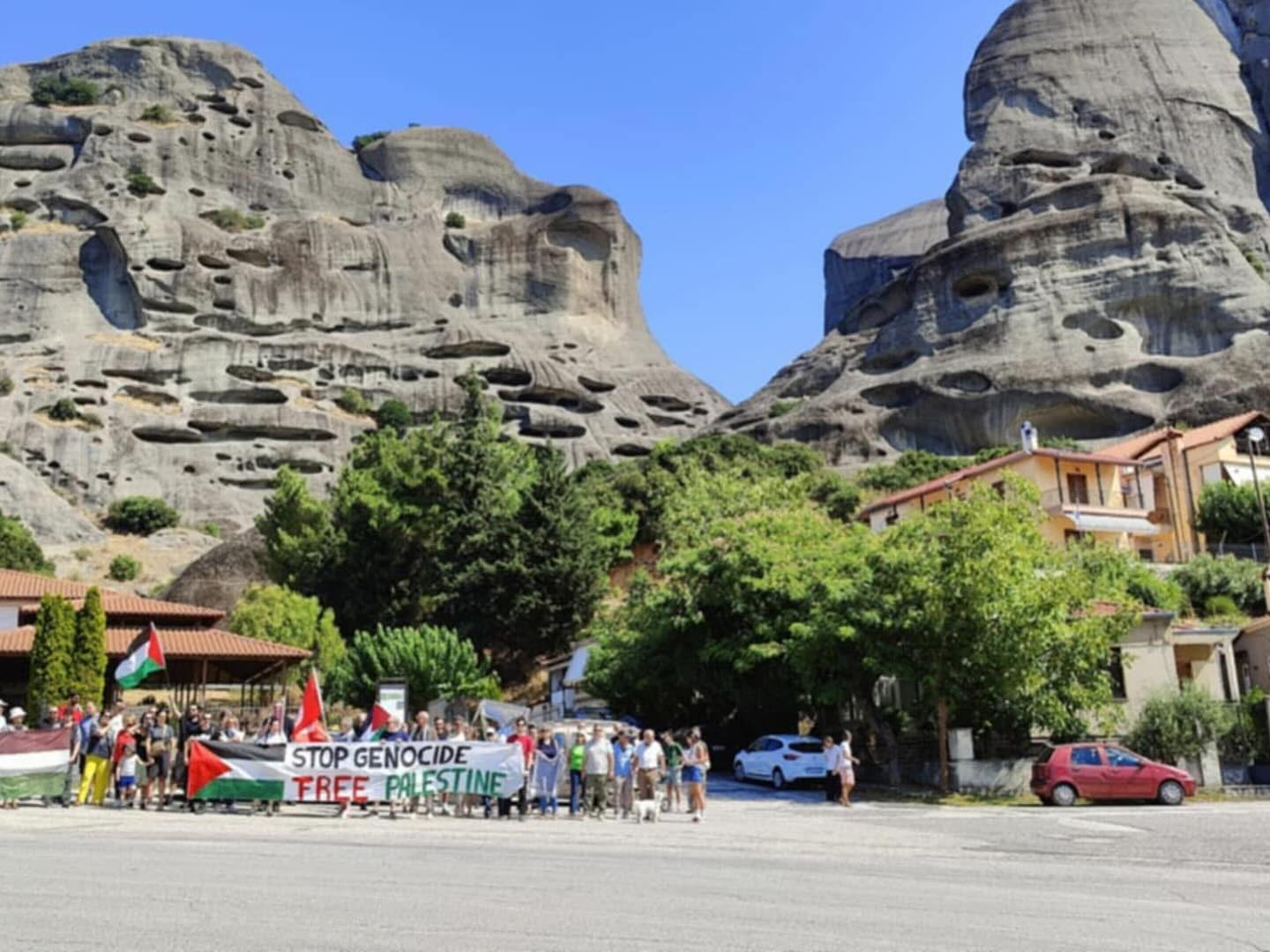
On July 22 of this year, about 300 protestors prevented the Crown Iris, the only Israeli-owned cruise ship, from landing about 1,600 passengers in Ermoupoli on the Greek island of Syros.
Along the harbor, many protesters waved Palestinians flags, as a large group held up a colossal Palestinian flag. The crowd chanted “Free, Free Palestine” and displayed a big homemade banner demanding “Stop the Genocide.” Protesters stayed behind lines set by authorities, and were hardly a scary lot: No balaclavas or military garb, no threats of violence—just a gathering of local trade unionists, members of grass roots organizations and townies, all dressed in everyday summer togs. A statement they released assailed Greece’s increasingly close economic and military ties to Israel, and Israel’s ongoing genocide in Gaza.
The Israeli reaction was explosive:
On deck the Crown Iris, passengers waved Israeli flags, sang nationalistic songs and shouted “May your village burn!” and “Death to Arabs!” The latter, a common bit of right-wing Zionist racism, was clearly out of place: no Arabs were evident among the protesters. Passengers also chanted “Am Yisrael Chai” (The people of Israel live), an equally obtuse choice since Greek protesters never threatened Israeli lives. They were protesting against the Israeli state taking the lives of Palestinians.
While Crown Iris passengers raised a ruckus onboard, Israeli Foreign Minister, Gideon Sa’ar, called his Greek counterpart to caution that continued protests could scare away future Israeli tourists. Even though protesters never threatened or perpetrated physical harm, Sa’ar reportedly emphasized Greece’s obligation to protect Israeli tourists from violence.
Some Israeli news outlets sensationalized things further. The digital platform JFeed went full-out yellow journalism with the headline, “Pro-Hamas Protest Traps Israeli Passengers…in Greece” At a lower decibel level, Israel Hayom, Israel’s free and most widely read newspaper, proclaimed that Israeli tourists were “stranded.” Two days later, the editorial board of The Jerusalem Post, Israel’s oldest English-language newspaper, echoed that Israelis had been “stranded” off Syros. It was a rash claim, given that Crown Iris authorities prevented passengers from deboarding for less than three hours before pulling up anchor and rerouting to Cyprus. Less than three hours!—hardly enough time for the ship’s coveted salad and cold cuts bar to go warm.
The Israeli reaction can easily be viewed as a knee-jerk attempt to intimidate and silence anyone brazen enough to hold Israel to account for its policies and actions. More generously, the forcefulness of the Israeli reaction may have been influenced by everything from sensitivities built up over eons of odious antisemitism in Europe to deep frustration over missing a ramble through the medieval streets of Ano Syros. Whatever the case, seen simply as a response to a three-hour delay on a comfortable cruise liner, the Israeli reaction was overblown. Seen in comparison to recent Israeli policies and actions, the Israeli reaction to the Syros protesters was shameless, bordering on depraved.
Take, for example, what the Greeks in Syros were protesting: the almost two years of catastrophic suffering of Palestinians from Israel’s genocide in Gaza. Israel, of course, officially denies this genocide, but its denials ring hollower every day. Even Israel’s most prestigious and circumspect observers, such as Israeli-American Omer Bartov, universally hailed as a leading historian of the Nazi Holocaust and a leading expert on genocide, and B’Tselem, Israel’s foremost human rights organization, just recently recognized Israel’s ongoing bombing, shooting, displacing and starving of Gazans as genocide. By comparison, a three-hour delay aboard the luxuriously appointed Crown Iris is nothing to complain about.
But consider another example, of things that are more obviously and closely comparable: the efforts of Greek protesters’s to keep Israeli tourists from coming ashore and Israel’s long-standing blockade of Gaza. Since 2008, the Israeli Navy has been routinely stopping Freedom Flotilla boats from delivering much-needed humanitarian aid to Gaza. Over the years, Israeli forces have sabotaged, shot at, killed, beaten, tasered, arrested, jailed, repatriated Flotilla volunteers to prevent them from coming ashore to help Gazans. So far this year alone, the Israeli Navy has illegally seized three such boats, the most recent being the Handala on July 26, 2025. Sa’ar’s Ministry of Foreign Affairs offered this Orwellian justification of Israel’s capture of the Handala: “Unauthorized attempts to breach the blockade are dangerous, unlawful, and undermine ongoing humanitarian efforts.” This at a time when Israel’s own numbers show that it has been systematically starving Gazans. Imagine the uproar if Greek protesters had commandeered the Crown Iris and inflicted similar harm on its passengers.
The Syros protest spurred not only a strong Israeli reaction, but also condemnation by Greek tourist and other businesses interested in preserving or expanding ties to Israel, and by various state officials, including leaders of Greece’s current center-right government. On the day of the Syros protest, Michalis Chrysochoidis, Greek Minister of Citizen Protection, pointedly warned that “Anyone who attempts to prevent a third-country national from legally entering the country will face prosecution, arrest, and then criminal prosecution under the anti-racism law.” He thus resorted to a favorite tactic of Zionists around the world of intimidating and silencing critics by smearing them as “anti-semitic.” The Minister’s statement conveniently ignored Greek protesters’ frequent disclaimers that they have nothing against individual Jews or Israelis who do not support genocide. The Greek protests are anti-genocide not anti-semitic.
A clear result of Israeli and official Greek reactions has been much larger and more aggressive police action. At Rhodes on July 28, 2025, heavily armed police made eight arrests and wielded torso-size shields to push and disperse protesters. At Crete on July 29, police detained four individuals and used pepper spray and tear gas to scatter protesters as Crown Iris passengers were bussed to tourist sites. Also at Crete on August 5, Cruise Iris passengers disembarked without incident as police and Coast Guard cordoned the port of Agios Nikolaus, and protesters cancelled their action. But then on August 10, when organizers called for broader “Days of Action” at twenty-five tourist locations, protesters were not deterred and came out in over one-hundred, both on the mainland and the islands.
Overblown reactions, smears of anti-semitism, increased repression—none of these has a chance of deterring Greek protests against Israel’s genocide. Despite some setbacks, Greek protests are riding a wave of success. As Crown Iris operators admit, they are actively adjusting their routes trying to avoid protesters. Operators also admit having difficulty fulfilling promises to passengers for plentiful time to roam freely or to enjoy guided sightseeing tours on shore. Over time, continuing protests have the potential of depressing bookings and plunging the Israeli tourism business in Greece into crisis.
And protesters will keep going. Protests at Crown Iris ports of call are part of a much wider anti-genocide and pro-Palestinian Greek movement against Greece’s tourism, economic and military ties to Israel. Ο αγώνας συνεχίζεται στη σύγχρονη!—The struggle continues!
ZNetwork is funded solely through the generosity of its readers.
Donate