
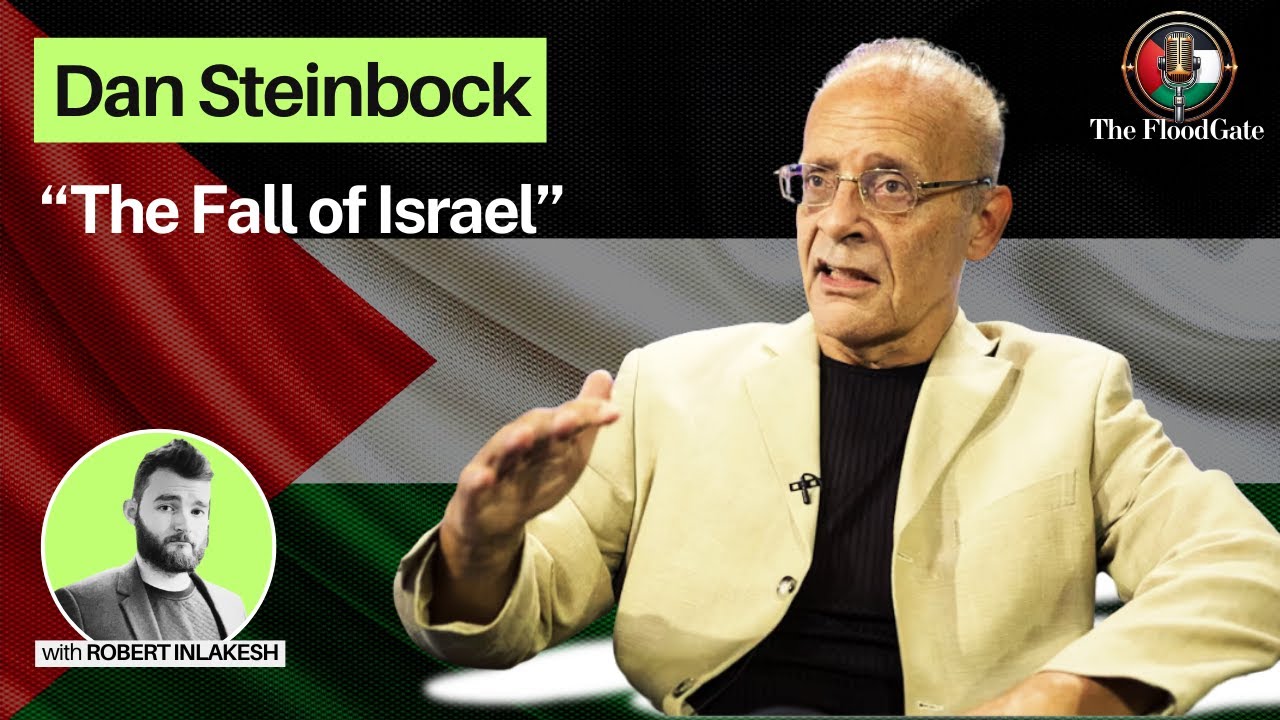
In the latest episode of The FloodGate Podcast, Robert Inlakesh sat down with Dan Steinbock, an expert on global economy, international relations, and the multipolar world order, to discuss Israel’s unraveling — politically, economically, and militarily.
Drawing from Steinbock’s two latest works, The Fall of Israel and The Obliteration Doctrine, the conversation explored the internal decay of Israel’s politics, economy, and military, how the “obliteration doctrine” had shaped Gaza’s genocide, the complicity of Western powers, the failures of international law, and the global shifts then challenging Israel’s regional dominance.
However, through starvation policies, propaganda, authoritarian drift, and genocidal military doctrines, Israel is, in Steinbock’s words, “sleepwalking into a catastrophe.” His analysis underscored that the same processes devastating Palestinians were also eroding Israel from within.
As global power shifts are reshaping the Middle East, he cautioned, Israel’s unraveling could accelerate — unless international law and accountability were finally enforced.
Here are five takeaways from the interview.
Starvation as a Weapon of War
For Steinbock, one of the starkest indicators of Israel’s trajectory is its systematic use of starvation as a tool of war. He recalled how, long before October 7, “four out of five of Gaza’s residents were already largely dependent on humanitarian aid,” the result of years of deliberate economic strangulation.
As he explained, Israeli officials themselves had admitted — in documents later revealed by WikiLeaks — that the goal was to keep Gaza’s economy “on the brink of collapse without quite pushing it over the edge.”
That policy is not simply about economics but about controlling life itself. “They started calculating what would be an adequate number of kilocalories for the people to manage but not to cause a famine,” Steinbock noted.
He situated this grim calculus in a longer colonial history, comparing it to the British famine policies in India, which had deliberately set rations so low that millions died. In Gaza, he argued, the logic is similar: “Perhaps only in the Warsaw Ghetto we have seen something even worse.”
Propaganda and Denial of Reality
Alongside the weaponization of food, Steinbock highlighted a campaign of denial designed to obscure what is happening. Israeli spokespeople and their defenders insist that Palestinians are not starving, attributing deaths to disease or pre-existing conditions.
To Steinbock, these arguments echo dangerous historical precedents: “Their arguments seem very similar to the arguments you hear from Nazi Holocaust deniers… pulling up a photo of somebody overweight in Auschwitz to claim no one starved.”
But, he warned, denial could not be sustained forever. “The reality is that ultimately the real data will come out,” he said, adding that even many Israelis were becoming “increasingly uncomfortable with what they see when they can see something that happens in Gaza.”
For Steinbock, the more such propaganda is repeated, the more it risks backfiring — not only morally but politically — because it lays bare the real objective: “not truth, but ethnic cleansing, taking over Gaza just as the West Bank.”
Institutional Crisis
The decay, Steinbock stressed, is not only external but internal. He sees Israel’s crisis as rooted in its transformation from a fragile democracy into something far more authoritarian.
He traced this shift back to the decision of David Ben-Gurion not to adopt a formal constitution, leaving open deep divisions between secular and religious Zionists. Those divisions, Steinbock argued, have later been exploited by Netanyahu and his far-right allies through judicial overhauls and nation-state laws.
“It was this movement from a country that was supposed to be democratic and secular and then Jewish into something very different,” he explained, “not so democratic or autocratic, religious and far right by its methods.”
The 2018 nation-state law, Steinbock said, codified apartheid into the legal order, paving the way for Netanyahu’s efforts to fully subvert the judiciary. “The very nature of the country as a democracy is changing dramatically,” he concluded.
Netanyahu’s Far-Right Bubble
This institutional collapse is compounded by Netanyahu’s personal style of rule. Steinbock described the prime minister as having surrounded himself with “yes men and yes women,” creating a political bubble in which dissenting voices were purged — including former defense ministers and even the head of the Shin Bet.
Such consolidation, he argued, had left Israel “dangerous to itself,” as decision-making became detached from reality.
“The enemy of Israel is not the Palestinians,” Steinbock insisted. “There is an enemy that Israel has and it is itself — its far right.”
The consequences, he said, are already catastrophic: “What has happened in Gaza (is) the major collapse of morality in the early 21st century… it has already hurt so many Palestinians that I consider it catastrophic.”
By elevating extremist figures such as Smotrich and Ben-Gvir, Netanyahu has, in Steinbock’s words, “opened the hen house for other foxes far more lethal than himself.”
The “Obliteration Doctrine”
The culmination of this decay, Steinbock argued, is what he called the “obliteration doctrine” — a strategy that combines four interlocking elements: scorched earth, collective punishment, civilian victimization, and indiscriminate aerial bombing.
Unlike traditional military doctrine, it does not distinguish between combatants and civilians. “The idea is that civilians are no longer just collateral damage,” he explained. “It is the objective to hurt civilians and civilian infrastructure.”
What is new in Gaza, he stressed, is the role of artificial intelligence in targeting, where kill probabilities replace human judgment. “If it’s civilians all the better, then people will move faster if you’re after ethnic cleansing,” he warned.
For Steinbock, this is not war in any meaningful sense: “This is not war. It’s mass butchery by any other name. We should call these things as they are and treat them as such.”
Romana Rubeo is an Italian writer and the managing editor of The Palestine Chronicle. Her articles appeared in many online newspapers and academic journals. She holds a Master’s Degree in Foreign Languages and Literature and specializes in audio-visual and journalism translation.
ZNetwork is funded solely through the generosity of its readers.
Donate