
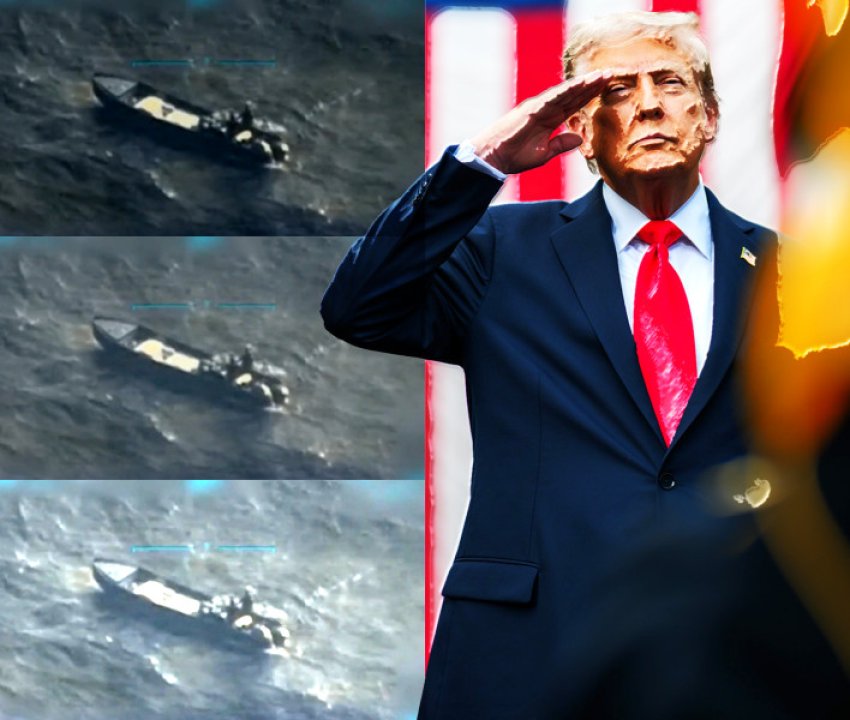
Since August, the US has been amassing military assets in the Caribbean. Warships, bombers and thousands of troops have been joined by the USS Gerald R. Ford, the world’s largest aircraft carrier, in the largest regional deployment in decades. Extrajudicial strikes against small vessels, which UN experts have decried as violations of international law, have killed at least 80 civilians (CNN, 11/14/25).
Many foreign policy analysts believe that regime change in Venezuela is the ultimate goal (Al Jazeera, 10/24/25; Left Chapter, 10/21/25), but the Trump administration instead claims it is fighting “narcoterrorism,” accusing Caracas of flooding the US with drugs via the Cartel of the Suns and Tren de Aragua, both designated as foreign terrorist organizations.
Over the years, Western media have endorsed Washington’s Venezuela regime-change efforts at every turn, from cheerleading coup attempts to whitewashing deadly sanctions (FAIR.org, 6/13/22, 6/4/21, 1/22/20). Now, with a possible military operation that could have disastrous consequences, corporate outlets are making little effort to hold the US government accountable. Rather, they are unsurprisingly ceding the floor to the warmongers.
Fabricating ‘tensions’
Despite Washington ominously amassing naval assets and issuing overt threats against Caracas, Western journalists often talk of “tensions” between the two countries (Fox, 11/17/25; ABC, 11/18/25), or even a “showdown” (Wall Street Journal, 10/9/25; Washington Post, 10/25/25). This is conceptually similar to the framing of Israel’s genocide in Gaza as a “conflict” with Hamas (FAIR.org, 12/8/23), except in this case the media does not have an equivalent of October 7 to rationalize all the atrocities by the US and its allies.
Though the Trump administration has largely abandoned the traditional US exceptionalist discourse of promoting “freedom” and “democracy,” that has not stopped corporate journalists from relentlessly demonizing the Venezuelan government.
Journalists are quick to label Venezuelan President Nicolás Maduro, currently facing hundreds of Tomahawk missiles pointed at his country, an “authoritarian” (Guardian, 11/14/25; New York Times, 10/15/25😉 or an “autocrat” (Wall Street Journal, 11/5/25; Washington Post, 10/24/25). In contrast, the same pieces place no labels on the Trump administration despite its authoritarianism both at home and abroad (Guardian, 10/16/25; CNN, 8/13/25).
Articles in the Guardian (11/6/25, 10/22/25) describe US operations in Grenada (1983) and Panama (1989) as success stories, fawning over special operations forces while ignoring the deadly impact. The Panama City neighborhood of El Chorrillo became known as “Little Hiroshima” after civilians were massacred there during the US invasion.
Very few outlets recall more recent US interventions, such as Afghanistan, Iraq, Libya and Syria, which according to Brown University’s Costs of War project have killed an estimated 4.5–4.7 million people over the past two decades. Such “accumulation by waste” has seen $8 trillion transferred to the military-industrial complex, Wall Street and Silicon Valley.
Hiding the evidence
Washington’s steady escalation in the Caribbean has evoked memories of the buildup to the Iraq War, when Washington also counted on crucial support from the media establishment to manufacture consent for imperialist war (FAIR.org, 2/5/13, 3/22/23).
At that time, corporate media parroted White House claims about Iraq’s hidden arsenal, despite evidence that Iraq had destroyed its banned weapons arsenal, in contradiction to the White House’s case for war (FAIR.org, 2/27/03). Fast forward more than 20 years, and once more there is ample information undermining the administration narrative, this time about “narcoterrorism.”
Reports from the United Nations Office on Drugs and Crime (UNODC) have consistently found Venezuela’s Eastern Caribbean corridor to be a marginal route for US-bound cocaine trafficking, with former UNODC director Pino Arlacchi estimating that only around 5% of Colombian-sourced drugs flow through Venezuela (L’Antidiplomatico, 8/27/25).
These findings have been corroborated by the DEA itself. For instance, the agency’s 2024 National Drug Threat Assessment report does not even include the word “Venezuela.” The 2025 report only has a small section on the gang Tren de Aragua, which dismisses any ties to the Venezuelan government and places its drug trafficking activities “mainly at the street level.”
Yet these glaring flaws in the Trump administration’s casus belli are often overlooked by Western media. Several outlets reporting on potentially imminent US strikes mention the White House’s declared anti-narcotics mission but conveniently omit the fact that, even according to US agencies, fewer drugs flow through this region than many others (Guardian, 11/11/25; Washington Post, 11/14/25; Bloomberg, 11/14/25; New York Times, 11/14/25).
Former UNODC director Arlacchi pointed out that “Guatemala is a drug corridor seven times more important than the Bolivarian ‘narco-state’ allegedly is.” He accused Washington of hypocritically driving the anti-Venezuela narrative due to interest in its massive oil reserves.
‘Maduro denies’
With the “narcoterrorism” accusations against Maduro and associates, Western journalists absolve US officials of the burden of proof (New York Times, 11/4/25; Financial Times, 10/6/25; Wall Street Journal, 11/5/25). There has never been any public evidence about Maduro, or other high-ranking Venezuelan officials indicted by the US, being involved in drug trafficking via the Cartel of the Suns, while a leaked US intelligence memo rejected the notion of government ties to Tren de Aragua.
The Cartel of the Suns’ very existence is far from established, with subject experts contending that, while drug trafficking may be entwined with corruption in Venezuela’s military, there is no evidence of a centralized structure going all the way up to the president (InSight Crime, 11/3/25, 8/1/25; AFP, 8/29/25).
Instead of exposing the unfounded accusations and providing data from experts and specialized agencies, Western outlets either let Trump’s case for war go unchallenged, or merely present a dissenting opinion from Maduro, whom they have systematically demonized (New York Times, 10/06/25; DW, 11/14/25; NPR, 11/12/25; CBS, 10/15/25; CNN, 11/14/25).
This behavior is certainly not new, as Western outlets have consistently pushed the unfounded “narcoterrorism” narrative, going back to the first Trump administration (FAIR.org, 9/24/19). Similar unfounded accusations of drug trafficking were made against Nicaragua in the 1980s (Extra!, 10–11/87, 7–8/88; FAIR.org, 10/10/17), which served to justify US attempts to overthrow the Sandinista government through the CIA-backed Contras.
Warmongers to the stage
In his typical style, Trump has sent mixed signals over whether he wants to strike targets inside Venezuela, with contradictory on-record and unofficial statements going back and forth. When asked if the White House is seeking regime change in Venezuela, Trump has been noncommittal (Wall Street Journal, 11/4/25). It is worth recalling that in June, Trump similarly sent all sorts of inconsistent messages before ultimately attacking Iran’s nuclear facilities.
True to form (FAIR.org, 2/9/17, 4/13/18, 7/3/20), many liberal establishment outlets have been more bellicose than the US president they have occasionally chided for murdering scores of civilians in the Caribbean (The Hill, 10/30/25; Foreign Policy, 11/7/25). The New York Times’ Bret Stephens (1/14/25, 10/10/25, 11/17/25) has advocated for a regime-changing military intervention for months (FAIR.org, 2/12/25). Quite tellingly, Stephens does not regret supporting the Iraq War (New York Times, 3/21/23).
The Washington Post published an editorial (10/10/25) after the recent Nobel Peace Prize award to far-right Venezuelan leader María Corina Machado, arguing that US interests would be “better served” by someone like Machado, a firm endorser of US-led regime-change (FAIR.org, 10/23/25). But with the war drums beating louder, the Jeff Bezos–owned paper granted a column (11/12/25) to John Bolton, a former Trump adviser whose main criticism was that the administration is not being efficient enough in overthrowing Maduro.
Bolton, an architect of the Iraq War, and of the “maximum pressure” campaign against Venezuela during Trump’s first term, bemoaned the White House’s “inadequate” explanations about the ongoing lethal boat strikes and international quarrels as damaging the “laudable goal” of throwing Venezuela into chaos.
Bolton went on to urge the administration to create a better “strategy,” which includes “greater efforts to strangle Caracas economically.” The Washington Post is happy to platform a call for escalating measures that have already caused tens of thousands of deaths (CEPR, 4/25/19).
Finally, the former Trump official says that “we owe it to ourselves and Venezuela’s people” to violently oust the Maduro government, despite opinion polls showing that such a military intervention is widely rejected both in the US and in Venezuela.
Bloomberg columnist Javier Blas (11/4/25) went one step further by saying the quiet part out loud: “Venezuelan Regime Change May Open Oil’s Floodgates.” Blas rejoiced at the prospect of a “US-enforced change of ideology” that would install a “pro-Western and pro-business government,” which would do wonders for energy markets in the long run.
Unfazed by the human cost of a military intervention, the corporate pundit was only concerned about the possible impact of Venezuela’s current 1 million daily barrels of oil being wiped out. Who cares about millions of Venezuelans when a “brief military campaign” could drive oil prices down and secure a steady supply in the 2030s?
Complicity with war
The White House’s military build-up and illegal strikes have drawn widespread condemnation and opposition, even from within the US political establishment (NPR, 11/5/25; Intercept, 10/31/25). US politicians have also raised alarm bells about a potential military intervention in Venezuela without congressional approval (New York Times, 11/18/25; Politico, 11/6/25), but these voices feature much less prominently than the administration’s.
There is hope that a combination of Venezuelan defense deterrence with domestic and international pressure, coupled with Trump’s own unpredictability, might ultimately avoid yet another US regime-change military assault.
But should the worst come to pass, the media establishment will have once again done nothing to stop yet another deadly US foreign invasion. Over weeks of military buildup and threats, corporate outlets elected to ignore the evidence disproving Trump’s claims and to platform warmongers. They will not wash the Venezuelan people’s blood off their hands.
ZNetwork is funded solely through the generosity of its readers.
Donate