

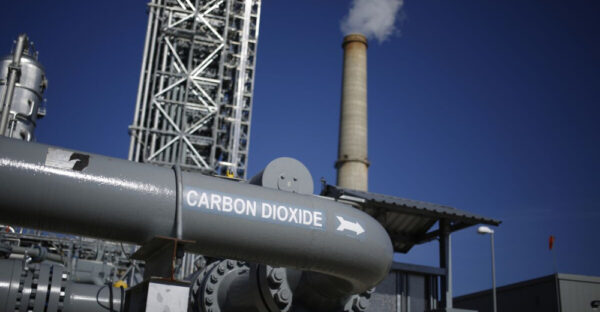
The COP 28 UN climate conference concluded with countries agreeing to a plan to transition away from fossil fuels, using language that fell short of calling for an explicit phaseout. In the debates over whether countries need to phase fossil fuels “out” or merely “down,” carbon capture and storage (CCS), a form of so-called fossil fuel “abatement,” played a central role.
Rather than exposing CCS as the greenwashing ploy it essentially is, some reporting placed disproportionate significance on the technology, adding to the confusion and misunderstandings about climate change that fossil fuel companies have been funding for decades.
An excuse to not eliminate

“Don’t be fooled,” writes Jonathan Foley in Scientific American (12/4/23): Carbon capture is “mostly a distraction from what we really need to do right now: phase out fossil fuels and deploy more effective climate solutions.”
Before COP 28 even began, climate activists were not hopeful. The conference, held in Dubai, capital of the oil-dependent United Arab Emirates, reeked of almost comedic irony. The conference’s president, Sultan Al Jaber, is the head of the petrostate’s national oil company.
During a November livestream event, Al Jaber falsely claimed there was “no science” indicating a phaseout of fossil fuels was necessary to keep warming levels below the 1.5°C threshold set by the Paris Agreement. He added that phasing out fossil fuels would “take the world back to the caves” (Guardian, 12/3/23).
CCS technology—which involves capturing carbon from sources like power plants and steel mills, and storing it underground—has become a key part of the fossil fuel industry’s arguments against the elimination of its environmentally devastating product. Instead of rapidly ending the extraction and burning of fossil fuels, the claim goes, we can simply “abate” the emissions with CCS.
The reality is that even optimistic estimates see CCS (also known as carbon capture and sequestration) as playing only a limited role in mitigating emissions from difficult-to-decarbonize sectors. But polluters aggrandize its potential contributions in order to keep expanding fossil fuel extraction while at the same time claiming to take action on climate (Scientific American, 12/4/23). In fact, most successful CCS projects are actually used to force more oil out from underground, in a process called “enhanced oil recovery” (Washington Post, 10/25/23).
Given the chokehold the fossil fuel industry had on this COP and subsequent conversations about climate change mitigation, journalists must be clear and realistic in their reporting about the capabilities of carbon capture, and its role in both climate crisis solutions and fossil fuel industry greenwashing.
‘A valuable role’

To back up the idea that carbon capture is a “valuable tool,” the New York Times (12/6/23) links to a study whose headline calls it “Too Little, Too Late, Too Slow.”
The New York Times’ headline, “Can Carbon Capture Live Up to the Hype?” (12/6/23), could have been most easily and accurately answered by a short “no.” Instead, the subheading misled about CCS’s plausibility as a climate change solution, claiming that “experts say it could play a valuable role.”
But what’s the evidence on offer? The article mostly described the failures of expensive carbon capture projects to even get off the ground. The only reference to that supposedly “valuable role” linked to three studies or reports. The titles of two were “[Carbon Capture]—Too Little, Too Late, Too Slow—It’s No Panacea” (S&P Global, 10/18/23) and “Heavy Dependence on Carbon Capture and Storage ‘Highly Economically Damaging,’ Says Oxford Report” (SSEE, 12/4/23).
A third, seemingly more optimistic, report came from the International Energy Agency (11/27/23). But that agency’s latest report actually offered the opposite message, its executive director explained (Toronto Star, 11/23/23): Oil companies’ plan to achieve “net zero”—removing as much carbon from the atmosphere as they emit—by capturing emissions while increasing production is an “illusion” based on “implausibly large amounts of carbon capture.” Lucky for those companies, New York Times headline writers are here to keep up that illusion.
The Times article itself even noted that “total fossil fuel use will have to fall sharply no matter what to keep global warming at relatively low levels,” and that carbon capture is “no silver bullet.” It cited the IEA’s roadmap to lowering carbon emissions to net zero by mid-century, noting that even in this ideal plan, CCS would account for just 8% of the world’s total emissions cuts, and that “the vast majority of reductions would come from countries shifting away from fossil fuels entirely.”
While CCS could play a part in mitigating emissions from industries like cement, steel and fertilizers, the benefit can only be realized if the technology’s logistical and financial limitations are addressed, explained Jonathan Foley in a piece for Scientific American (12/4/23). Food and Water Watch (7/20/21) characterizes CCS as an “expensive failure” that’s energy intensive and actually increases emissions.
Even while outlining CCS’s “limitations,” the Times managed to both-sides the issue:
One big dispute is over how big a role this technology, known as carbon capture and storage, should play in the fight against global warming. Some oil and gas producers say it should be central in planning for the future. Others, including many activists and world leaders, dismiss carbon capture as too unproven and too risky.
In a “dispute” about how to cut carbon emissions, oil and gas producers’ arguments should certainly not be taken at face value. And, while “activists and world leaders” are among those who “dismiss carbon capture,”crucially, so are scientists.
The Times piece played down the many economic and logistical failures of CCS as “limitations.” While removing carbon will likely play a necessary—albeit small—role in meeting climate goals, CCS’s success hinges on our abilities to phase out fossil fuels. The tone of the piece’s headline is overly optimistic, offering a false sense of hope—and “hype”—for a technology that’s used more as a fossil fuel fig leaf than a climate change solution.
‘Vital…but falling short’

Bloomberg (12/6/23) notes without rebuttal that “CCS has been discussed as a way to limit the damage caused by fossil fuels without having to abandon them.”
An explanatory Bloomberg piece (12/6/23) about carbon capture, headlined, “Why Carbon Capture Is Seen as Vital in Climate Fight but Falling Short,” used similarly weak language.
In addition to CCS, the piece highlighted direct air capture (DAC), another carbon capture technology that removes carbon that is already in the atmosphere, rather than at the site of emission, and also performs at a tiny fraction of the scale that would be necessary for it to be an actual solution. According to the article, the largest DAC hub in the world, found in Iceland, only removes the equivalent of the annual emissions of 250 average US citizens.
For more context, the Regional Direct Air Capture Hubs that Biden’s Department of Energy is supporting are anticipated to suck only about 1 million metric tons of CO2 from the atmosphere annually. In 2022, global emissions of CO2 were 40.5 billion metric tons (Scientific American, 12/4/23)–adding more than 40,000 times as much carbon as the hubs are supposed to take out.
To say these technologies are “falling short” is quite the understatement.
To say they’re “vital” requires context. The Bloomberg piece explained:
Even if solar and wind energy largely supplant fossil fuels, holding temperatures down will require capturing large amounts of emissions produced by activities that are hard to decarbonize, such as making cement.
That much is true. However, it leaves out the most important part: Carbon capture can only make a difference in a world that drastically cuts emissions. Without that priority being met, its impacts are marginal at best—and, at worst, a distraction that permits fossil fuel companies to increase emissions and worsen the crisis.
In a press briefing with Covering Climate Now (11/9/23) regarding CCS and carbon dioxide removal, David King, former chief science adviser to the British government, emphasized that reducing greenhouse gas emissions was still the No. 1 priority, as human activity continues to emit the equivalent of about 50 billion tons of carbon dioxide into the atmosphere each year.
‘Some environmentalists’

Washington Post (12/11/23) attributes the idea that carbon capture is a “false climate solution” to “some environmentalists.”
A Washington Post report (12/11/23), leading with the tearful remarks of Mona Ainuu, a climate activist from Niue, a small island nation, described the ultimate, disappointing outcome of the COP: The draft agreement to come out of the conference called not for the phaseout of fossil fuels, but for the mealy-mouthed “reducing both consumption and production of fossil fuels, in a just, orderly and equitable manner.”
The agreement also called for the rapid phase-down of “unabated coal.” The Post explained carbon capture and sequestration:
Some environmentalists view CCS as a false climate solution, saying it could prolong the life of polluting facilities for decades to come. They note that the International Energy Agency has warned that humanity cannot build any new fossil fuel infrastructure if it hopes to limit warming to 1.5°C.
Like the Times report, the Post framing failed to give readers the unvarnished truth they need, that CCS is only seen as a key climate solution by industries whose profitability depends upon the further burning of fossil fuels. No further information on the IEA report was given, or any information about the other litany of scientific studies, reports and information on the failures of CCS, allowing the specific concerns of “some environmentalists” to go unmentioned.
All of these pieces fail to mention why the fossil fuel industry is so gung ho about this dubious technology: While oil companies’ greenwashed PR campaigns tout CCS, corporations and governments continue to ramp up extraction.
Carbon capture and removal will likely play a small role in avoiding the most devastating effects of climate change, but it’s spitting in the ocean without a fossil fuel phaseout. It is journalists’ job to explain this accurately, while reminding audiences to not forget the No. 1 priority: eliminating fossil fuels.
ZNetwork is funded solely through the generosity of its readers.
Donate