
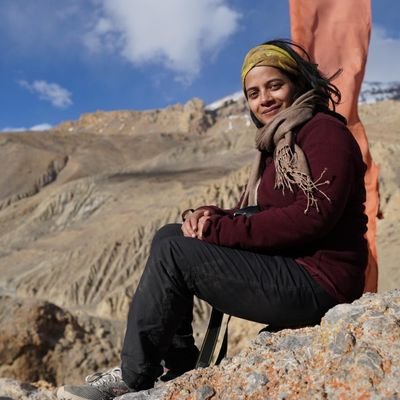

Are we really free? With this seemingly straightforward yet provocative question, Vijay Dethe from Pachgaon village in the Chandrapur district of Maharashtra, India, opened several philosophical and political questions. Vijay belongs to Dalit community and works with the Gond adivasis (indigenous peoples in India) and other marginal communities of Pachgaon towards self rule and overall governance in the village. He further added “the ones who destroyed their forests, polluted their waters, are now telling us what ‘vikas’(development) is! Do they really know what ‘development’ is!?”
Many terrestrial and nautical miles from Maharashtra, at the wild coast of South Africa’s Eastern Cape, Nonhle Mbuthuma, who leads a movement to stop destructive seismic testing for oil and gas, says, “they come in the name of helping ‘the poor,’ but we ask, ‘who is poor’? We have land, water, we feed ourselves, we have our livelihoods, how are we poor?” Organizing their Amadiba community, Nonhle and others secured their victory by asserting rights of the local communities to protect their marine environment. “Our sea is where our ancestors live. White people think that Shell (British multinational oil and gas company) can make them rich but for us happiness is with our sea and its beings. Peace comes with not wanting more” adds Nonhle. She was speaking at a public meeting organized by the Amadiba Community in Xolobeni as part of “Global Confluence on Radical Democracy, Autonomy and Self Determination” in February 2025 by Global Tapestry of Alternatives, WOMIN and the Academy of Democratic Modernity. By halting oil and gas exploration in a particularly biodiverse area, the Amadiba Crisis Committee has protected migratory whales, dolphins, and other wildlife from the harmful effects of seismic testing.
What is real democracy?
Importantly, what connects Vijay Dethe from India and Nonhle Mbuthuma from South Africa, is their defiant assertion that they are already free. They along with thousands of other Indigenous, ethnic minority, and marginalized communities around the world, have been asking, “are we free to decide what ‘development’, ‘well-being’ and ‘good life’ is for us? Can that ‘good life’ be built without trashing the earth and leaving millions behind?” Along with asking these fundamental questions, they are creating ways to assert and insist on creating a future world of freedom and self-determination – a pluriverse of peace.
Answers to these questions are rooted deeply in people’s practices and capacities to self-govern. Indigenous (adivasi/tribal) and other local traditional communities around the world have had their own systems of local governance, which have informed people’s interaction with fellow community members as well as the rest of nature. Maintaining these rules and customs are crucial for the continuation of spiritual and cultural life, community identity and knowledge, the management of land and natural resources, and the use and protection of the rest of nature. In several parts of the world, especially in the case of communities still practicing traditional occupations and ways of life (forest-based, pastoral, fishing, and/or agricultural), many such systems are still pursued in parallel with the formal governance systems introduced by the state, or are being reinvented by combining the old and new modes of governance.
The question that several communities have been asking, especially in these times of rising authoritarianism, is “what is real democracy? Is it electoral liberal democracy, co-opted by finance capitalism, or is real democracy one in which people break free from the shackles of their subjugation and define ‘well-being’ for themselves? Is democracy only about people and/or also about the rest of nature?”
Elements of earthy governance
“We can’t give away our rights. We need to strengthen our communities and ourselves to struggle against unjust exploitation of our forests, rivers, mountains and our human rights” says Hishey Lachungpa, a river activist, a nature enthusiast, and member of the local self-governing council, called Dzumsa of the village Lachung in state of Sikkim nestled in North-east India. Primarily inhabited by the Bhutia tribal community, the centuries-old dzumsa system of decision-making is still kept alive along with adjustments being made so that it can respond to modern transformations. In 2006, the village led a strong protest against the hydroelectric projects proposed to be built on their river and made a decision to not allow any further attempts to destroy the river and its ecology. In 2009, after three years of agitation, the local self-governing council of Lachung decided to ban all hydropower projects on their rivers. In fact, they have made it a crime to discuss or propose dams in any public space in Lachung.
Among several communities their systems of governance have been an important mode of managing the custodianship of the commons including their forests, rivers, pasture lands, farm lands among others. Most of the planning and decision-making is usually done in the centers of state power, far from the regions. Sometimes the administration doesn’t even know about the people’s own decision-making system and/or doesn’t want to recognize it, let alone acknowledge it, so the desire to maintain centralized power is also part of it. As a result, they do not understand the realities and characteristics of the region. That is why they are prone to failure, or even harmful. However, customary governance systems emerged in the regions based on the ecology, topography, geology, traditional livelihoods responding to the land, water, snow, mountains, rivers and how humans can navigate these ecosystems. These systems are therefore based on experiential learning, hundreds of years of observation, study of natural patterns, and design of life around those patterns. The customary laws are based on what Australian aboriginal scholar, Anna Polina calls Land Law or Water Law, framing customs and practices around the demand and agency of land, water, snow, rivers, mountains and their deities.
“For us, happiness is not about more material goods, but about good relations with ancestors and descendants… and for the latter, we need to look after our territories as part of a communal protection system,” says Ildefonso Sánchez Velázquez from the autonomous community of Cherán Michoacán Mexico during the Radical Democracy and Autonomy gathering. Since 2011, the community has been building systems of autonomy and self-governance and now has assemblies in four neighborhoods, and a general assembly as the highest body for decision-making and managing communal territory, family, neighborhood assemblies. Is radical democracy about asking the government what to do? For several of these communities, it is not about elections, or requesting governments but about ‘grounding’ ourselves in territories and places of struggles. These communities are not asking for regime change, they are demanding for systems change.
Grounding ourselves in territories and places of struggles
In parts of India, especially in the case of communities still practicing traditional occupations and ways of life (forest-based, pastoral, fishery, and/or agricultural), many such systems continue to operate in parallel with the formal governance systems introduced by the state, or are being reinvented by combining the modern forms of governance with the traditional ones. Vittal Rao from the ‘Gondwana Panchayat Rai Center’ (Traditional Tribal Council), an indigenous Raj Gond Tribals organization in the Adilabad District of Telangana state in South India, tells us that “the tribal council continues to play a critical role in resolving disputes, maintaining traditional livelihoods, land rights and management of commons. We have our own system of self-rule”.
Of course, not everything is perfect within these systems. Many of these traditional systems have been oppressive towards or marginalizing women and/or ethnic minorities, and young people. They may internally compromise basic principles of equity, justice and well-being for all, even if they help in sustaining ecosystems that they inhabit. But, instead of throwing the baby out of the bathwater, communities are building systems to transform these internal injustices. In Korchi, Maharashtra, Central India, when 87 villages came together to form a Maha Gramsabha to better represent villagers’ issues, something historic happened. Women from the Mahila Parishad, a collective of self-help groups, insisted on at least 50% women being represented in the collective. “I want my daughter to have a better life, and for her dreams to come true. She should get her rights to jal, jangal, and zameen (water, forest and land) and that can only happen if I raise my voice today” said Kalpana Naitam, the feisty young village head of Bori village.
Another powerful example comes from Central Asia. The Kurdish movement, rooted in democratic confederalism, is centered around the liberation of women from millennia of enslavement in various forms of patriarchy and masculinity. According to Abdullah Öcalan, the ideologue of the movement, the state is a manifestation of patriarchy, so true democratic liberation can only come about if it is based on a “science of women’s freedom” called jineoloji.
Self-governance as a way of life
Communities believe in choosing their own leaders by taking decisions collectively, making their own laws and following consensus-based decision-making processes. Self-determination, planning for their own lives and holding autonomy of their territories is the fulcrum of self-governance where a sense of democratic community is not limited to simply humans but includes the rest of nature too.
Mahatma Gandhi and Rabindranath Tagore spoke a lot about the idea of self-rule as a spiritual practice for oneself, other humans, and the earth. Tagore, in particular, drew much from nature and articulated how the structural ecological alienation that underlies modernity robs humanity of all freedom. David Graeber, anthropologist and anarchist, argued for autonomy as the most crucial fight for the 99% in the coming future during the Occupy Wall Street movement in the US. Graeber was very much inspired by another anarchist, Peter Kropotkin, who wrote “Mutual Aid: A Factor of Evolution” (1902), which argued for mutual aid as an important form of organizing autonomous societies by observing the rest of nature and ancient human societies to see how cooperation worked. To see the connections between these theories, one could say that an organized self-governing community does not seek individualistic freedom, but argues for autonomy with responsibility to humans and more-than-humans.
In some of the communities I’ve mentioned above, as well as in hundreds (perhaps thousands) of others I haven’t, there are ongoing acts of resistance to destructive ‘development’ projects or other kinds of (often military-backed) impositions by the state. In these struggles against what one could call a War on Earth, communities are also articulating the need for an alternative based on traditional systems of self-governance. This underscores the challenge for the world of electoral democracy to better understand and strengthen these traditional systems of self-governance (while giving them space to explore and address their inherent problems) in order to counterbalance modern governance discourses and institutions. It is crucial to understand that these traditional systems of self-governance are rooted in the struggle for autonomy, asserting that people living in their regions must have the autonomy to decide what happens to their lands and territories. Autonomy is at the heart of most community-based political mobilizations because it is both a practice and a theory of the inter-existence and inter-beingness of life on the land. These systems of decision making are place-based i.e. responding and based on the needs, rhythms, and movements of the land that they are situated in. Several of these decision-making processes exhibit the wisdom of decision-making processes that are not reduced to majoritarianism or unfairness towards some people.
In many ways, then, the real challenge in times of ecological collapse, the rise of authoritarian governments, capitalist crisis, and war-mongering militarization is to truly understand these systems, their evolving nature in relation to contemporary societies, their potential interface with modern institutions of governance, and how to strengthen overall governance for the purposes of justice and sustainability. The dominant story we have been told is one of homogenized humans, scarcity, competition, hierarchies, the politics of fear, competition to accumulate capital through productivity, growth, and continued extractivist expansion. However, these autonomy-seeking communities are powerfully challenging this dominant worldview. “To achieve well-being, everyone needs to know what their responsibility is,” says Izamsai Katengey of the Gond indigenous community in central India. They are articulating different ways of being in the world that include sustaining the living landscapes, the territories we inhabit, and communal forms of economy and justice wherever we are.
ZNetwork is funded solely through the generosity of its readers.
Donate