
Source: Venezuelanalysis.com
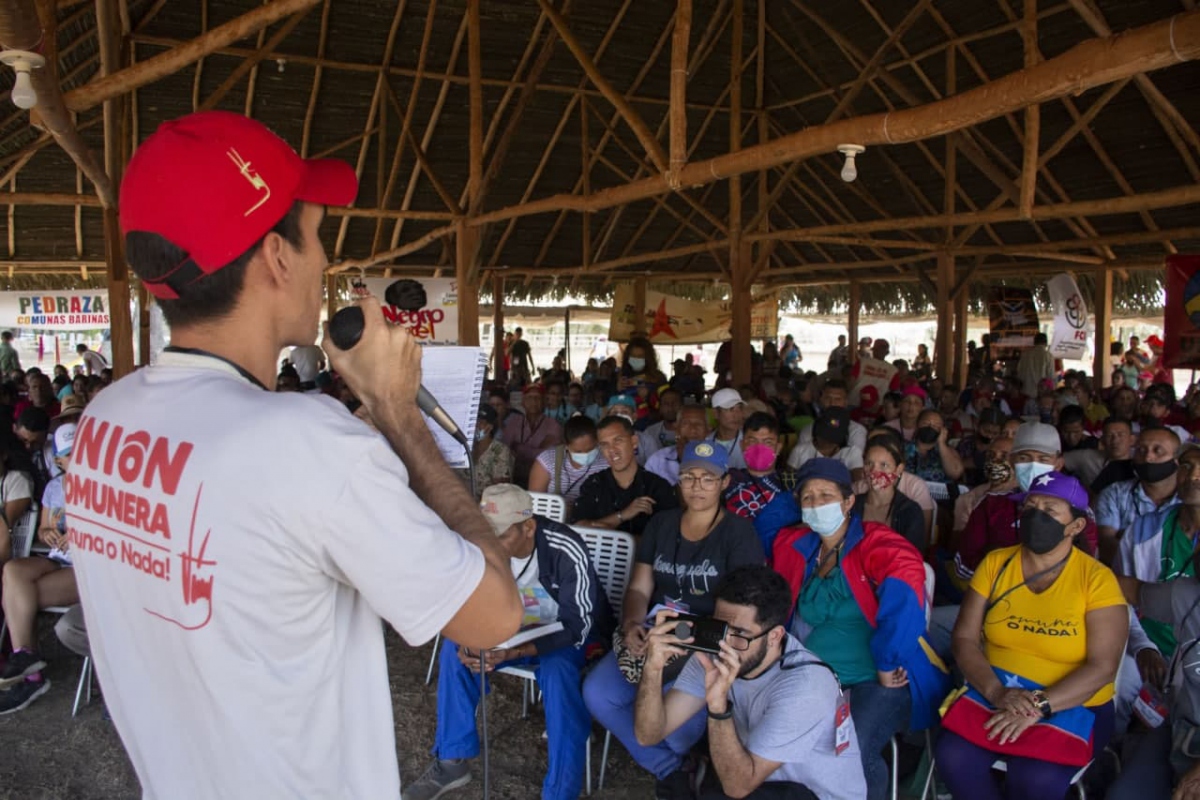
Venezuelan communards gathered on March 3 and 4 to officially launch a national organization.
More than 450 delegates were present in El Maizal Commune, Lara State, for the founding congress of the Communard Union. The collective aims to build a network of social organizations throughout the country.
The delegates, representing 48 communes and 12 other social movements, approved the organization’s political program and internal statutes, which include a political structure and mechanisms for new organizations to join. The founding documents were collated by a provisional leadership following more than three years of meetings and grassroots work.
A number of flagship communes, among them El Maizal, Che Guevara (Mérida state) and Luisa Cáceres (Anzoátegui state), held several gatherings before launching the Communard Union in early 2020.
In February and March, 2020, dozens of communes held five regional meetings to discuss the organization’s mission, internal dynamics and political character. The Covid-19 pandemic largely halted progress, with a pro tempore structure setting up brigades to bring further communes on board. Efforts regained steam in late 2021 with renewed regional gatherings leading up to the founding congress.
After the documents’ approval, the delegates split up to elect the members of the newly approved instances. Four regions (Center-Capital, Center-West, East and the Andes) elected three spokespeople each for the Communard Union’s national board and regional officers for eight different sectors, among them production, education and security.
A fifth region, the Llanos, did not have as much preparatory work and elected a promotional team to contact more organizations before choosing its structures like the others in the coming months.
The organizations and activists present pledged to set up productive and trade ties as well as to expand the Communard Union in their territories.
“We have not failed (former President) Chávez,” El Maizal spokesperson Ángel Prado told those in attendance. “This is a Bolivarian and Chavista movement!”
The popular leader, who was also elected mayor in the local Simón Planas municipality last November, urged grassroots organizations to not remain isolated.
“We are growing step by step in this very difficult moment for the country,” he added. “If we remain isolated, the counterrevolution will destroy us.”
Prado stressed that the Nicolás Maduro government “is not an enemy” but that social organizations had their own interpretation of Chávez’s Homeland Plan and should look to continue building alliances.
On Friday, the communard meeting had a visit from newly appointed Commune Minister Jorge Arreaza.
“I want communes to work side by side with our team, to give us ideas,” he said. Arreaza served as foreign minister for several years and lost a governorship electoral re-run in Barinas state in January. He pledged to work with other ministries to implement policies favoring communes and grassroots organizations.
“Popular power is the guarantee for a transition towards socialism in Venezuela. We need its voice to be listened to and taken into account,” the minister concluded.
Former President Hugo Chávez proposed communes as the “unit cells” for the construction of socialism in the Caribbean nation. They are assembly-driven organizations envisioned as local self-governments before setting up larger networks to build the so-called Communal State.
Following their official launch in 2009, communes grew and expanded across the country, acquiring or taking over land and other means of production. However, the years-long economic crisis and US sanctions saw popular power collectives struggle to remain active, while social leaders have denounced efforts by state institutions to curtail grassroots autonomy.
According to the Venezuelan government, there are around 3,000 officially registered communes.
ZNetwork is funded solely through the generosity of its readers.
Donate