
Capitalism is a term that comes fully loaded in the Western psyche. It is a Rorschach test that brings history, ideology and personal experience to the fore. Capitalism is perceived as oppositional, as a choice among several, most often without relation made between its promises and its facts. Even left leaning academics and scribes approach the topic with antique Cold War talking points— arbitrary rules made by faceless communist bureaucrats versus the freedom to choose which bathing suit to buy. What typically isn’t put back is actual history. When it comes to the current crises of capitalism, climate crisis in particular, the broad frame is skewed through the anti-history that in some sense ‘the world was always this way.’ The facts are that in material ways, it wasn’t.
It is far from the consensus view that capitalism is responsible for the climate crisis. Part of the divergence of views comes from the distance between capitalism as it exists in theory and its modern facts in deeply integrated corporate-state relations. What keeps capitalist theory, as opposed to simply its facts, relevant is its deep embedding in the institutions of the West. A central hindrance to meaningful analysis comes directly from this theory— the idea of economic ‘system’ as a unity of interests. Left conspicuously out of this alleged unity is the historical distribution of the benefits and detriments of capitalist production. It is far easier to have a positive view of political economy when you get the benefits and someone else pays the costs. This divergence is central to discussion of climate crisis.

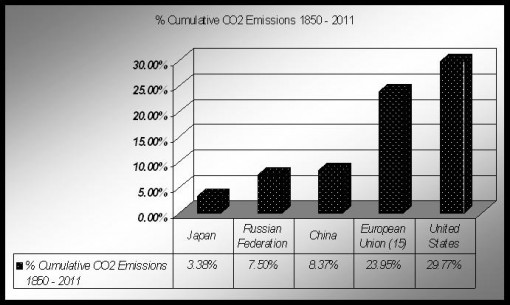
Graph (1) above: the large-scale industrialization that emerged from the ‘second industrial revolution’ in the mid-nineteenth century launched the epic of environmental destruction that has now accumulated to climate crisis. Prior to this period carbon dioxide (CO2) levels in the atmosphere had remained relatively stable throughout human history. CO2 is the greenhouse gas now found in the greatest quantity in the atmosphere. As can be seen, the U.S. and Europe are responsible for more than half of CO2 emissions since 1850 despite only having 11% of the world’s population. The U.S. is the largest single emitter over this period. Source: CAIT.
A wide variety of sources from polar ice analyses looking back eight hundred thousand years to modern methods of historical inference and carbon counting confirm that the rise in greenhouse gas emissions, in particular carbon dioxide (CO2), date the start of the second industrial revolution. In contrast to the first industrial revolution, the second brought the advent of modern large-scale industrial production. Electricity was ‘discovered’ in the late nineteenth century and fossil fuels were being used to run industrial machinery by the early twentieth century. Scottish economist Adam Smith had written ‘The Wealth of Nations’ a century prior and British and American industrialists drew from Smith’s theories and those of other Western economists in their production processes. This was pure capitalism in its nascent form.
Graph (2) above: world CO2 emissions were stable from the dawn of human history to the mid-nineteenth century and grew only incrementally until large-scale industrialization began in the early twentieth century. The first major war between the European and American imperial powers, WWI, is usually explained in political terms. But contests for natural resources, including oil, played a large role in the tensions that led to war. CO2 emissions rose dramatically following the end of WWII when the U.S. had the only industrial infrastructure undamaged by war. Through the Marshall Plan launched in 1949 the U.S. set about exporting American style industrial capitalism to Europe. Ominously, CO2 emissions rose nearly as much in the eleven years between 2000 and 2011 as during the prior half-century. Units are MtCO2— metric tons of CO2. Source: CAIT.
The link of greenhouse gas emissions to industrial production, to capitalist production, is unequivocal. The motivation for capitalists to treat the world as their very own garbage dump is simple: it raises profits. This can be seen in the corporate profit equation: Revenue minus Costs = Profits, R – C = P. Here it is evident that reducing costs raises profits. Capitalists can either pay to prevent pollution, compensate those affected by it or they can ignore it. The first two ‘options’ are costs that reduce profits. The latter, simply ignoring pollution, doesn’t eliminate its costs, it shifts them from the capitalist to those affected by it. In the case of environmental destruction like global warming, dead and dying oceans and widespread toxic contamination, these costs are borne far and wide. Viewed in this light the profit motive, long considered the central innovation of capitalism, makes it the political economy of catastrophe generation— capitalist profits are directly linked to the capacity to force other people to bear the costs of production.

Graph (3) above: with apologies for the crudeness of the opposition posed, doing so is apparently necessary. The capitalist economies of Japan, the E.U. and the U.S. together have 13% of the world’s population but have contributed 57% of global CO2 emissions since 1850. China and Russia together have 20% of the world’s population but contributed only 16% of global CO2. Most of the emissions from China are recent and are tied to manufacturing goods for export to the U.S. and Europe. This can be re-framed as U.S. and European CO2 emissions that were outsourced to China adding emissions back to the capitalist column. Sources: CAIT, World Bank.
The stale opposition of capitalism to ‘competing’ ideologies carries with it the baggage that much of what currently ails the world is directly attributable to American capitalism and its imperial reach. With much larger population China has contributed a smaller proportion of CO2 emissions to the (global) atmosphere. The absence of correlation between population size and historical CO2 emissions suggests that global warming is not being driven by overpopulation. The limited (accumulated) emissions from ‘communist’ countries suggest that ideological differences are more than just differences of opinion— they reflect fundamentally different approaches to the world. And through these and other measures it is clear that the overwhelming preponderance of greenhouse gas emissions in world history are directly and unambiguously related to capitalism through capitalist production.
This difference can be, and often is, put forward as evidence of the greater wealth creating capacity of capitalism. This is the basic premise of Western economics. But environmental destruction is the cost of this wealth not paid by its possessors. With the global environmental destruction that capitalism has produced in evidence, it quite clearly is political economy where some receive the benefits while others pay the costs. Taken at face value, the American ‘position’ that global warming is a global problem in need of global solutions leaves nearly all of the wealth created over the last century and one-half in American and European hands and the costs of producing it to be borne by those who have seen no benefit from it. This ties capitalism in history to its genesis in genocide and slavery that now threatens the continued existence of the world.

Graph (4) above: lest this remain ambiguous, capitalist economies, largely the U.S., have been the largest emitters of CO2 over the last century and one half. CO2 has been released in greater quantity than any other greenhouse gas. Fracking in the U.S. is a major source of methane, another potent greenhouse gas. To recap, capitalist economies are overwhelmingly responsible for releasing the greatest quantity of the most prevalent greenhouse gas, CO2, in human history. If global warming caused by greenhouse gas emissions has one central cause, it is capitalism. Source: C2es.
The Western conceit of a unity of interests in resolving the multiple crises of capitalism is ludicrous bordering on sociopathic. Legitimate mutual interest in preventing the destruction of the world is offset by political economy that distributes its benefits to one group and its costs to another. The profit motive of capitalism is the driving factor and social mechanism of its mal-distribution— it is the social philosophy of class warfare that through its claim of a unity of interests assures that its only resolution is through actual class warfare. And given one and one-half centuries of accumulated capacity to defend itself, the most likely outcome is that capitalism ends itself. With global wars and rapidly accumulating climate crisis, this end is not likely to be socially constructive.
When assigning cause for climate crisis to capitalism no opposition is necessary. Any radical shift in political economy would come through a lot of people acting in concert, not from antique ideologues sitting in chairs at universities. The idea / fear that this shift would resemble some nineteenth century ideological precept is wholly improbable. This improbability can be seen at present in the distance between capitalism as it exists in theory and the complexity of current corporate-state relations tied to imperial history. Ultimately capitalism is the most potent enemy of capitalism. Any hope for climate resolution requires the end of capitalism and its replacement with political economy that directly and explicitly serves a social purpose.
Rob Urie is an artist and political economist. His book Zen Economics is forthcoming.
ZNetwork is funded solely through the generosity of its readers.
Donate