
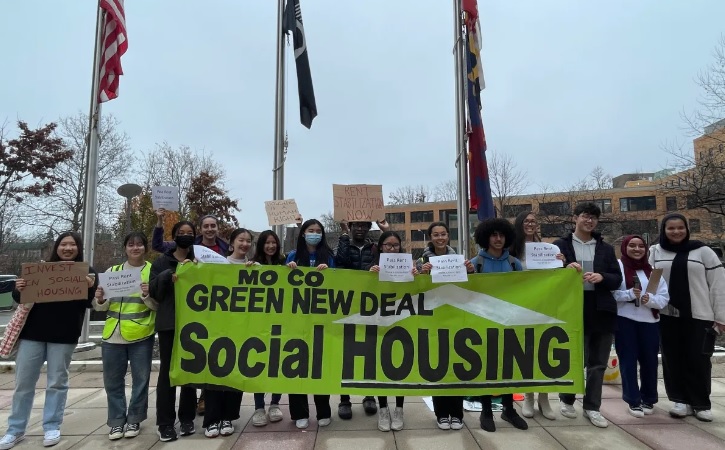
(Image: Em Espey, from moco360 website)
Two years ago, we began experimenting with a new approach to diversify and strengthen local climate action just outside Washington, DC, USA. We hired 25 BIPOC high-school students from our community as paid interns for the summer semester to help launch a local Green New Deal. This spring, then in its sixth semester, the BIPOC Montgomery County (Maryland) Green New Deal (GND) Internship helped a broad coalition including BIPOC-led social justice organizations, labor unions and 13 climate organizations win rent stabilization with a permanent, annual cap on rent increases in the County at 6%. Since high and increasing rents already make 10% of our County workforce commute from outside the County, rent stabilization is also a climate justice issue. Forty diverse organizations signed our final letter of support to the Council. This success could not have happened without some significant learning.
In 2017, the mostly older, white activists in the local climate movement had persuaded the Montgomery County (MOCO) Council to declare the first climate emergency anywhere in the world. We were excited. However, the same Council subsequently did very little to meet the goals in that non-binding declaration, even after one of its principal sponsors was elected County Executive.
To build more political power to win real change in County policy and programs around the climate issue, local leaders from Extinction Rebellion (XR) and 350.org decided to launch a local GND. We hired a local, nationally-renowned, BIPOC, GND consultant. She advised us to begin by convening three constituency-based tables to connect respectively with the local BIPOC, youth and labor communities.
After two years of limited progress amidst the pandemic, we got a great follow-up suggestion from a member of our new BIPOC table. She reminded us that the BIPOC community cares deeply about climate change, but generally does not get involved in climate policy fights. She suggested that we do more education on climate change with the local BIPOC community. So, as a first step, we decided to hire a group of BIPOC interns from local high schools to educate them about the climate crisis and to help build our relationships within and across our three priority communities.
In June, 2021, with funding from the national Climate Emergency Fund, we paid that first class of 25 BIPOC interns each a $500 stipend for 5 hours of work a week for 10 weeks. Meeting on Zoom, we invited local climate leaders to teach them about the climate emergency. One key additional insight was to invite leaders from local, mostly BIPOC-led, social-justice organizations to speak to the interns each week about other local problems and their work to solve them. We encouraged each intern to pick one of these social justice organizations as a place to volunteer for at least a few hours. We had leaders of local groups join us who were working on racism, police violence, housing and labor organizing among other issues. Leaders from over twenty organizations, many of which we had been pursuing for several years, mostly unsuccessfully since we had no pre-existing relationships, showed up. As a structural intervention, the Internship required the personal interactions which subsequently formed the basis for our local GND. Our own racism had helped prevent us from building these relationships.
Since then we have hired 20-25 interns, summer, fall and spring, for a total of six semesters, from over a dozen local high schools–over 100 different students to date (on Instagram at mocogndinternship.) To run this program, we raised roughly $15,000 each semester, exclusively from the white climate movement. We raised money from two local Unitarian congregations (a denomination deeply committed to climate justice), the local organic grocer (Mom’s Organic Market), a couple of local climate groups–350.org and XR, one individual and the national Climate Emergency Fund.
Based on these relationships and the initial success of the internship program, last spring, we successfully applied to CEF for a larger grant to take the next step and launch a full-blown GND. We hired our first full-time GND staff person, another experienced, local BIPOC organizer, who conducted dozens of one-on-one conversations with progressive volunteers and staff leaders in BIPOC, labor and youth communities across MOCO. Those conversations suggested housing as the top local progressive priority and social housing as the most promising issue for our first campaign as a GND. Key progressive organizations, that semester’s interns and our organizer convened a GND Assembly in November, last year. We recruited individual participants by door-to-door and street canvassing in BIPOC neighborhoods, by outreach to our interns’ families and by direct invitation to the members of participating organizations. This was not just a meeting of organizational staff, although the key organizational leaders took part. Those organizations attending included CASA, the large, regional, immigrant-based organization; Everyday Canvassing, a BIPOC-led, local, door-to-door, deep-canvassing organization focused on low-income, BIPOC neighborhoods; the MORE Network (a coalition of BIPOC organizations); Young People for Progress (mostly BIPOC), the MOCO Education (teachers) Association; three labor unions; MOCO Democratic Socialists of America; Sunrise; MOCO 350.org; XR MOCO; and several climate organizations from the 18 member organizations in the MOCO Climate Coalition. That cross-race, cross-class Assembly confirmed “social housing” for our first GND issue campaign and launched the MOCO GND for Social Housing (MGNDSH.)
We define social housing as publicly-owned, mixed-income housing, designed with public input, zero-emission, transit-centric and built by local workers hired based on affirmative action, local geography and fair labor standards. This issue meets the needs of BIPOC, youth and labor in MOCO.
First, however, our new committee had to help our new allies pass the rent stabilization program they had been pushing for three years. This semester’s interns learned about rent stabilization, organized a town hall on that topic in cooperation with Sunrise and undertook the only disruptive street demonstration in the rent stabilization campaign, blocking the streets around the County Council Building (pictured above.) They shared their personal stories and those of their families and friends in many settings, culminating in a powerful lobbying session with Council staff. The interns were a very popular addition to the campaign and made a significant contribution to its success. Following this victory, the fall interns will now focus along with the rest of the MGNDSH on our new goal of winning a billion dollars in social housing.
As the rent stabilization campaign peaked over the spring, we were able to engage 13 organizations from the 18 in the local Climate Coalition. So, this BIPOC internship also helped move the local climate movement from relatively isolated, political weakness to greater connection with the BIPOC, youth and labor communities in a diverse coalition committed to social housing, an important climate objective. We have helped educate over 100 BIPOC high-schoolers on climate justice and transferred $75,000 to local BIPOC youth.
What can we learn from this small success?
ONLY HIRE BIPOC YOUTH. Throughout history, young people have led revolutions and serious social change. In the US, the centrality of racism to such social change requires foregrounding BIPOC communities. In addition, BIPOC youth have charisma. The media cover them. Elected officials and their staffs want to meet with them. Other organizations want them to volunteer with them. This focus also spares us some of the challenges inherent in dealing with racism in a mixed race group. The interns are now one of the major progressive outreach and mobilization efforts among youth in MOCO high schools. They are a player in local politics. We will never build the society we need to deal with the climate emergency without BIPOC youth. On the simplest grounds, social justice suggests providing these financial and educational opportunities to this historically-deprived demographic.
STAY INDEPENDENT OF THE PUBLIC SCHOOLS SYSTEM. This allows some crucial actions. We have sharply criticized the school system itself—fully half the County budget–for its lack of progress on climate change. Indeed, over these two years, we have held several civil disobedience protests outside its headquarters.
FLEXIBILITY IN CONTENT. Such independence has also allowed us to put together a syllabus based on radical assumptions. Besides telling the truth about the climate emergency (a perspective sadly lacking in the school system and in most non-profits), we prioritize the negative workings of our economic system, the negative consequences of militarism and the importance of disruptive direct action, peer support and horizontal organizing (affinity groups and spokes councils).
PAY THE INTERNS. Internships are complicated legal terrain. If interns benefit more from the internship than they benefit their employer, they do not have to be paid. As in most cases, our internship has elements of both. The interns learn information and develop a range of useful skills. They develop important personal and organizational relationships. However, they also do work that advances the mission of our nonprofit, organizing meetings, recruiting participants for those meetings, meeting with legislators, etc. We matched the going rate for high school interns in MOOO, $500 per semester. For five hours a week, varying with the length of the semester, that comes out between $5 and $10/hour.
MY PERSONAL RACISM HAS IMPROVED. On a personal note, the simple communication involved in hiring these interns, working with them, scheduling the mostly BIPOC organizational speakers and now working in coalition with many BIPOC-led organizations has helped reduce some of the racist discomfort that limited the effectiveness of my many years of organizing in primarily white, middle-class constituencies. There are now BIPOC people in most of the meetings I attend. Indeed, I am often the only or one of the few white people in the room. Progress, not perfection.
SHORTCOMINGS. Of course, setting up a BIPOC internship or a local GND will not solve the problems of racism, classism and all the oppressions baked into our climate movement and in the larger society. It did take a long time to come up with the idea of an internship and really get our GND off the ground. Over that time, some early organizers left for other priorities.
Organizing students generally has one major flaw. Students graduate or do not reapply. Every semester we lose some of our strongest interns. Some white, middle-class, activists opposed rent stabilization. Most critically, much of our funding came from one national funder, CEF. We have yet to prove that enough money can be raised locally to support the internship. That is our current focus.
On balance, a large (20 plus), BIPOC, high-school internship with a Green New Deal agenda is one way to diversify our mostly white, middle-class climate movement and help build real political power. We encourage you to consider it.
ZNetwork is funded solely through the generosity of its readers.
Donate