
At the Society of Environmental Journalists conference this year, we heard about a promising legal case that experts believe actually has a real shot at holding the fossil fuel industry accountable for climate change.
City & County of Honolulu v. Sunoco LP is the first climate liability lawsuit against fossil fuel companies to be greenlit for trial, expected later this year. In it, Honolulu accuses several oil and gas giants of misleading its citizens about the environmental consequences of fossil fuels for decades, and seeks financial compensation for past, present, and future damages to the region.
As a trial comes closer, however, we learned that the lawsuit is facing more and more serious obstacles. Most notably, last week, a plethora of fossil fuel-funded groups–including the American Petroleum Institute–filed petitions asking the U.S. Supreme Court to step in and stop the trial from moving forward.
In addition, a whopping 20 Republican state attorneys general also filed a petition asking the Supreme Court to do the same. So it’s not just industry groups: nearly half of the country’s chief legal officers are asking the nation’s top court to intervene in a local government’s climate lawsuit.
How did this happen? If you only read Fox, or other conservative news, you’d likely believe that these state attorneys general were acting on behalf of their citizens, out of deep legal concern they all just so happened to share.
But this is not the whole story. In reality, the state AG petition is part of the organized effort by the fossil fuel industry to kill all formal efforts to hold corporations accountable for the climate crisis—both in the litigation space, and beyond.
RAGA: A legal group fueled by oil and gas
To understand how these 20 state attorneys general are connected to the fossil fuel industry, you first must understand The Republican Attorneys General Association, known as RAGA.
“RAGA is a pay to play group,” says Lisa Graves, the executive director of the watchdog group True North Research. “It was created to allow industries to wash money into RAGA, which RAGA then uses to fuel the election campaigns and ambitions of AGs.”
RAGA’s name is not on the Hawaii brief, and beyond its official X account posting a news story about it, it has not publicly admitted its involvement. But the self-described group of “conservative fighters,” which includes 28 Republican attorneys general among its members, has endorsed every single attorney general involved.
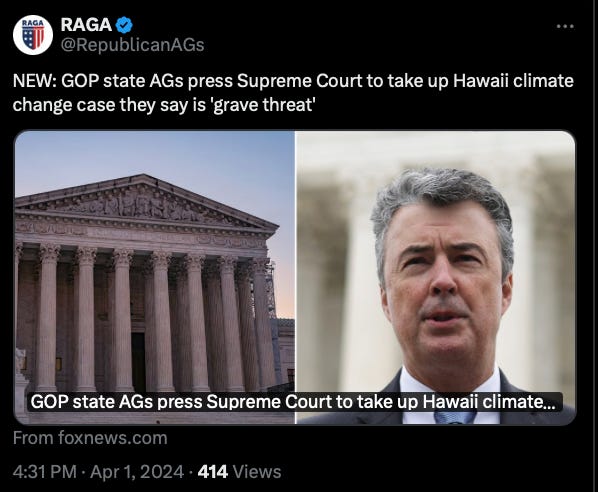
According to research by HEATED and the Center for Media and Democracy, all 20 state attorneys general that signed the amicus brief are not only featured on RAGA’s website, but many were elected with RAGA’s help. The lead counsel for the amicus brief, Alabama attorney general Steve Marshall, was the organization’s chair in 2023. Three attorneys general have served on RAGA’s executive committee (Indiana, Mississippi, and Utah), and five have been chairs or vice chairs (Alabama, Georgia, Montana, South Carolina, and Utah). At least six AGs won their elections with the support and funding of RAGA, including the attorneys general from Oklahoma, Missouri, Kentucky, Louisiana, Iowa, and Idaho. In a statement last year, RAGA celebrated “a 100 percent success rate for RAGA in the 2023 election cycle.” This included the election of Louisiana AG Liz Murrill, which the organization supported with “a substantial, statewide paid advertising campaign.”
“These AGs, their political futures are underwritten by RAGA,” Graves said. “And who underwrites RAGA? The fossil fuel industry, along with Leonard Leo.”
RAGA did not respond to our requests for comment; when HEATED called executive director Pete Bisbee, he said he doesn’t speak to journalists, referred us to a spokesperson, and hung up. (Bisbee has previously been under fire leading the organization that paid for robocalls encouraging former President Trump supporters to protest the election results at the Capitol on Jan 6.)
But public statements, donations, and recordings of private meetings reveal RAGA’s deep ties to the fossil fuel industry. In 2023 alone, RAGA received more than $15 million in donations, and more than $1 million of those contributions came from the fossil fuel industry, according to HEATED’s analysis of IRS tax forms. Over the last decade, RAGA has accepted more than $10 million from fossil fuel companies, electric utilities, and industry trade groups.
Among RAGA’s donors are Koch Industries, Exxon, Chevron, ConocoPhillips, the American Petroleum Institute, and American Fuel and Petrochemical Manufacturers (AFPM)—and these donors have pushed AGs to adopt an aggressive anti-climate strategy.
How RAGA connects fossil fuel companies to AGs
To connect AGs with the priorities of donors, RAGA offers different tiers of access for different amounts of donations. “It’s not technically money laundering, but it has that appearance,” Graves said.
RAGA members who pay annual fees of $25,000 can help shape the organization’s legal strategy via “online RAGA briefing rooms,” for example. And members who pay more than $125,000 are given access to private meetings with attorney generals and invitations to in-person events with them, according to documents obtained by The New York Times in 2014.
In 2016, the Center for Media and Democracy obtained audio from one of those events. Titled “Climate Change Debate: How Speech is Being Stifled,” the session included former Alabama attorney general Luther Strange; AFPM president Chet Thompson;and noted fossil-funded climate denier Myron Ebell.
Together, they talked about the importance of protecting ExxonMobil from lawsuits like Honolulu’s. “We’re facing a coordinated campaign to demonize, weaken and try to destroy the industry,” Thompson said.
But Thompson also said stopping climate liability lawsuits would not be enough to protect the fossil fuel industry. What the industry really needed, he said, was protection from nearly all federal environmental regulation.
What followed was years of litigation led by Republican attorneys general against every environmental regulation worrying Thompson, and more.
RAGA’s goal: industry capture of the U.S. legal system
In 2021, 20 AGs sued the EPA to block its power plant emissions rules, which Thompson specifically called out in the panel. West Virginia v. EPA ultimately went to the Supreme Court, whose ruling significantly decreased the EPA’s authority to regulate emissions.
In 2023, 25 Republican AGs sued the Department of Labor over retirement funds that considered ESG factors, including fossil fuel divestment. Thompson had called out divestment in the panel, too.
In 2024, 10 Republican attorneys general, all members of RAGA, sued the SEC over its climate disclosure rules, which Thompson also called out in the session.
RAGA members have also brought lawsuits fighting the Clean Water Act, limits on vehicle emissions, and the LNG exports pause—all while being paid by the industries that profit from pollution.
But the suits brought by RAGA members aren’t limited to the federal government. They’re also trying to stop localities like Honolulu from trying climate liability cases in state courts. RAGA, and the corporations it defends, want these cases tried in federal courts, where Republican-appointed federal judges are more likely to rule in the fossil fuel industry’s favor.
In fact, the same funders who helped appoint ultra-conservative judges to federal courts also donate to RAGA. Among RAGA’s top donors is the dark money group The Concord Fund, which is affiliated with the Federalist Society’s co-chairman Leonard Leo. Leo is credited with playing moving the federal court system to the right, and was instrumental in appointing multiple conservative justices to the U.S. Supreme Court, including Justices Alito, Roberts, Gorsuch, Kavanaugh, and Coney Barrett.
That network of industry influence has purchased the current anti-regulatory legal environment—and RAGA plays an essential role. “These AGs are willing to let the planet burn as they continue to take funding through RAGA from this industry,” Graves said.
Former Hawaii Supreme Court Justice Michael Wilson went one step further in describing the effect of RAGA in fighting climate change.
“The AGs are violating their public duty to protect the future of their citizenry,” he said. “This partisan political use of the rule of law is what has caused the judicial branch of government to descend to its lowest level of public approval in recorded history.”
ZNetwork is funded solely through the generosity of its readers.
Donate