

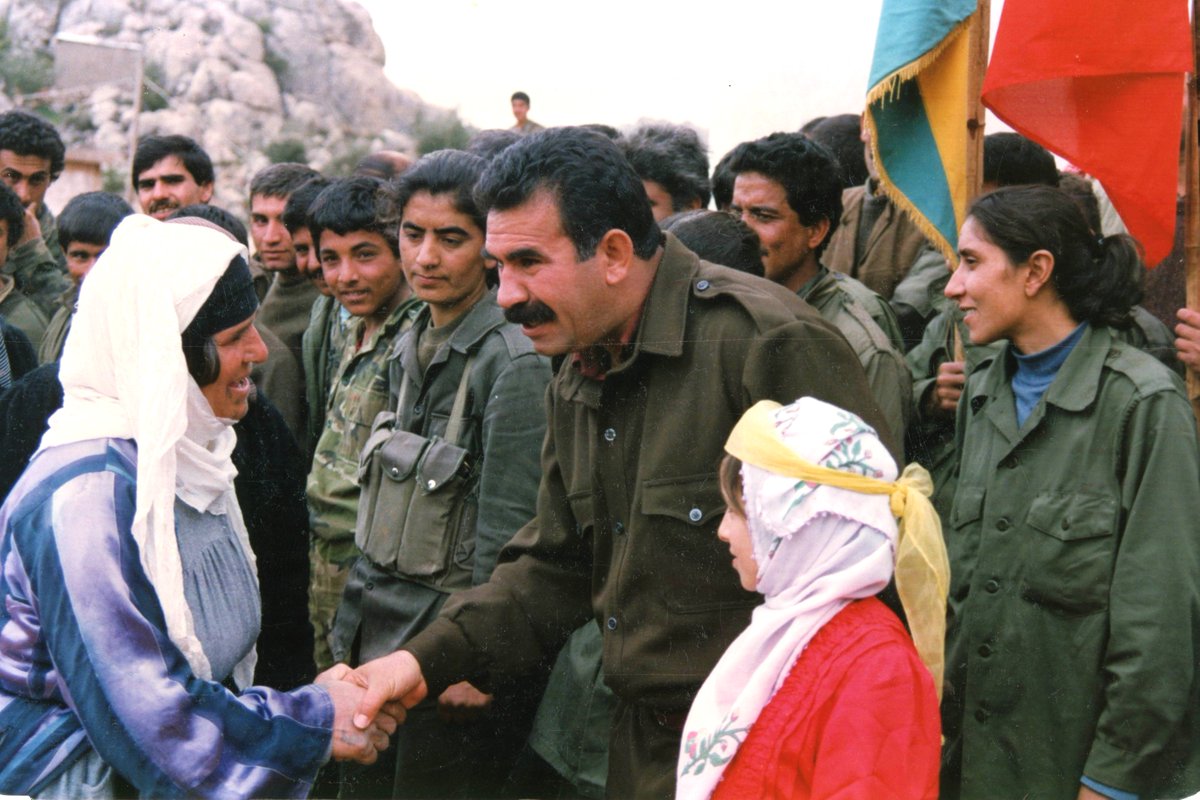
We celebrate the 47th anniversary of the official establishment of the Kurdistan Workers’ Party (PKK) (November 27, 1978).
The emergence of the PKK at the end of the 1970s should be assessed as a moment that triggered a deep rupture, not only in Turkey’s political history but also within the multi-layered social structures trapped in the civilization crisis of the Middle East.
An analysis of this movement’s 47 year trajectory clearly demonstrates the theoretical inadequacy of placing it in the simple category of a national liberation movement.
The PKK is neither merely an ethnically based organization in the classical sense nor a socialist structure that entirely fits the traditional Marxist Leninist template.
What distinguishes the PKK from other revolutionary, left, or socialist movements is not just its existence as a political subject. It is also the creation of a unique theoretical dynamic that re identifies modernity’s three fundamental pillars the nation state, capitalism, and patriarchy essentially as a single, interconnected civilization machine, radically questions the entire historical continuity of this machine, and develops an alternative social ontology against it.
While most movements of the rising left wave in 1970s Turkey were shaped by the determinations of either the Maoist rural revolution model, the Soviet type vanguard party concept, or the Latin American guerrilla tradition, the PKK’s founding core, despite being in contact with these traditions, grasped early on the impossibility of confining the Kurdish reality within these templates.
This grasp creates the historical rupture that would define the movement’s fundamental character. The PKK does not merely become a socialist organization; it tackles the fragmented structure of Kurdish society, marginalized by state civilization for centuries, along with the ancient heritage of Middle Eastern civilization.
And thus, it develops a theoretical reading that details the civilization anatomy of the Middle East while analyzing the historical origins of the modern capitalist system. In short, the PKK establishes a political ontology that blends revolutionary theory and civilization analysis into a single whole.
This approach decisively separates the movement from other left structures. Because most socialist structures lean on a revolutionary strategy centered on seizing power, the PKK early on developed a much deeper analysis of the nature and historical continuity of power.
The idea of transforming society by seizing the state is evaluated not as a solution method, but as a form of hegemony that must be criticized from the very beginning. This evaluation would form the most fundamental theoretical basis for the movement’s transformation spanning many years.
The PKK’s radicalism lies not merely in its militant forms of action but in its way of rethinking society, history, and power.
Given the tribal structures, feudal relations, scattered political culture, and multi identity fabric of Kurdish society, it was clear that classical nation state centered revolution strategies were incompatible with this social reality. Therefore, the PKK had to create a completely new intellectual framework to confront both the historical marginality of the Kurds and the civilization crises of the Middle East.
This framework created a radical theoretical break by uniting the freedom struggle of an ethnic group with the re evaluation of the history of civilization.
The armed struggle the PKK waged throughout the 1980s is only one period of the movement, and its entire theoretical character cannot be limited to the military aspects of this period. What is truly decisive is the unique paradigm that developed concurrently with this struggle. This paradigm exposes how the modern state creates domination through the concentration of power over society, while radically revealing the historical role of patriarchy at its base.
Thus, women’s freedom was considered not merely a secondary element of the movement, but the very subject of the revolution and the fundamental condition for social reconstruction. This point distinguishes the PKK from all other revolutionary movements with clear and sharp lines.
No revolutionary movement in history has placed patriarchy as the founding violence of civilization in such a central position. Precisely for this reason, the PKK’s paradigm produces an alternative definition of socialism: a revolution that does not center women’s freedom cannot move beyond reproducing the state.
The PKK’s transformation became even more pronounced from the 1990s onward with the recognition of the limits of the classical Marxist Leninist organizational form. The end of the Cold War, the collapse of real socialism, and the failure of nation state models compelled the movement toward a new theoretical orientation.
However, this transformation was not a dissolution but an attempt at self transcendence. In this respect, the PKK’s evolution differs from the defeatist dissolutions seen in most left movements. The PKK, during this period, realized not just a political strategic update, but an ontological reconstitution.
This process, termed a paradigm shift, involved shedding all the ideological burdens of modernity and developing an alternative social model called democratic modernity. This model relies on a vision that horizontally organizes social freedom capacity against the state modernity which centralizes power.
This reconstitution’s most shattering aspect is the idea of stateless democracy. This idea directs a radical critique at both the Left’s power centered revolution understanding and liberal democracy’s election focused representation models.
According to the PKK, the nation state is the necessary institutional form of modern capitalism’s mechanism for controlling society. Therefore, achieving freedom within the nation state is impossible.
This critique constitutes the fundamental difference between the movement and all other left structures. Because the classical left often evaluated the state apparatus as a neutral instrument, assuming that society would be liberated once it was seized. The PKK, conversely, argues that the state is the institutionalized form of hierarchy and domination itself.
For this reason, democratic confederalism is proposed as a form of political organization outside the state. This proposal is not merely a theoretical project but has gained a practical sphere of experience. The Rojava experience has emerged as a concrete area for the application of democratic confederalism, becoming an important laboratory for modern political theory.
The significance of this laboratory lies in the fact that a non nation state governance model can find a practical realization. This demonstrates that the PKK is not only an armed organization but an intellectual movement that generates comprehensive social theory.
One of the most important elements evident in the PKK’s 47 year journey is its capacity to continuously criticize its own ideological framework, resist dogmatism, and renew itself.
This capacity, which allows it to scrutinize even concepts considered taboo, completely separates the movement from classical revolutionary structures. Even the concept of leadership is within the scope of this self critique. A moral center has been built that sustains charismatic leadership alongside the collective subject but does not rely solely on personal charisma.
Therefore, the PKK’s understanding of leadership is evaluated not as an authoritarianism that deifies the individual, but as a collective cognitive core necessary for holding together fragmented and dispersed social structures.
The movement’s radicalism is even more pronounced in its approach to forms of social organization. The social system proposed by the PKK is a model that organizes itself in the absence of central power, relies on a communal economy, views women’s freedom as a constitutive element, and makes ecological balance a political principle.
This model assumes that socialism is not merely a problem of economic regulation, but also an ethical, cultural, and ontological problem. This is a radical claim arguing that socialism must be rethought.
The historical experience of the PKK cannot be read solely as an armed resistance or a set of national demands. Because over the 47 year process, the movement has transformed into much more than an organization.
The PKK has become a colossal intellectual political school that generates its own theoretical reference framework, creates its unique concepts, and develops an alternative social ontology against the crises of modernity.
In this respect, the PKK, unlike most 20th century socialist movements, has not limited its existence solely to the goal of establishing a state; conversely, it has identified the state as a problem and argued that freedom is possible through a social reorganization beyond the state.
Today, looking at the 47 year history of the PKK, it is clearly seen that the movement occupies a unique position both in terms of the political geology of the Middle East and global modernity.
As signs of the dissolution of capitalist modernity increase, as the authoritarian tendencies of nation states become more pronounced, and as social inequalities deepen, the paradigms developed by the PKK gain meaning not only for the Kurds but also for peoples facing similar crises in many regions of the world. This moves the movement from being regional to becoming part of global theoretical discussions.
The PKK’s radicalism lies exactly here. It is a powerful political current that integrates all structural contradictions of modernity into a single analysis, develops a new political philosophy to confront these contradictions, and creates social practices where this philosophy is tested.
For this reason, the PKK can be read as a movement poised to fill the theoretical vacuum left by the classical left. What distinguishes it decisively from other revolutionary structures is the continuity of radical ruptures.
The PKK constantly reproduces itself by continuously conflicting with history, modernity, male dominated civilization, and its own past. This form of conflict is a dynamic that protects the movement from dogmatism and continuously makes it unique.
In conclusion, the 47 year journey of the PKK is not only the freedom struggle of the Kurdish people but the history of an alternative political philosophy, a new social ontology, and a radical theory of freedom developed against the crises of modernity.
This history has created a powerful intellectual political heritage that compels us to rethink socialism, places the state at the center of criticism, and carries the claim of re establishing society on the foundation of freedom.
ZNetwork is funded solely through the generosity of its readers.
Donate
