

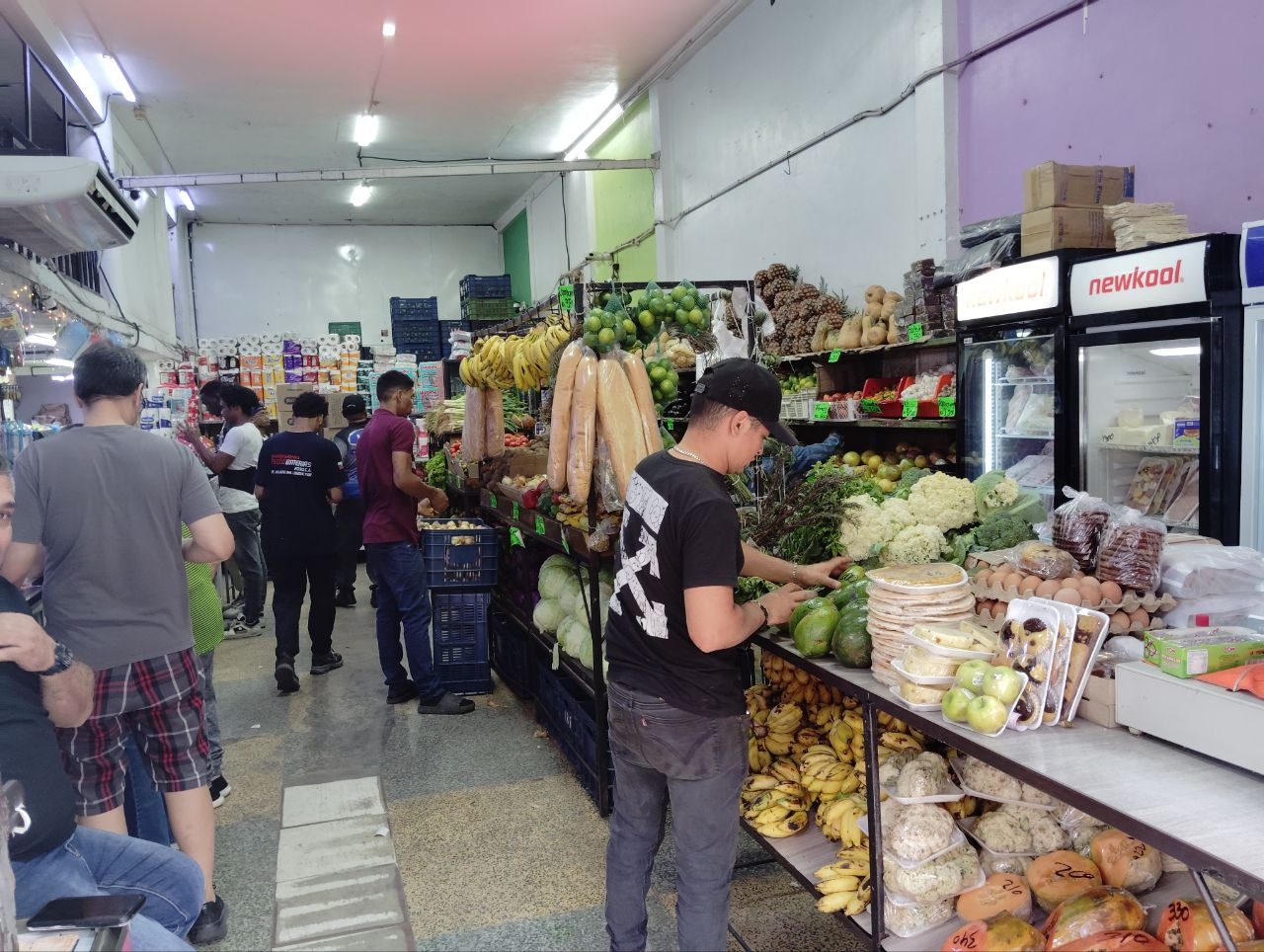
I have now been in Caracas for 48 hours and the contrast between what I have seen, and what I had read in the mainstream media, could not be more stark.
I drove right through Caracas, from the airport through the city centre and up to posh Las Mercedes. The next morning I walked all through and weaved my way within the working class district of San Agustin. I joined in the “Afrodescendants festival”, and spent hours mingling with the people. I was made extremely welcome and invited into many homes – this from a district they tell you is extremely dangerous.
I must admit I had great fun at this bit.
After this I continued on for miles walking through the residential area and through the heart of the city centre, including Bolivar Square and the National Assembly.
In all of this I have not seen one single checkpoint, whether police or military. I have seen almost no guns; fewer than you would see on a similar tour taking in Whitehall. I have not been stopped once, whether on foot or in a car. I have seen absolutely zero sign of “Chavista militia” whether in poor, wealthy or central areas. I drove extensively round the opposition strongholds of Las Mercedes and Altamira and quite literally saw not a single armed policemen, not one militia man and not one soldier. People were out and about quite happily and normally. There was no feeling of repression whatsoever.
Again, nobody stopped me or asked who I am or why I was taking pictures. I did ask the Venezuelan authorities whether I needed a permit to take photos and publish articles, and their reply was a puzzled “why would you?”
The military checkpoints to maintain control, the roving gangs of Chavista armed groups, all the media descriptions of Caracas today are entirely a figment of CIA and Machado propaganda, simply regurgitated by a complicit billionaire and state media.
Do you know what else do not exist? The famous “shortages.” The only thing in short supply is shortage. There is a shortage of shortage. There is no shortage of anything in Venezuela.
A few weeks ago I saw on Twitter a photo of a supermarket in Caracas which somebody had put up to demonstrate that the shelves are extremely well stocked. It received hundreds of replies, either claiming it was a fake, or that it was an elite supermarket for the wealthy and that the shops for the majority were empty.
So I made a point, in working-class districts, of going into the neighbourhood, front room stores where ordinary people do their shopping. They were all very well stocked. There were no empty places on shelves. I also went round outdoor and covered markets, including an improbably huge one with over a hundred stalls catering solely for children’s birthday parties!
Everyone was quite happy to let me photograph anything I wanted. It is not just groceries. Hardware stores, opticians, clothes and shoe shops, electronic goods, auto parts. Everything is freely available.
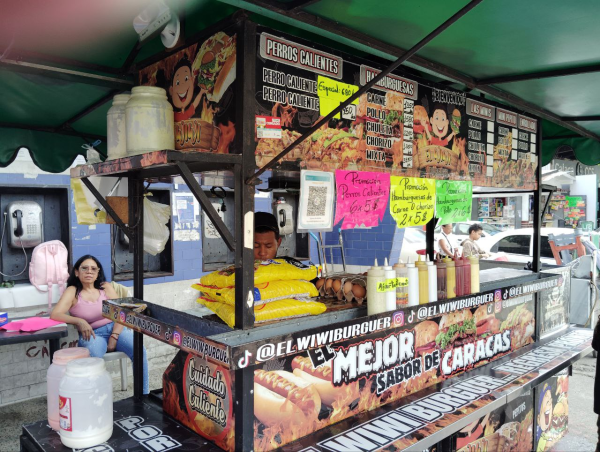
There is a lack of physical currency. Sanctions have limited the Venezuelan government’s access to secure printing. To get round this, everybody does secure payment with their phones via QR code using the Venezuelan Central Bank’s own ingenious app. This is incredibly well established – even the most basic street vendors have their QR code displayed and get their payments this way. Can you spot the QR codes on these street stalls?

To get a Venezuelan phone and sim card for the internet I went to a mall which specialises in phones. It was extraordinary. Four storeys of little phone and computer shops, all packed with goods, organised in three concentric circles of tiered balconies. This photo is just the inner circle. I picked up a phone, sim card, lapel microphones, power bank, multi-system extension lead and ethernet to USB adapter, all in the first little store I entered.
Registering the sim was quick and simple. There is good 4G everywhere I have been in Caracas, and some spots of 5G.
“Relaxed” is a word I would use for Venezuelans. You could forgive paranoia, the country having been bombed by the Americans just three weeks ago and many people killed. You might expect hostility to a rather strange old gringo wandering around inexplicably snapping random things. But I have experienced no sense of hostility at all, from people or officials.
The African festival was instructive. A community event and not a political rally, there were nevertheless numerous spontaneous shouts and chants for Maduro. The Catholic priest giving the blessing at the festivities suddenly started talking of the genocide in Gaza and everybody prayed for Palestine. Community and cultural figures continually referenced socialism.
This is the natural environment here. None of it is forced. Chavez empowered the downtrodden and improved their lives in a spectacular manner, for which there are few parallels. The result is genuine popular enthusiasm and a level of public working-class engagement with political thought that it is impossible to compare to the UK today. It is the antithesis of the hollowed out culture that has spawned Reform.
I am very wary of Western journalists who parachute into a country and become instant experts. Although the stark contradiction between actual Caracas and Western-media Caracas is so extreme that I can bring it to you immediately.
Pretty well everything that I have read by Western journalists which can be immediately checked – checkpoints, armed political gangs, climate of fear, shortages of food and goods – turns out to be an absolute lie. I did not know this before I came. Possibly neither did you. We both do now.
I had lived for years in Nigeria and Uzbekistan under real dictatorships and I know what they feel like. I can tell sullen compliance from real engagement. I can tell spontaneous from programmed political expression. This is no dictatorship.
I am, so far as I can judge, the only Western journalist in Venezuela now. The idea that you should actually see for yourself what is happening, rather than reproduce what the Western governments and their agents tell you is happening, appears utterly out of fashion with our mainstream media. I am sure this is deliberate.
When I was in Lebanon a year ago, the mainstream media were entirely absent as Israel devastated Dahiya, the Bekaa Valley, and Southern Lebanon, because it was a narrative they did not want to report.
Disgracefully, the only time the BBC entered Southern Lebanon was from the Israeli side, embedded with the IDF.
The BBC, Guardian or New York Times simply will not send a correspondent to Caracas because the reality is so starkly different from the official narrative.
One narrative which the Western powers are desperate to have you believe is that Acting President Delcy Rodríguez betrayed Maduro and facilitated his capture. That is not what Maduro believes. It is not what his party believes, and I have been unable to find the slightest indication that anybody believes this in Venezuela.
The security services house journal, the Guardian, published about their fifth article making this claim, and flagged it as front-page lead and a major scoop. Yet all of the sources for the Guardian story are still the same US government sources, or Machado supporters from the wealthy Miami community of exiled capitalist parasites.
What is interesting is why the security services wish you to believe that Delcy Rodríguez and her brother Jorge, Speaker of the National Assembly, are agents for the USA. Opposition to US Imperialism has defined their entire lives since their father was tortured to death at the behest of the CIA when they were infants. They are both vocal in their continuing support for the Bolivarian Revolution and personally for Maduro.
The obvious American motive is to split and weaken the ruling party in Caracas and undermine the government of Venezuela. That was my reading. But it has also been suggested to me that Trump is pushing heavily the line that Rodríguez is pro-American in order both to claim victory, and to justify his lack of support for Machado. Rubio and many like him are keen to see Machado installed, but Trump’s assessment that she does not have the support to run the country seems from here entirely correct.
A variation on this that has also been suggested to me is that Trump wants to portray Rodríguez as pro-American to reassure American oil companies it is safe to invest (though exactly why he wants that is something of a mystery).
Meanwhile of course the USA seizes, steals and sells Venezuelan oil with no justification at all in international law. The proceeds are kept in Qatar under Trump’s personal control and are building up a huge slush fund he can use to bypass Congress. For those with long memories, it is like Iran/Contra on a massively inflated scale.
I am trying to get established in Venezuela to report to you and dive much deeper into the truth from Venezuela. I am afraid I am going to say it takes money. I am looking to hire a local cinematographer so we can start to produce videos. The first may be on what happened the night of the murderous US bombings and kidnap.
I did not want to crowdfund until I was sure it was viable to produce worthwhile content for you. The expenses of getting and living here, and building the required team, to produce good work do add up. I was very proud of the content we produced from Lebanon, but ultimately disappointed that we could not crowdfund sufficiently to sustain permanent independent reporting from there.
So we now have a Venezuela reporting crowdfunder. I have simply edited the Lebanese GoFundMe crowdfunder, because that took many weeks to be approved and I don’t want to go through all that again. So its starting baseline is the £35,000 we raised and spent in Lebanon.
I do very much appreciate that I have been simultaneously crowdfunding to fight the UK government in the Scottish courts over the proscription of Palestine Action. We fight forces that have unlimited funds. We can only succeed if we spread the load. 98% of those who read my articles never contribute financially. This would be a good moment to change that. It is just the simple baseline subscriptions to my blog that have got me to Venezuela, and that remains the foundation for all my work.
Anybody is welcome to republish and reuse, including in translation.
Because some people wish an alternative to PayPal, I have set up new methods of subscription payment including a Patreon account and a Substack account if you wish to subscribe that way. The content will be the same as you get on this blog. Substack has the advantage of overcoming social media suppression by emailing you direct every time I post. You can if you wish subscribe free to Substack and use the email notifications as a trigger to come for this blog and read the articles for free. I am determined to maintain free access for those who cannot afford a subscription.
Subscriptions to keep this blog going are gratefully received.
ZNetwork is funded solely through the generosity of its readers.
Donate




