


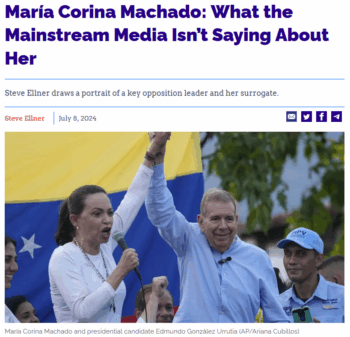
The awarding of the 2025 Nobel Peace Prize to Venezuelan far-right leader María Corina Machado took nearly everyone by surprise (with the exception of insiders who apparently used advance knowledge to profit on betting markets—New York Times, 10/10/25).
The Nobel Committee justified the award on the basis of Machado’s “tireless work promoting democratic rights” and “her struggle to achieve a just and peaceful transition from dictatorship to democracy.” However, Machado’s track record paints a very different picture (Sovereign Media, 10/11/25; Venezuelanalysis, 7/8/24).
Rather than scrutinize the opposition politician’s credentials, the media establishment seized the opportunity to whitewash the most unpeaceful elements in her background in order to advance its cynical pro–regime change agenda targeting Venezuela’s socialist government (FAIR.org, 2/12/25, 1/11/23, 6/13/22, 4/15/20). Not coincidentally, Machado’s award coincided with an escalation of US military threats against Venezuela, meaning that corporate pundits used a “peace” prize as a platform for war propaganda.
Whitewashed profiles

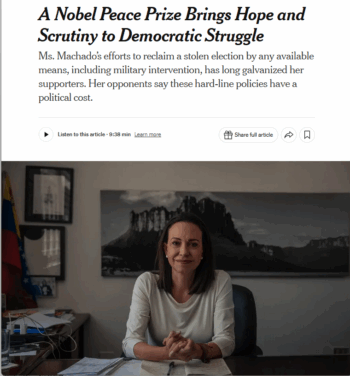
The Nobel Prize meant corporate outlets had to give their readers an idea of Machado’s political trajectory. And though some had profile pieces (Reuters, 10/10/25; New York Times, 10/10/25), there was a concerted effort to conceal the most unsavory elements. The Financial Times (10/10/25) euphemistically stated that Machado “enter[ed] politics in opposition to Hugo Chávez”—president of Venezuela from 1999 through 2013—while the Guardian (10/10/25) summed up that she has been “involved in politics for more than two decades.”
No establishment outlet mentioned Machado’s first relevant political action: supporting the short-lived April 2002 coup against the Chávez government, and signing the infamous “Carmona Decree.” In one fell swoop, this decree did away with all democratically elected institutions, annulled the 1999 Constitution, and established a de facto dictatorship headed by the leader of Venezuela’s corporate business lobby. Machado later denied signing the decree, though her name appeared on a list published by Venezuelan newspaper El Nacional.
Looking past the undemocratic debut, establishment journalists instead started the story with the mid-2002 creation of Súmate, calling it an NGO dedicated to election monitoring or transparency (Bloomberg, 10/10/25; Washington Post, 10/10/25; Reuters, 10/10/25; New York Times, 10/10/25). Yet they did not mention that this alleged quest to safeguard democracy was funded by the US, or that the opposition made unfounded fraud claims after failing to unseat Chávez in a 2004 recall referendum (Venezuelanalysis, 8/21/04, 9/9/04).
Machado’s second act was also the antithesis of peace and democracy, as the opposition politician led the 2014 “La Salida” (“The Exit”) campaign of street violence to overthrow the Nicolás Maduro administration, leaving dozens dead. That same year, in order to denounce the Venezuelan government, she acted as an “alternate ambassador” for Panama at a meeting of the Organization of American States (BBC, 3/25/15). The stunt led to Machado losing her parliamentary seat.
Yet instead of scrutinizing the new laureate’s less-than-peaceful actions, corporate outlets chose to ignore or misrepresent them as “denouncing the regime’s abuses” (Washington Post, 10/10/25), “participating in anti-regime protests” (New York Times, 10/10/25) or “allegations she’d tried to foment a coup” (Bloomberg, 10/10/25). Only the Associated Press (10/10/25) offered a minimal concession that the Machado-led “anti-government protests…at times turned violent.”
Another key aspect of the opposition operator’s political career has been outspoken advocacy for US sanctions, which have caused economic devastation and led to tens of thousands of deaths (CEPR, 4/25/19). But Western media ignored Machado’s lobbying for collective punishment of the Venezuelan people—with the New York Times (10/16/25) a notable exception.
The US-backed figure has also made no secret of her plans to repress her political opponents. Machado is on the record making thinly veiled threats to “eradicate socialism,” and pledging to “neutralize” destabilizing groups should she eventually take power. Factoring in the Venezuelan far right’s history of racist violence (Venezuelanalysis, 3/28/14, 7/30/17), it is not unreasonable to predict a dirty war against Chavistas if Machado ever reached Miraflores.
The company you keep

The reporting on the Nobel Peace Prize plainly described Machado as belonging to the Venezuelan opposition, but few outlets bothered to disclose her political views, apart from euphemistically labeling her a “conservative” (New York Times, 10/10/25; Guardian, 10/10/25) or a supporter of “economic liberalism” (New York Times, 10/16/25; Reuters, 10/10/25).
Machado has heaped praise on far-right former presidents Álvaro Uribe of Colombia, who was responsible for serious human rights violations, and Brazil’s Jair Bolsonaro, who tried to foment a coup.
In February, Machado sent a video message during a “Patriots for Europe” summit, calling for far-right leaders’ support and openly referring to them as “allies.” The high-profile gathering featured neo-fascist parties like Spain’s Vox, Italy’s Lega and France’s Rassemblement National (RN). The same media establishment that paints the likes of Hungary’s Viktor Orban as a threat to democracy (Guardian, 2/7/25; NPR, 4/22/25) chose to ignore Machado’s quite open alignment with his politics.
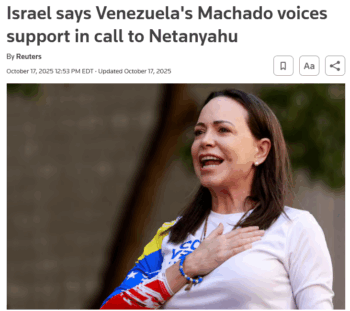
But more damning is the complete erasure of Machado’s outspoken support for Israel, even amidst the recent genocide. Venezuela’s far-right leader has repeatedly praised Israel’s defense of “Western values” and “freedom,” while her party established an alliance with Benjamin Netanyahu’s Likud in 2020. In 2018, Machado penned a letter to the Israeli prime minister, asking him to lead a foreign intervention to “dismantle the criminal Venezuelan regime.”
At a time when the US/Israeli genocide in Palestine has sparked outrage around the world, no corporate outlet found it relevant to mention that this year’s “peace” laureate did not utter a single word of condemnation. On the contrary, according to Netanyahu himself, Machado told the prime minister she “appreciates” his “resolute” actions in a recent congratulatory phone call. Unsurprisingly, only Reuters (10/17/25) briefly reported on the Nobel laureate’s war criminal ally.
Beating the war drums

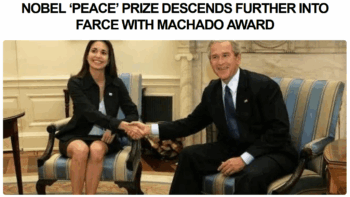
The media establishment’s careful whitewashing of Machado’s undemocratic past and genocidal allies is particularly damning, given the present context of a US military buildup and overt threats against Venezuela. One of the US-backed politician’s most persistent habits has been calling for a foreign intervention against her country (Sovereign Media, 10/11/25).
In the wake of her peace prize, Machado has wasted no time in lobbying for violent regime change. In a BBC interview (10/11/25), she argued that Venezuela needs to be “liberated” via a “coordination of internal and external forces,” an expression she also used in an interview with El País (10/10/25).
Borrowing a page from US administration’s book of redefining concepts such as “imminent threat” or “civilian,” Machado bombastically claimed that the Maduro government “has declared a war” against the Venezuelan people, and urged Trump to help her side “win” this war (BBC, 10/11/25; Infobae, 10/11/25; CNN, 10/15/25). The opposition leader has latched onto the administration’s “narcoterrorism” fairy tale that has been debunked over the years (FAIR.org, 9/24/19; Venezuelanalysis, 9/2/25), just like she supported the White House’s Tren de Aragua narrative, even if it meant a gruesome crackdown against Venezuelan migrants.
Machado has gone as far as to cheerlead the Trump administration extrajudicially executing her fellow citizens, arguing that the lethal US strikes in the Caribbean, which have killed at least 30 people, are “saving lives, not only Venezuelan lives, but also life of American people” (Daily Beast, 10/10/25).
But it is not just Machado using her new platform to promote US military intervention. The Washington Post editorial board (10/10/25) openly expressed that US interests would be “better served” with a “reliable American partner” like Machado. True to form, the Wall Street Journal (10/10/25, 10/12/25) also used Machado’s award to double down on calls for Trump to bomb Venezuela in the name of “freedom” and “democracy.”
The warmonger lineup was complete with the New York Times’ Bret Stephens (10/10/25), who never needs excuses to endorse the murder of Venezuelans in the name of US interests (FAIR.org, 2/12/25). In this case, Stephens claimed that regime change is the only option to address the “catastrophe of Chavismo,” even if it means “full-scale military confrontation.”
The Nobel Peace Prize has long lost any credibility when it comes to upholding actual peace. With Machado’s award, it followed a recent tradition of aligning itself with Western foreign policy. And even more predictable was the corporate media seizing the opportunity to advance its war and regime-change propaganda against Venezuela.
ZNetwork is funded solely through the generosity of its readers.
Donate





1 Comment
Ricardo, I think you dont know anything about the life conditions of Venezuelans. Do you know anything about repression? Criminality? Salaries? People by you getting money from dictators, and totalitarians regimes should be vanished of claiming “reasonable opinions”. Shame on people like you backing dictators.