

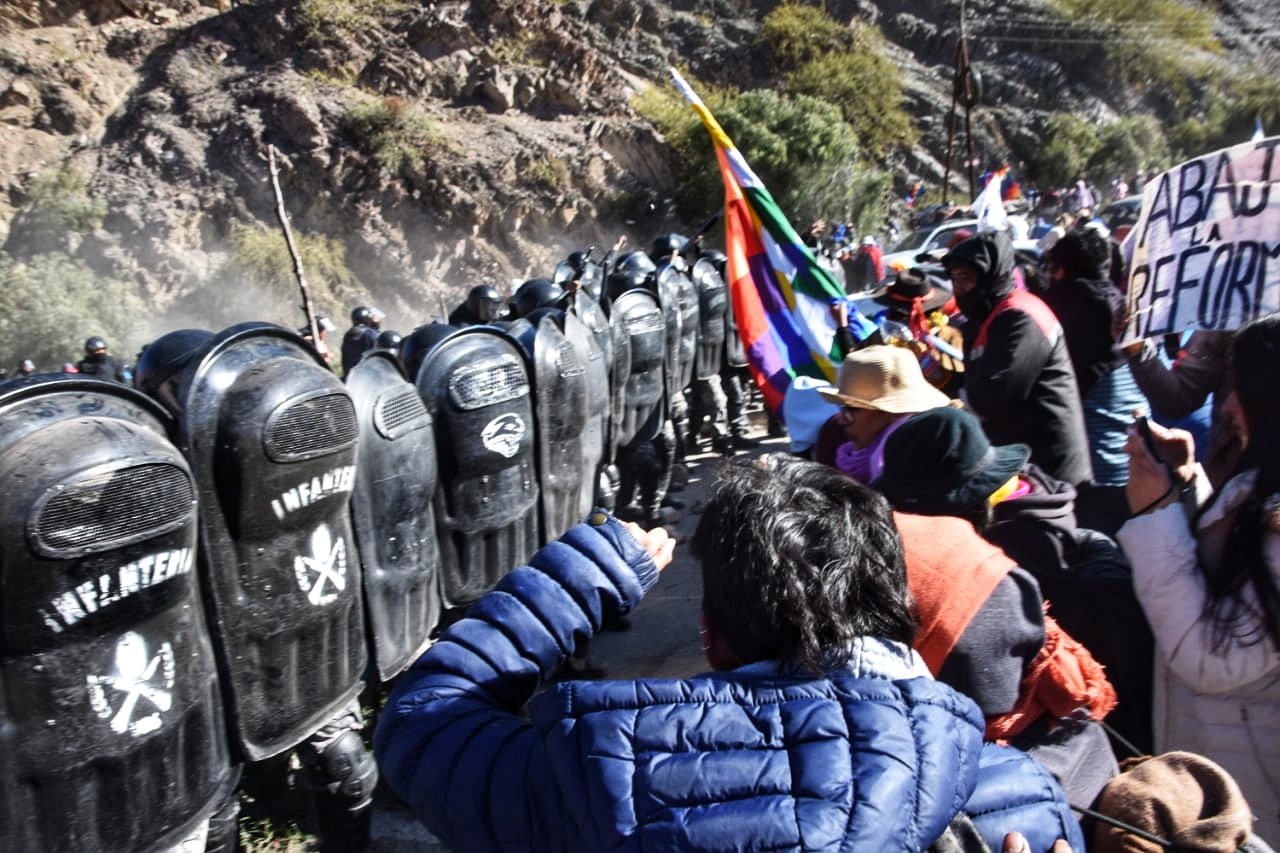
Javier Milei’s government recently suffered a double defeat. The first occurred in the streets, with massive protests against his plan to liberalize land purchases by foreigners. The second took place in the halls of the Argentine Congress, where he failed to secure enough votes to pass the bill as presented. Both defeats point to the same thing: a power project that is beginning to show the limits of its strength.
The bill that the ruling party sought to impose, under the name ‘Law on the Inviolability of Private Property,’ was neither an isolated initiative nor a simple regulatory adjustment. It was part of a broader series of attacks on national sovereignty: establishing mechanisms to accelerate the foreign ownership of land, facilitating external control over strategic resources, and clearing the way for Argentine territory, its common goods, and its decision-making authority over them to become increasingly subordinate to interests outside the country.
In the streets, thousands of people took to the streets to protest this advance. The government responded as it always does when the people organize: with tear gas and rubber bullets, leaving people injured and detained. The repression was not an isolated excess. It is a method. Every time austerity measures encounter resistance, the state reveals its most violent face in an attempt to discipline those it cannot convince.
Because that is what is beginning to crumble: hegemony, the ability to persuade. In the streets, one can feel the weariness in the face of economic austerity that punishes the popular majority while benefiting a handful of concentrated sectors. These austerity measures are neither a technical whim nor a deviation from a well-intentioned plan. They are the form that, in Argentina, a broader strategy of the international New Right takes to subjugate the peoples of the Global South: lowering wages, handing over natural resources, dismantling rights, and calling this plunder ‘modernization.’ Milei does not manage this strategy from an autonomous position; he carries it out as an unconditional ally of a hyper-imperialism that is currently in a phase of decline and, for that very reason, is all the more dangerous: it needs to seize what remains of the Global South to sustain an order that can no longer guarantee well-being, not even in its own centers.
In Congress, the other front, the government also failed to achieve its goals. Attempts to buy parliamentary support—to forge majorities through the offer of positions, promises, and pressure—fell short. It had to back down. First, on the core provisions of the misnamed ‘Law on the Inviolability of Private Property.’ Then with the reform of the Fire Management Act, resigning itself to a scaled-back version. Two setbacks that expose the fragility of a project once believed to be unbeatable.
The mobilization against foreign land ownership revealed something deeper than mere opposition to a specific law. It revealed a breaking point in the ruling class’s ability to build consensus around a social order that benefits only itself. That consensus, which for months seemed solid, began to crack. It remains to be seen how the anger that became visible in the rain, surrounding Congress, will be channeled into organized action.
Vijay Prashad has been pointing out from the Tricontinental Institute that the current cycle of global capitalism offers no solutions within its own rules: the crisis is managed by shifting its costs to the Global South, while local bourgeoisies—now junior partners in that system—apply domestically the prescriptions that international finance capital designs abroad. Prashad insists that no austerity measure of this kind can be sustained without a parallel cultural battle, aimed at presenting as inevitable what is, in reality, a political choice serving specific interests. When that cultural battle begins to lose ground—as happened in Argentina—a rift opens that no amount of repression can fully close.
A glimpse of this was seen in the banner passed around repeatedly by thousands in the crowd—the same one the national team players unfurled after their victory over England in the last World Cup—bearing the slogan “The Malvinas are Argentine.” Since the Malvinas War in 1982, that match has been anything but just another game. The 1986 match, just a few years after the war, was unforgettable: it was the match of the ‘Hand of God’ and the greatest goal in history, both scored by Diego Maradona. Football carries the burden of the claim to the Malvinas Islands, now a NATO base under British control and a platform for the plundering of oil and other common resources of the South Atlantic. That flag struck a chord with the Argentine people—the chord of a sovereignty never fully relinquished, not even when the ruling power insists on negotiating it away.
But no single chord, on its own, is enough to change the course of a country. The anger seen in the streets needs to be organized, channeled, and transformed into a concrete plan. Otherwise, it runs the risk of burning out in the very intensity of the moment, of dissipating into frustration as soon as the tide of mobilization recedes. The task at hand, then, is not merely to resist the next onslaught. It is to build the political force capable of sustaining over time what the streets demonstrated amid the storm: that there is a limit, that this limit must be defended, and that the homeland is not for sale.
This article was produced by Globetrotter.
Julian Bokser is a political activist. He holds a bachelor’s degree in psychology from the University of Buenos Aires (UBA) and is a doctoral candidate in social sciences at UBA. He is a professor in the UBA School of Psychology, at the Colegio Nacional de Buenos Aires / UBA, and in the Master’s Program in Policies on Relations with China (UNPAZ). He has participated in several research teams and published articles nationally and internationally. He is currently the head of communications and institutional relations at the Latin American office of the Tricontinental Institute for Social Research and coordinates the human rights program at the CNBA/UBA.
ZNetwork is funded solely through the generosity of its readers.
Donate




