

During the recent climate summit in Dubai, COP28 president Sultan Al-Jaber, with some exasperation, came out with the following rather amazing statement:
“Please help me, show me the roadmap for a phase out of fossil fuel that will allow for sustainable socioeconomic development, unless you want to take the world back into caves.”
Al-Jabar was posturing when he made this quip about caves, but he can almost be forgiven. We badly need a roadmap for a “phase out of fossil fuel that will allow for sustainable socioeconomic development.” By noting the lack of one, he underscored its absence. This is true even if he spoke as a flack of the fossil fuel cartel.
Speaking of COP28, it helped settle the question of the COPs, which still troubles the climate left. The COPs are easily dismissed as “blah blah blah.” But they are, in a word, necessary. We would be in far greater trouble without them, and this is true even though the COPs are condemned to make decisions by consensus, even though they engender endless greenwashing, even though, with next year’s COP29 slated for Azerbaijan, two in a row will be hosted by straight-up petrostates.
The climate negotiations are finally circling core issues. COP26 saw a decision to “phase down” coal, and COP28 opened with the Loss and Damage fund finally lurching into existence. Then came COP28’s key decision text, which called for “Transitioning away from fossil fuels in energy systems, in a just, orderly and equitable manner, accelerating action in this critical decade, so as to achieve net zero by 2050 in keeping with the science.” Only a month later—with President Biden’s decision to “pause” the approval of new liquified natural gas terminals, a decision the White House explicitly linked to COP28— the meeting demonstrated real world benefits. It could have many more in the future, including outside the United States.
Meanwhile, COP29 is set to see climate finance take center stage, and the next big battle begin. It could (if all goes well) culminate in 2025, where COP30 will be hosted by Lula da Sila’s Brazil, and deliver a meaningful decision on that crucial front. This is not the time to performatively insist that COP stands for “conference of polluters.”
Having said all this, I must immediately add that the climate negotiations have thus far failed, as decisively witnessed by the steadily rising atmospheric carbon-dioxide concentration. COP skeptics are quite right about this. But in their failure the international negotiations are hardly alone. Domestic climate action has had many victories, but it has hardly put us on a path to deep and rapid decarbonization. Nor has the green technology revolution brought planetary emissions into a peak-and-decline pathway. Nor—and this is not easy to say—have the world’s direct action and climate justice movements filled the gaps. Politically, they may be everything, but they too have failed to stop the warming.
One key point: the COP28 text does not simply call for transitioning away from fossil fuels but rather stipulates that this transition must be “just, orderly, and equitable,” a much more challenging prospect. This led Sivan Kartha, a climate equity specialist at the Stockholm Environment Institute, to add that the “deepest fissure” in Dubai was between those who simply want a rapid fossil phase out and those who insist that, to have any hope of success, such a phase out must be fair.
Many of us agree—but what does such fairness imply?
Embracing “Climate Emergency”
It has become fashionable, yet again, to argue that terms like “climate emergency” are dangerously demoralizing. Perhaps they are. Unfortunately, they are also accurate. We really do have to aim for net-zero emission by 2050, and that means facing political-economic challenges that are difficult to exaggerate. As are those posed by the closely related 1.5°C temperature goal.
There are lots of voices telling us that 1.5°C is no longer achievable, but this is not quite true. Rather, 1.5°C remains achievable, but only via “overshoot and decline” pathways in which, sometime after the warming grinds past 1.5°C, we manage to claw it back down. Will we achieve such a mobilization, or at least avoid catastrophe? This is the real question.
We are going to go into 1.5°C overshoot soon. As we do, even if we assume we’ll be able to draw the temperature back down, we can’t know how extreme the overshoot will be, or how long it will last. Some people, Marxist climate hawk Andreas Malm among them, do not think we’ll be able to pull off the necessary drawdown (“I’m not an optimist about the human project”), though he agrees that it is technically possible.
If we seriously intend to keep 1.5°C alive (as a long-term goal—think 2100), we must in the short term do everything to keep the temperature peak “well below 2°C” (the weak end of the Paris target), which is widely judged, by top scientists, to still be achievable. But there’s a hitch. Even this weaker goal demands, per the IPCC, “rapid, far-reaching and unprecedented changes in all aspects of society.” It’s not going to happen in today’s world.
If, in 2050, we are approaching true net-zero planetary emissions, we’ll have a good chance of avoiding a world in which the cascading consequences of the warming become unmanageable. Very rapidly building low- and ultra-low emissions energy systems around the world is a necessary step towards that goal—and because such systems are emerging, and rapidly dropping in cost, it’s possible to be honestly optimistic. But such systems are not going to be enough.
Net-zero 2050 means going beyond the deployment of new, ultra-low emissions infrastructure to also eliminate existing fossil fuel infrastructure. This means that virtually all countries, be they rich or poor, developed or developing, should immediately stop investing in fossil fuel infrastructure, not least because that infrastructure will have to be decommissioned—shut down, mothballed, stranded—long before it’s worn out. All countries must also very rapidly decommission the fossil fuel infrastructure (e.g. existing oil wells, old coal plants) they already have in place—even if it’s profitable and even if people depend on it for their livelihoods. Such a decommissioning process is going to be both expensive and disruptive, in both political and economic terms, and in ways that are particularly hard on poor and insecure populations.
In a world geared for rapid transition, these would be tractable challenges, but that would be a world in which we were speaking honestly about the depth and profundity of the necessary transformation, a world in which we were, as per Australian author and analyst David Spratt, in “emergency mode.” This, obviously, is not our world, which still tends towards greenwashing, soft-pedaling, and small-bore gradualism, if not actual denialism and climate “brightsiding.”
The encouraging possibilities are real, don’t get me wrong.
The green technology revolution really does make it possible for us to save ourselves, and to build new futures. But we’re still facing almost impossible strategic challenges, and justice is at the heart of many of them. Brave choices are going to be necessary, and a political movement that tries to avoid them will not do well when push comes to shove. As it will, within the lifetimes of our children.
A Global Extraction Phase Out
It will be very difficult to engineer a sufficiently rapid phase out of fossil fuel consumption. But the difficulties are even greater when it comes to fossil fuel extraction and production. Think mining, and drilling, and fracking.
There are rich countries like the United States and Norway, which are heavily invested in oil and gas extraction. High-poverty developing countries, like South Africa and India, are heavily invested in coal, while the Democratic Republic of Congo is highly dependent on oil revenue to provide public services. Gulf oil exporters like the United Arab Emirates, the COP28 host, was a developing country before it struck oil. Today, though the UAE may not be “developed” in the same way as, say, the United States or Germany, it is nonetheless a wealthy, high-capacity country with the money and resources to buffer the turbulence that will come with any rapid abandonment of oil.
Which countries deserve more time before they have to stop extracting and selling fossil fuels? The question haunts the climate negotiations, but it is not, in an important sense, the right question at all. The greater truth is that we must stop the fossil energy pipeline, globally and as soon as possible. The right question is which countries need support—financial, political, and technological support—before they can hope to rapidly break their dependency on fossil fuel extraction.
All extracting countries will plead their cases. The most legitimate pleas come from poor developing countries that are highly dependent on fossil-related revenues and livelihoods. But although lots of countries call themselves developing, some of them are a lot richer than others. The good news is that this confusion is dissipating, for reasons that were easy to appreciate in Dubai, the global city of the United Arab Emirate. The UAE, like Saudi Arabia, is an extremely wealthy Gulf oil exporter that, while still officially a member of the “Group of 77” developing countries, is not a developing country at all.
Why must we say this? Because we must transition away from fossil fuels in a “just, orderly, and equitable” manner, and because such a transition is going to be extremely difficult. It is also going to be expensive, which immediately raises the “who pays?” question. Those who wish to evade this question—there are many, and they tend to be rich—seek delay by any available means, and in the next 10 years aggressively rosy predictions about carbon-dioxide removal—which would, if real, make a perfect case for delay—seem certain to play a leading role in their strategies.
In such a situation, with uncertainty layered upon complexity upon emergency, optimism is as much a danger as pessimism. For one thing, it is not at all obvious that we will manage to rapidly draw temperatures back down after they overshoot 1.5°C—Malm’s pessimism may, in the end, be well placed. For another, all efforts to honestly face the severity of our situation will be endlessly harried by soft-pedaling, false solutions, dangerous distractions, and lies. Politicians everywhere will want all the wiggle room they can get, and meanwhile the fossil cartel will move at every opportunity to deflect all efforts to mandate, or even discuss, the strategic demands of an actual planetary fossil-fuel phase out.
Al-Jaber was right: we need that roadmap.
On the Ground, with War in the Air
The climate negotiations are marked by endless skirmishing between global North and global South, which will not abate anytime soon. After all, the planet is still strongly structured by the “uneven and combined development” of the colonial past, and the countries of the global North still host the majority of the world’s wealth.
Despite this skirmishing, which has for decades kept fossil fuels off the negotiating agenda, COP28 saw the fossil phaseout challenge finally take center stage. Activists and diplomats alike saw this challenge as a litmus test that would show if the climate negotiations were fit for purpose. Will the negotiations take up the challenge, or can they be forever derailed and distracted, while the fossil cartel just continues its relentless, exterminist expansion? Perhaps we’ll know in a few years, but just now, after Dubai, a bit of guarded optimism may be in order.
To be sure, not everyone in Dubai connected the brutal logic of the climate reckoning to the larger geopolitical crisis, but this crisis hung palpably in the air. COP28 took place in the Arab world, and Gaza did not seem so very far away. The atrocity of the Israeli bombing continued day by excruciating day, and it could not be entirely separated from the discussions in the conference halls. The pain was acute within civil society circles. Demonstrations took place and were noticed, though they were marginalized by the COP’s security regime. Importantly, the ethos of the protest was an expansive one. The bombing, in particular, was not an isolated consequence of local hatreds. There were larger forces at work. The United States—which refused all talk of climate liability—was more than implicated. The term “settler colonialism” was heard again and again. The war, and war in general, was not a distant abstraction.
COPs are not mere climate meetings. The talk is not confined to carbon budgets and energy-system transformation. International debt relief, for example, is now front and center, as is the need for a radically new planetary finance architecture. The military budget—now over $2 trillion a year—is a common point of comparison, and a reminder that we routinely subsidize violence on a vast scale. The problem of climate is the problem of history, and history is suddenly a very big problem. As the Financial Times noted,
The anecdotal evidence that war is surging round the world is confirmed by the numbers. A recent report by the International Institute for Strategic Studies documented 183 ongoing conflicts around the world, the highest number in more than three decades. And that figure was arrived at before the outbreak of the war in Gaza.
The fraying of the world order is, obviously, a threat to climate cooperation. Beyond this, and beyond the fading illusion that the climate challenge will yield to simple interventions, we’re still only beginning to come to terms with its implacable sprawl. There is little chance of climate stabilization without a political-economic shift that makes robust cooperation possible, but such a shift isn’t going to come cheaply and easily, and simple stories will not help trigger it. How could they when the riddle of climate stabilization is as well the riddle of development, and the riddle of peace?
The Gaza bombing is now on the agenda of the International Court of Justice, where it has joined a crowded docket that includes climate change lawsuits and all manner of other infamies. Nor can these all be laid entirely at the feet of the global North. The two million people of Gaza are currently, and justly, in the spotlight, but spare a thought for another two million people, the Rohingya of Myanmar, who have been murdered and expelled by a huge and terrifying wave of anti-Muslim violence. Southern elites are not innocent.
And don’t forget Russia’s war in Ukraine, which, in addition to its immediate murderous consequences, is a milestone in the global right’s campaign against collective action, including climate action. It has certainly been an enormous setback to the Russian activist campaign for carbon neutrality.
Spinning the Outcome
During COP28’s second week, the negotiations were roiled by the leak of a letter that Haitham al-Ghais, the OPEC secretary general, had sent to the 13 members of OPEC. The letter warned that “pressure against fossil fuels may reach a tipping point with irreversible consequences”, and argued that OPEC members must “proactively reject any text or formula that targets energy i.e. fossil fuels rather than emissions.”
This was not an isolated move. There was also, by accounts, a great deal of arm twisting, and even a Saudi walkout. Jennifer Morgan, a long-time civil society climate strategist who is now Special Envoy at the German Foreign Ministry, went so far as to speculate that OPEC might be in “a bit of panic.” If so, the panic quickly passed. Once COP28 was over, the Saudis argued that the Dubai agreement to transition away from fossil fuels was entirely optional, just one of several “choices” on an “a la carte menu.”
First of all, the OPEC cartel, and the fossil cartel more generally, wants to prevent the transition away or phase down/out frames (the two are essentially equivalent) from taking hold, and argues instead that “emissions” (which can, it is said, be “captured”) are the real problem. This is the greenwashing strategy, and its partisans will use all available arguments in its service, including repeated references to energy justice. Al-Ghais, for example, explains that “Our goal must be to reduce emissions, which is the core objective of the Paris Agreement, while ensuring energy security and universal access to affordable energy.”
OPEC, moreover, has no intention of scaling back fossil fuel extraction. This could change (one must hope) but there is absolutely no chance that it will do so unless the great powers of the global North have already taken the lead and begun their own fossil fuel extraction phase out. Which is why the Biden administration’s decision to scrutinize and hopefully reject a wave of new LNG export terminals, if it survives the counterattacks, could mark a true turning point. Talk, after all, is cheap, and just because a country’s delegation supported phase down/out at COP28 (as did the U.S. delegation) this doesn’t mean its decision makers are ready, and able, to follow through. At the COP, many of them clearly weren’t, as is crisply shown in this December 2023 graphic from Carbon Brief:
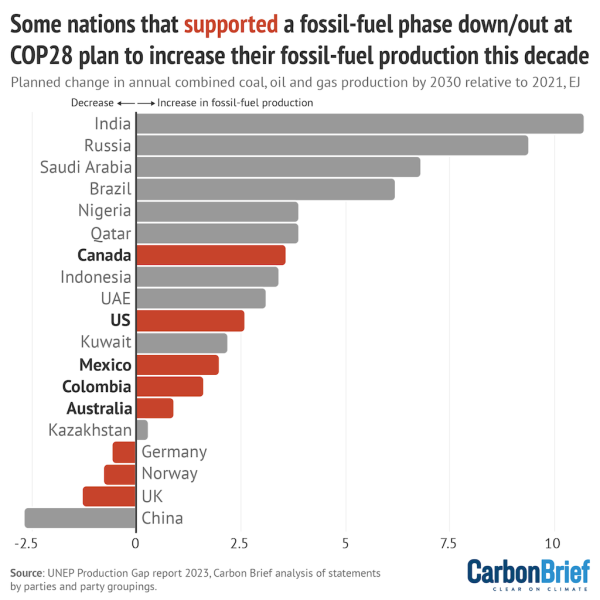
Some countries, or rather the fossil powers within those countries, are planning even greater production increases than the United States is. Some of these (India and Nigeria) are clearly developing countries, while some (Canada, Russia, and Saudi Arabia) are not. Most all fossil-rich countries, whether their history lay with the global North or the global South, are still planning on exploiting their coal, oil, and gas resources for as long as they possibly can, though do note that China is at the encouraging bottom of the chart. All told, despite its complexities, the picture is grim.
At the same time, the climate reckoning is arriving, and it finds us everywhere divided between rich and poor. In consequence, the countries of the global South can continue to make compelling appeals to basic levels of developmental justice, and these appeals cannot be easily dismissed, even when they bleed into PR cover for continued fossil investment. The energy poverty of the global South is deadly real, as is its pressing need—and its right—to a viable development path, as are the obstacles that today’s world system strews in its path.
(Note that this chart is somewhat out of date – Azerbaijan, which holds the COP29 presidency, has since COP28 announced that it is planning on raising its gas production by a third.)
Moving Forward
To succeed, the fossil fuel phaseout roadmap must be reasonably detailed and properly funded. At the same time, it must sharply increase the development and build-out of low-carbon energy systems. In practice, this roadmap has to include nationally differentiated coal, oil, and gas extraction phaseout timeframes detailed enough to be useful to both government planners and political organizers, and financing strategies that can support them.
Given the emergency, these phaseout timeframes will be extremely challenging, as befits the goal of net-zero emissions by or around 2050. We have to be realistic about this, but it’s not a traditional realism that we’re after. Traditional realism tells us that the necessary timeframes are unachievable, in large part because countries always hew to their “national interests,” which can be only slowly changed. Climate realism, on the other hand, tells us that it’s the pace of the necessary decarbonization, not the politics of the day, that is immutable, that the problem of climate stabilization must be seen as a solution to a collective action problem, in which national interests rapidly change.
Collective action problems—commons problems—have a special relationship to justice. So, while I have no idea what the “orderly” part of “just, orderly, and equitable” is going to wind up meaning, I’m confident that justice and equity are going to be key to any successful climate transition.
But what kind of justice? And what shape must it take? These questions bring us back to Al-Jaber’s roadmap, the one for a “phase out of fossil fuel that will allow for sustainable socioeconomic development.” It’s a bear of a problem, but lots of people are working on it. For starters, look at the work of the Fossil Fuel Non-Proliferation Treaty initiative. Or Phaseout Pathways for Fossil Fuel Production within Paris-Compliant Carbon Budgets, the Tyndell Centre report that Dan Calverley and Kevin Anderson published in 2022. Or Economic Diversification from Oil Dependency, a report Vicente Yu, a key G77 negotiator, wrote for the Third World Network. Or the many reports of the Civil Society Equity Review, an international collaborative that, full disclosure, I work closely with. The conversation is still in its early days, but there are lots of good ideas floating around.
Meanwhile, if we’re going to use terms like “economic diversification” and “developing countries,” let’s use them carefully. The challenges here involve “differentiation” between different kinds of countries and different kinds of circumstances, and they are anything but easy. The obvious example is the Gulf oil exporters like Saudi Arabia and the UAE. They may in some sense be developing countries, but they have the money to diversify their economies as they phase out fossil fuel extraction, in ways that other developing countries like Kenya or even India absolutely do not. Harder cases come when you consider countries like China, hybrids that are both developed and developing, or when you take inequality within countries into proper account. For example, Saudi Arabia is traditionally considered to be a developing country, while the United States is the richest country in the world, but both are brutally divided between rich and poor. Somehow, this has to matter.
At the end of the day, the biggest differentiation problem remains the one between the global North and the global South. The challenges here are now widely if not routinely recognized. In Dubai, soon after the COP28 decision was gaveled through, Avinash Persaud, now Barbados’ special climate envoy, noted that “Some activists were disappointed we didn’t commit to an immediate fossil fuel phase out. Still, without the trade, investment, and finance to achieve it, it would either have hit developing countries hardest or been meaningless.”
These points will have to be addressed as the finance challenge—the need for a global financial architecture that can support rapid climate transition—takes center stage. Which brings me to a new report – An Equitable Phase Out of Fossil Fuel Extraction: Towards a reference framework for a fast and fair rapid global phase out of coal, oil and gas—the preliminary version of which was released at COP28 by the Extraction Equity Working Group of the Civil Society Equity Review.
I can’t summarize this report here—though it does sport a fine executive summary—but I do want to explain why its subtitle includes the words “towards a reference framework.” The explanation, basically, is that a detailed climate transition roadmap is not yet possible. An Equitable Phase Out of Fossil Fuel Extraction thus proposes a framework by which to judge the steps that can be taken in the next few years, to at least indicate if they are fair and ambitious enough to have a real chance. To this end, it concentrates on calculating coal, oil, and gas phaseout dates for all major fossil fuel producing countries—here’s a scatterplot with the oil dates; scroll right or left for coal and gas—and on estimating the minimum level of annual international public finance that will be needed to support these phase outs.
This minimum is denominated in “hundreds of billions of dollars” a year.
An Equitable Phase Out of Fossil Fuel Extraction argues that, if we would limit warming to 1.5°C, all countries must immediately cease to build new fossil fuel extraction infrastructure. Further, wealthy fossil fuel producers whose overall economies are less dependent on fossil extraction—such as the United States, UK, Australia, Norway, Germany, and Canada—must phase out all fossil fuel extraction by 2031, while also providing significant financial support to poorer countries that are economically dependent on fossil fuel revenues and employment. Such poorer countries are given until 2050, though they too must be wrapping things up much earlier.
One key point, in all this, should never be forgotten. The “unrealistic” nature of these dates is not the result of any equity-side logic—in which we try to model a fair phase out—but rather derives from the implacable constraints imposed by the Earth’s nearly-depleted 1.5°C emissions budget. To push these deadlines out, say to 2060 or 2070, we must either weaken our temperature goal or we must assume—as the geoengineers will incessantly encourage us to do—that gigatons upon gigatons of carbon-dioxide can very soon, and affordably, and safely, be extracted from the climate system and “sequestered” away.
Back to the Ground
After Dubai, much of the left’s commentary focused on criticizing the late-game negotiations in which “phase out” was replaced by “transitioning away,” as if such diplomatic wordsmithing was only a watering down, as if it revealed the compromised truth at the core of a meaningless negotiation. For the activists embedded in the negotiations, the sense was different. They generally agreed that Dubai had “sent the necessary signal”—despite everything, the world’s governments have decided the fossil economy has to go.
Bill McKibben had the last word on this disagreement when he argued that the “transitioning away” phrase “will hang over every discussion from now on—especially the discussions about any further expansion of fossil fuel energy.” In a nutshell, he argued that the diplomats forged a tool and it’s up to us all to wield it.
The Dubai decision is of course limited. But its real weakness has more to do with loopholes and omissions than with any fine point of diplomatic wording. And the greatest of its omissions is financial: there is no agreement on how the phaseout will be funded. Harjeet Singh, now the Global Engagement Director for the Fossil Fuel Non-Proliferation Treaty Initiative, put the overall picture succinctly and well,
A long-overdue direction to move away from coal, oil, and gas has been set. Yet, the resolution is marred by loopholes that offer the fossil fuel industry numerous escape routes, relying on unproven, unsafe technologies. The hypocrisy of wealthy nations, particularly the USA, as they continue to expand fossil fuel operations massively while merely paying lip service to the green transition, stands exposed. Developing countries, still dependent on fossil fuels for energy, income, and jobs, are left without robust guarantees for adequate financial support in their urgent and equitable transition to renewables. COP28 recognised the immense financial shortfall in tackling climate impacts, but the final outcomes fall disappointingly short of compelling wealthy nations to fulfil their financial responsibilities—obligations amounting to hundreds of billions, which remain unfulfilled.
Harjeet is being diplomatic when he refers to “hundreds of billions,” a figure that echoes the one used in the Equitable Phase Out of Fossil Fuel Extraction report. It seems to be the formulation of choice these days, at least when civil society researchers and activists want to assert financial markers large enough to move the window, but small enough to be taken as realistic.
It’s important to understand that figures of this scale refer to public monies—grants and grant equivalents—and that they’ve lately been sharing the stage with references to trillions, which are typically private monies framed as “investments.” As in Dubai’s high-level Leader’s Declaration, which spoke of the opportunities that lay in “investing $5-7tn annually in greening the global economy by 2030.”
The elites are far more likely to deliver on private finance pledges than on public ones. Investment is something they know how to do. But a future defined by “investment” and “insurance” and “loans” and “aid” is unlikely be a future that takes proper account of even deep decarbonization, let alone the challenges of development in a climate-constrained world, let alone people-centered adaptation and an ethically defensible loss and damage response and recovery system. Which is to say that, unless we win a comprehensive climate finance breakthrough, all hope for a “fair, orderly, and equitable” transition will be abandoned in favor of a short-term neoliberal expediency that is unlikely to deliver the global just transition we actually need.
The challenge here encompasses everything from the historical responsibility of the global North to the debt crisis now wracking the global South to the inequality crisis raging in both North and South. Not to mention the crisis of democracy and the endless techno-economic complexities of the great rebuilding that’s now on the horizon. Bracket all this for now, but know that the next international battle will be fought over finance.
ZNetwork is funded solely through the generosity of its readers.
Donate