
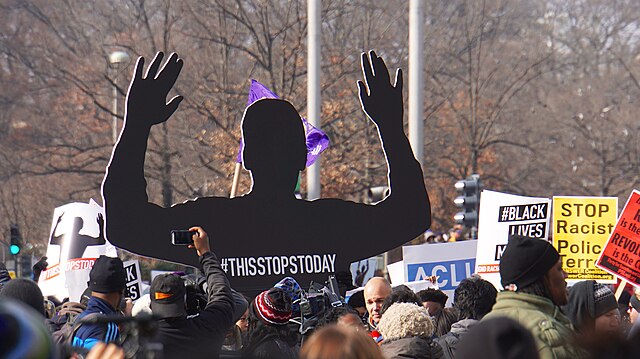
ICE’s servile savagery differs from conventional policing in degree, but not in kind. The same structural reasons that lead to brutality in local police departments applied to a greater degree to ICE even before it became Trump’s personal Gestapo. None of ICE’s action lack precedent among law enforcement agencies.
Take the example of the murder of Renee Good in Minneapolis by ICE agent Jonathan Ross on January 7th 2026. While driving as an observer, she was given conflicting orders by Ross and another ICE agent. Ross cursed at her telling her to “get out of the fucking car!,” firing three shots at her, one through her front window as she swerved around him, the other two through her side window as she was pulling away. At least one witness says a different agent told Good to drive away, though this command was not captured on any of the audio available to the public so far. The witness statement is highly plausible however; quite multiple police shout conflicting commands at people who become victims of police shootings. (For those who think better training is the solution to police violence, Ross has worked for ICE and before that for Customs and Border Control for around two decades, and is himself a trainer.)
A NY Times article “Pulled Over” in October 6th of 2021 documented that law enforcement officers murder of drivers who are not threatening their lives was already a long standing problem:
But in many instances, local police officers, state troopers and sheriff’s deputies put themselves at risk by jumping in front of moving cars, then aiming their guns at the drivers as if in a Hollywood movie, according to body-camera footage. Or they reached into cars and became entangled with motorists, then opened fire.
Often, the drivers were trying to get away from officers, edging around them, not toward them, the footage shows, and the officers weren’t in the path of the vehicle when they fired.
“You see many where bullets are in the back of the car, in the side of the car,” said Geoffrey Alpert, a criminologist at the University of South Carolina who has researched high-risk police activities for more than 30 years. “In the high 90 percentile of cases I’ve seen, the person’s just trying to get away.”
You can find instances of just about everything ICE does in the so-called US Justice system. Officers bluffing or bullying their way into places where occupants legally have the right exclude them happens constantly. Nearly 750,000 civilians were threatened or injured by police in 2022 in the US, around 94,000 of whom sought medical treatment. Prisoners die from violence or neglect in jails and prisons of all types, not just ICE facilities. One hint of the cruelty of our system of imprisonment: for every year a person serves in prison or jail, they lose two years from their lifespan!
How then does the cruelty of ICE and of US Customs and Borders differ from that of normal cops? Part of that difference is the mission of ICE and Border Control. Most law enforcement makes a distinction between civil, misdemeanors and felonies. But ICE and its sister agency spend most of their efforts going against civil infractions. (Being a non-citizen in the US without proper documentation is a civil offense, not even a misdemeanor.) Although, prior to Trump’s second term they also went after actual felony violations, smuggling, and cross-border gang activity, the primary target in practice has always been ordinary people fleeing extreme poverty or gang or political violence who were not guilty of any criminal offence. Because the primary targets were less likely to commit violent crimes than US citizens, ICE and Border agents risked much less by brutalizing suspects than normal cops. This distinction reflects a more fundamental difference between ICE/Border Control and other police agencies.
Law enforcement in the US has three roots: militias to drive out and murder American Indians and steal their land, night watches to protect the rich from the rest, and slave patrols to detect and return escaped enslaved people. Today there are broad attempts to treat these roots as controversial. But, before it was widely understood that they could lead to conclusions critical of the police, these were taken for granted across the political spectrum.
For example, Allan R. Millett and Peter Maslowsk’s For the Common Defense: A Military History of the United States of America, an excellent military history that is quite conservative in viewpoint, but whose first edition was in 1984, provides an excellent gloss on militias, slave patrols and night watches as foundational to policing, almost in passing. They start by describing how militias were the primary military instrument against American Indians in earliest colonial New England. But they go on to explain that such militias were not very effective “…The militia failed to perform its theoretical defense function, and in a war’s early stages, the frontier invariably retracted towards the more heavily populated seaboard.”
Then Common Defense continues: “The militia was more effective as a local police force or a standby posse comitatus. It preserved the domestic peace, protected propertied and privileged colonists from the disadvantaged elements within society and quelled movements against the established political order. Militia frequently performed crowd control duty. In the south, colonists merged their slave control patrols with the militia and converted it into an internal police force to recover fugitive slaves and suppress slave insurrections. New Englanders in essence converted their militia into a civil police force by merging it with the night watch.”
A quite conservative, but extremely competent, pair of historians in 1984 were describing anti-Indian militias, slave patrols and night watches as the roots of American civil policing, not as something novel, but as something well known, something to mention in passing, so as to move on to how expeditionary military forces were constituted going forward.
However, while class and race oppression remains fundamental to policing, policing also performs socially necessary tasks, albeit often poorly. For example, traffic tickets to discourage reckless driving is socially beneficial. For a specific comparison, NYC has far better traffic law enforcement than Rio De Janeiro, even though neither city does a great job. But because NYC does manage to enforce its traffic laws far better than Rio, it has one third the traffic fatalities per 100,000 of the Brazilian city. I’m not saying that police forces as presently constituted are net social goods, merely that they do include needed functions that need performing, probably by institutions that have very little in common with law enforcement today.
ICE and Borders & Customs have many fewer socially beneficial responsibilities than normal police agencies. The roots of policing in class and racial oppression are almost undiluted. That is one reason, long before Trump, ICE and its predecessor agency were more violent and dishonest than most police forces.
I don’t want to suggest that the slight dilution of the roots of policing in normal police agencies erases those roots or makes normal police forces a bunch of Officer Friendlies. As pointed out earlier in this article, rudeness, dishonesty and unjustified violence are routine in all police departments. If you believe that most law enforcement officers are in fact Officer Friendly, and that what is wrong is law enforcement is due to a few bad apples, attend a demonstration where the authorities decide it is out of control and the cops are fully unleashed. What you will face is a police riot, where every cop indiscriminately beats or arrests everyone they can reach. In those circumstances, no cop present will be a “good apple.” They will all take part. I will add that Black people, Indians, and other people of color face cops in riot mode a great deal of the time, even when a mass police riot is not occurring.
That, I think, is a good lens to view how a Gestapo or a Stasi or an ICE function; they transcend the normal brutality of the everyday police to become a permanent floating police riot.
Sources:
Kim Barker, Steve Eder, David D. Kirkpatrick and Arya Sundaram. “Pulled Over.” NY Times November 6th 2021. https://www.nytimes.com/2021/11/06/us/police-traffic-stops-shooting.html or https://archive.is/f74g3#selection-577.2-597.13
Evelyn J. Patterson. “The Dose–Response of Time Served in Prison on Mortality: New York State, 1989–2003.” American Journal of Public Health March 2013: 103(3): 523–528. https://www.ncbi.nlm.nih.gov/pmc/articles/PMC3673515/
Peter Silver. Our Savage Neighbours: How Indian War Transformed Early America: WW Norton (October 30, 2007). it describes how Indian Wars shaped colonial consciousness, including creating a sort of pre-racism very different from our current form of racism, but still is one of the roots of today’s form. But it also describes the atrocities committed by these early militias against Indians, and how military action against American Indians was one of the primary motivations for creating these militias.
Allan R. Millett and Peter Maslowski. For the Common Defense: A Military History of the United States of America 3rd Edition. Free Press (September 7th,1994). This is known as an excellent *military* history, though it is deeply racist in its view of American Indians. But it also contains a magnificent paragraph on how the militias, initially intended for military action primarily against Indians, soon proved unsuitable for military purposes, and instead became the core of civil policing.
Bill Chappell and Juliana Kim. “The Killing of Renee Good by an ICE Agent in Minneapolis.” Iowa Public Radio Weekend All Things Considered – NPR: January 8, 2026. https://www.iowapublicradio.org/news-from-npr/2026-01-08/what-we-know-one-day-after-the-killing-of-renee-good-by-an-ice-agent-in-minneapolis Description of the murder of Renee Good.
Michael T. Light. “Unauthorized Immigration, Crime, and Recidivism: Evidence from Texas.” National Criminal Justice Reference Service. January 2024. https://www.ojp.gov/pdffiles1/nij/grants/308552.pdf Undocumented immigrants commit violent crime at half the rate of citizens, and property crimes at one quarter the rate.
Susannah N. Tapp and Elizabeth J. Davis. Table 3 In “Contacts Between Police and the Public, 2022.” U.S. Department of Justice, Office of Justice Programs, Bureau of Justice Statistics. October 2024 page 5. https://bjs.ojp.gov/document/cbpp22.pdf Total estimated number of contacts between police and civilians that lead to threats of violence or actual violence against those civilians
WISQARS Web-based Injury Statistics Query and Reporting System
WISQARS Fatal and Nonfatal Injury Reports
Legal Intervention All Causes Nonfatal Emergency Department Visits and Rates per 100,000
Data Years: 2023, United States, All Ages, All Sexes, Disposition: All Cases
Accessed 1/10/2026 3:24 PM
Number of civilians who sought medical attention due to injuries from police violence.
Readers may contact Gar W. Lipow at [email protected], or on BlueSky at @garlipow.bsky.social or on Mastodon at @GarLipow
ZNetwork is funded solely through the generosity of its readers.
Donate