
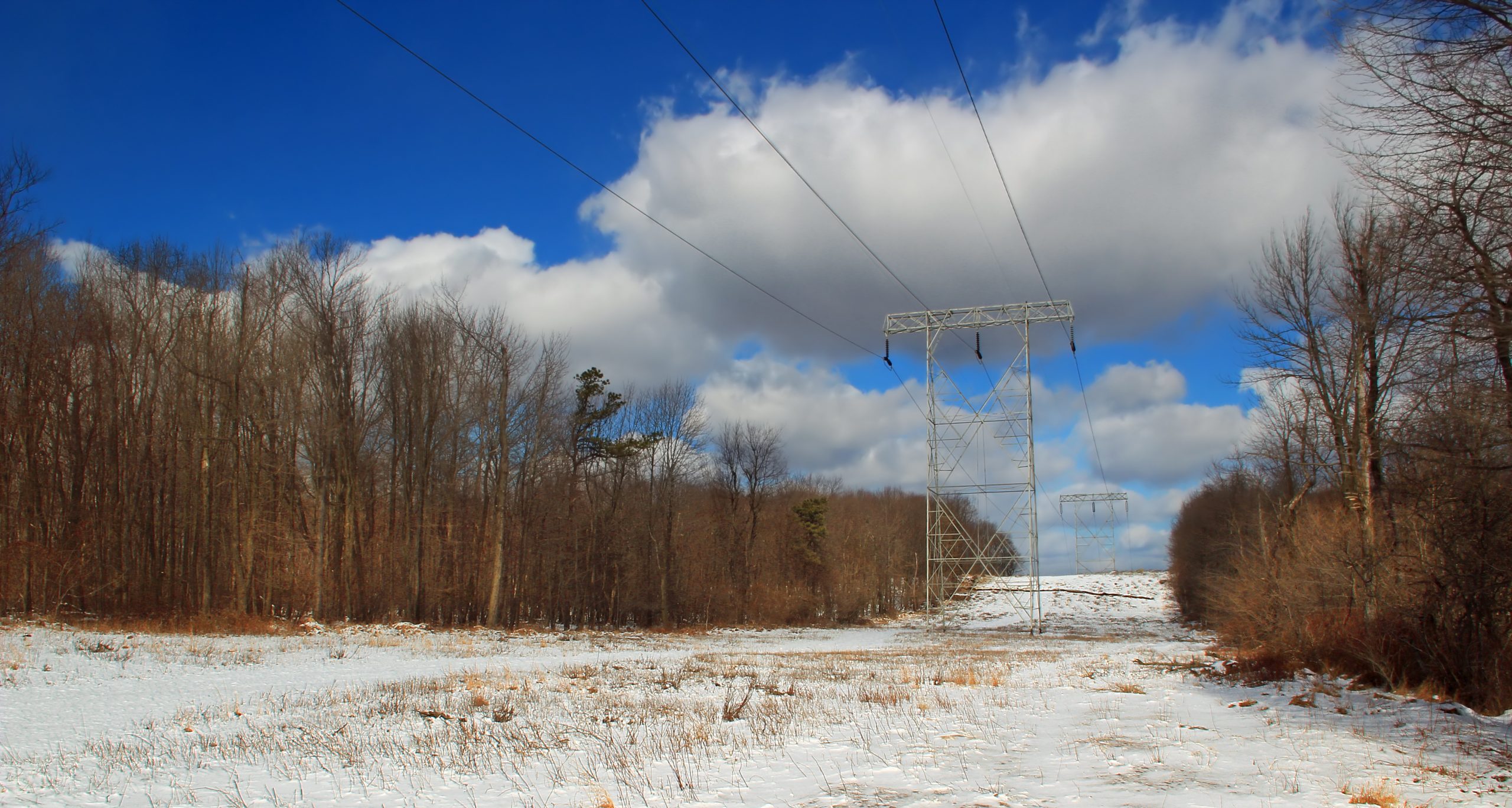
Mention “renewable energy infrastructure” and most people will probably picture solar and wind farms out in the country. What’s usually not envisioned is how the power from these often remote sites is brought to the cities and towns where it’s used. Obviously that part is essential, and it’s accomplished with high-voltage transmission lines, usually aerial (rather than buried). “High-voltage” is anything from 115 kilovolts (kV) up. For long distances, 354 kV and 500 kV lines are common.
Currently (no pun intended) the US has 200,000-240,000 miles of high-voltage transmission lines. In order to decarbonize or electrify the nation’s energy supply, many miles of new transmission lines would be needed. How many? The most commonly mentioned estimate is to double the present amount by 2035. However, according to a well-known and oft-cited Princeton study, two to five times as much will be required by 2050 to reach net-zero, which translates to a million or more new miles of lines.
Transmission lines are not benign structures. They have their own environmental impacts, both on-site and off-, that are not trivial. Besides the lines and towers themselves, there are also transformers, substations and other related infrastructure including roads.
On-site impacts include:
- Habitat loss (locally)
- Habitat fragmentation (regionally)
- Bird injury and death
Off-site impacts result from the manufacturing of the components themselves, and include everything from raw material extraction to component manufacturing to transportation.
Habitat loss / degradation
The right-of-way (ROW) for transmission lines must be cleared for construction, and kept clear for maintenance. Trees are cut down. Shrubland or grassland is mowed, mulched and/or masticated (chopped). Other actions might include grinding out stumps and applying herbicides. Ground-dwelling creatures including mammals, insects and birds lose their homes at least temporarily. Some are crushed during the process. Soil compaction from heavy equipment is a common result, which can lead to issues with hydrology (erosion, flooding and less percolation into the water table) and soil structure (reduced aeration and microbial activity, and more difficulty for roots to penetrate). Restoration activities may or may not be a phase of the project, with those that affect human endeavors more likely to be prioritized (like erosion control to prevent road washouts or blockages).
Over the entire course of a transmission line, acres will be cleared this way. Just how many depends on the width of the ROW. The minimum ROW depends on the voltage being carried, with higher voltages requiring wider ROWs. For common voltages and typical ROWs in the United States:
115 kV line = 100 ft ROW = 12 acres/mile of line
230 kV line = 125 ft ROW = 15 acres/mile of line
354 kV line = 150 ft ROW = 18 acres/mile of line
500 kV line = 200 ft ROW = 24 acres/mile of line
A multi-line ROW might be up to 300 ft wide, which would be 36 acres/mile of line. (An acre is roughly the size of an American football field not counting the end zones.)
![Scale is in meters, not feet. 50 m = 164 ft. [Source: Reddit.]](https://macskamoksha.com/wp-content/uploads/2025/12/transmission-tower-capacities-with-increasing-tower-heights-v0-mj5o96whr0u81.webp)
These figures don’t reflect the full amount of affected land since, during construction, wider areas are typically cleared in particular sections for staging equipment and materials, earth-moving, and temporary roads.
To put this into perspective, for a 200 acre solar farm sending electricity to a substation four miles away on a 115 kV transmission line, 48 acres would be cleared for the right-of-way, increasing the total habitat degradation of the project by almost 25%. For a 1000 acre solar farm producing for a city 50 miles away using 500 kV lines, the total footprint more than doubles, adding 1200 acres in ROW. In practice, several power stations whether wind, solar or otherwise can share transmission lines if they are along the same corridor. Regardless, the footprint of habitat loss/degradation for a transmission line is an overlooked source of environmental impact with these projects.
Long-term maintenance of these ROWs entails on-going vegetation management including more mowing, chopping and (too often) herbicides. Some utility companies are seeking more sustainable practices like not spraying, not mowing during particular bloom times or nesting seasons, and not bringing in heavy equipment when the ground is wet, etc. Some regulations do exist in various jurisdictions to limit harmful activities, but they are inconsistent. In the best case scenario, a ROW can be managed as early successional habitat for local flora and fauna. While such efforts are definitely laudable, and we should encourage them wherever we can, the most ecological ROW is the one that doesn’t happen.
A note about substations
Besides the towers and lines themselves, substations are integral to transporting energy from generating plants to end users. Substations perform a number of functions including connecting generating plants to the grid, stepping voltage up or down, eliminating surges (including from lightning), changing between A/C and D/C, regulating voltage consistency, and switching circuits into or out of the grid (i.e., bringing on a new line, or shutting one down for maintenance).
You’ve definitely seen substations before, as they are commonly found in urban, suburban and rural areas. On long-distance high-voltage transmission lines like the ones that carry electricity from remote solar and wind power stations, the route will have several substations along the way. For example, on this map of the SunZia project, which will transport electricity generated by windmills in central New Mexico 550+ miles to southern Arizona, there are substations at either end and three in the middle. (The multiple black lines show various proposed routes.) Btw, this is the largest windmill project currently under construction in the Western Hemisphere, and I’d never even heard of it until researching this article.

Substations come with their own environmental impacts including:
- habitat loss to the substation’s footprint and immediate surrounding
- disruption to soil and hydrology during construction
- permanent roads for access
- noise pollution (they make buzzing sounds)
- light pollution if illuminated at night for security
- herbicide use to control vegetation
- EMF radiation
Habitat fragmentation
A transmission line right-of-way splits a landscape. The resulting break-up of habitat into parts is what we mean by “fragmentation.” Natural dynamics are changed across the whole area, and within each part.
The ecological make-up of the ROW diverges from the surrounding landscape, sometimes drastically, sometimes less so. In a forest, the ROW is essentially a long, narrow clear-cut (as is a road or a railroad track). The contrast is sharp between shady and sunny, sheltered and exposed, multilayered and low. In a shrubland, scattered woodland, or desert, the distinction is less visually stark, but can be detected in the absence of older perennials and a higher prevalence of pioneer species, many of them annuals. The more arid the landscape, the more persistent the scar of the ROWs construction will be, which is why these projects are so harmful in deserts, where so many large solar and wind projects are planned. In a prairie, annual grasses will likely make up a greater percentage than in the adjacent areas, and many non-grass plants like wildflowers will be missing. Due to regular maintenance of the ROW (mowing, chopping, herbicides, etc.), the disparities will persist.
In all these cases, what we’re seeing is a break in the continuity of the landscape, which will inevitably affect the ecological relationships established there previously among plants and animals.
As it turns out, a linear disturbance like a right-of-way has different characteristics and effects than a polygonal one of the same area. Much more of a linear disturbance is edge, often abrupt edge. For example, a twenty mile long section of 150 ft wide ROW takes up about 360 acres and has 40 miles of edges. A square-shaped clear-cut of the same size has only about three miles of edges.
Edge effects are a well-documented subject in ecological studies, and are neither positive nor negative. People who have studied Permaculture will already be knowledgeable about this. Edges have high biological diversity compared to the ecosystems that come together along them and are the preferred habitat of some species. However, in the case of a transmission line ROW, the straightness and abruptness of the edge doesn’t really have an analog in nature, so novel things happen.
For example, “windthrow” mortality is a well-known phenomena in which uncut trees along the edge of a clear-cut are more likely to fall even though they are otherwise healthy. Formerly they were sheltered in the interior, but now they are exposed to higher wind speeds—sometimes from wind tunnel effects made by the narrow shape of ROW itself—and to increased turbulence. Their stability is also compromised underground: formerly, their roots were interlaced with neighbors who are now missing; changes to hydrology and soil structure can adversely affect their hold; and rotting stumps left in the ground in the ROW can be vectors for disease. Trees can also be injured by more exposure to sun and frost than they previously experienced. The result of all this is that trees that might appear to have survived the clearance event intact were in fact jeopardized, and their days are numbered.
Foraging and hunting relationships are also altered by linear disturbance because of its novel characteristics. One well-known case involves Cowbirds, who are “brood parasites,” meaning they don’t build their own nests, instead laying their eggs in the nests of other birds who end up raising them. As part of this behavior Cowbirds will sometimes push other eggs out of the nest. In normal circumstances, this isn’t problematic, but the edge habitat provided by the ROW leads to higher-than-normal populations of Cowbirds, and thus more pressure on the birds whose nests are being parasitized. This example has been documented but many others surely have not.
The local movement and regional migration of animals is affected by ROW-induced fragmentation too. Shade-dwelling creatures will not cross a transmission line ROW because it’s too sunny. Their populations end up becoming isolated in each fragment, which long-term can lead to genetic bottlenecks. Human-shy animals will avoid a ROW or travel long distances to cross at a narrow section. They end up expending more energy this way, which can be hazardous during a seasonal migration. Even birds are affected; some species stay low to the ground, seeking shelter in vegetation, and the ROW makes a boundary they might be hesitant to cross. Out there in the open, they’re more vulnerable to raptors, who often use the transmission towers as perches for scoping out prey.
The negative effects of a linear disturbance can be mitigated somewhat. For example, rather than clearing trees in a straight line along the ROW, the edge can be “feathered” or “scalloped.” Basically, a transition zone is created, 50-200 ft wide on either side, where vegetation is thinned in a gradient, from more open to more dense as you go further from the ROW. The goal is complexity, rather than the stark simplicity of an abrupt border. When done right, a feathered edge lessens wind tunnel effects and turbulence (decreasing windthrow), and softens the transition from sheltered to exposed, moderating effects of sun and temperature, all of which is appreciated by flora and fauna alike. Of course, the best artificial linear disturbance is the one that never happens.
Bird injury and death
Besides all of the above impacts of transmission line ROWs, wildlife are harmed by the physical equipment itself, mostly through literal impact. As in, birds are killed or injured when they run into the lines while flying, or are electrocuted. The birds who are most likely to run into lines are large raptors who patrol back and forth over the open area looking for prey, migratory birds who travel by night, and low-flying birds who fly at dusk. For all these birds, the thin lines are difficult to see in the best of conditions so low light levels only worsen the threat. Bat are also victims to the collisions with the lines.
Electrocution happens when a bird lands on a tower and inadvertently touches an energized component and a grounded one simultaneously, which completes a circuit and zaps them. If they are not killed immediately they can be badly burned or injured, and suffer for some time before passing away.
A conservative estimate is that tens of millions of birds are killed annually by transmission lines in these ways.
Off-site impacts
Transmission towers and power lines are not conjured out of the ether on site. Their components are manufactured elsewhere, from materials mined somewhere else. So those places are also impacted, though they might be distant from the cleared right-of-way. Following the supply chain for everything involved would take up a book, so I’ll just focus on the two components needed in the most volume: steel and aluminum.
When I started researching this topic, I assumed that long-distance high-voltage lines are made of copper, but that’s not true. Aluminum and steel are the main materials, with aluminum conductor steel reinforced (ACSR) cable being the most common. ACSR has a galvanized steel core wrapped in high-purity aluminum. Copper is a better conductor than aluminum, but aluminum is cheaper per pound and lighter-weight (meaning towers can be farther apart), making it more economical even though more aluminum is needed than copper to carry the same amount of voltage.
![ACSR cable. [Credit: ClarkMills, CC BY-SA 3.0, via Wikimedia Commons.]](https://macskamoksha.com/wp-content/uploads/2025/12/Sample_cross-section_of_high_tension_power_pylon_line.jpg)
Steel
The steel wire is made in a multi-step process that involves hot-rolling steel billets into rods, cold-drawing the rods through dies, heat-treating them, carefully cooling them, and then galvanizing them. Galvanizing adds a layer of zinc, which is done either by dipping the rods into molten zinc or using an electric current. This is a complex industrial process involving high energy use in a dedicated facility that I have summarized very briefly here.
I started with the steel billets, which are a semi-finished “feedstock” but the process begins before that, with the production of steel itself. Again, very briefly: Iron ore is heated in a 2912°F blast furnace with coal and limestone. The coal acts as a fuel which makes the the iron molten. The limestone removes some impurities. The resulting product is “pig iron.” Next the molten pig iron is made into liquid steel either through blowing oxygen through it or using an electric arc furnace, which are both high energy processes. After more refinement, the liquid steel is poured into water-cooled molds to solidify. Billets are one of the products made from there.
![South-facing aerial view of Cleveland Works steel mill on both banks of the Cuyahoga River. At middle left is one of two blast oxygen furnaces. [Credit: Nickknack00, CC BY-SA 4.0, via Wikimedia Commons.]](https://macskamoksha.com/wp-content/uploads/2025/12/Cleveland_Works_aerial_view-scaled.jpg)
Steel production has numerous environmental impacts:
- ~7% of total human CO2 emissions annually—I was astonished to learn that “In the end, the emitted greenhouse gases weigh roughly twice as much as the steel itself” [source].
- other air pollutants including particulates, nitrogen oxides, sulfur oxides and carbon monoxide
- enormous use of water use for cooling and cleaning
- wastewater contains contaminants like cyanide, ammonia, lead, arsenic, and mercury
- hot wastewater pumped into bodies of water harms aquatic organisms
- “slag,” the waste product of refinement, is super toxic
Last but not least, iron-ore mining is an environmental nightmare. Whether the ore is extracted open-pit or underground, the area is a total sacrifice zone for all living things, and is hazardous for the workers. Some of the biggest machines ever made operate at iron-ore mines, and huge amounts of energy are needed at all steps. The toxins that result from the processes poison the landscape for years. This subject could easily be its own essay.
![Gol Gohar iron ore mine, Iran [Credit: Fars Media Corporation, CC BY 4.0, via Wikimedia Commons.]](https://macskamoksha.com/wp-content/uploads/2025/12/Gol_Gohar_iron_ore_mine_2019-10-23_04.jpg)
Steel-making is one of the most energy intensive processes that humans engage in. Due to the high heat necessary, it can not be done with renewable energy. The coal is irreplaceable. Steel itself can’t be substituted in things like transmission towers and cables. As long as we have an industrial society, we will need steel, and therefore non-renewable energy sources. There is no “green energy transition” without it. My question, as always: how “green” is it with it?
Aluminum
The aluminum strands in the aluminum conductor steel reinforced (ACSR) cable are formed from rods by pulling them through dies. Lubricants are applied to prevent damage, and these are toxic. Finally the wire is heated and then cooled in a controlled manner to make it bendable.
Producing aluminum is a more complex process than steel, and frankly I don’t understand it. What I can say from my research is that the starting point is bauxite ore, which is subjected to crushing, dissolving, high pressure, washing, heating, cooling and filtering to get alumina. Alumina is treated with electrolysis, more heating and cooling, and further processes. There’s a lot of chemistry involved.
Tremendous amounts of fresh water are used. Air pollution includes sulfur dioxide, nitrogen oxides, and particulate matter. Electricity use is very high: 13 to 16 MWh per ton. Carbon emissions are 12-15 tons per 1 ton of aluminum, and add up to 2% of global emissions annually.
One of the byproducts is “red mud.” For every ton of alumina extracted, about one and a quarter tons of red mud result. Red mud is a thick sludge that is so alkaline it causes chemical burns on contact. It also contains toxic metals. In the past it was dumped into rivers or the ocean, or held in ponds or old quarries, or was impounded behind reservoirs. Many accidents have occurred when storage systems failed and nearby areas have been contaminated. People have died this way. Nowadays, new methods are being developed that involve thickening and drying it for safer storage, but many legacy ponds and reservoirs remain.
Bauxite mining, like all mining, is an ecological disaster.
![Huge mining equipment at the Comalco bauxite mine; Weipa, Cape York Peninsula, Queensland, Australia. Comalco is involved in all five stages of aluminum production: mining bauxite, refining it to alumina, smelting alumina to aluminum, processing aluminum, recycling aluminum. [Credit: Urbain J. Kinet, No restrictions, via Wikimedia Commons.]](https://macskamoksha.com/wp-content/uploads/2025/12/Mining_equipment_at_the_Comalco_bauxite_mine_Weipa-scaled.jpg)
Huge mining equipment at the Comalco bauxite mine; Weipa, Cape York Peninsula, Queensland, Australia. Comalco is involved in all five stages of aluminum production: mining bauxite, refining it to alumina, smelting alumina to aluminum, processing aluminum, recycling aluminum. [Credit: Urbain J. Kinet, No restrictions, via Wikimedia Commons.]
Impacts include:
- habitat destruction, often deforestation
- water tainted by heavy metals and chemicals
- air pollution in the form of toxic dust and particulate matter
- displacement of indigenous land keepers
Conclusion
I was motivated to write this essay after the mid-December announcement from environmental groups Basin & Range Watch and Western Watersheds Project that their actions had successfully delayed the northern portion of the Greenlink transmission line project in Nevada.
That project proposes 585 miles of 500 kV transmission lines through areas that I personally know and appreciate. I considered the delay to be good news, but realized that very people were giving the subject much thought at all.
Because most of the vegetation along the route is not tall or dense (except, notably, in some Pinyon Pine forests which are traditional gathering grounds for pinenuts), the wholesale clearance of everything in a 200 foot wide swatch won’t be necessary, though that much is under threat anywhere along the route. Still, a road will be necessary the whole way, so the on-the-ground fragmentation of the landscape will be real. Habitat for the endangered Desert Tortoise and Sage Grouse will be affected, as well as Native American cultural sites.
![New road being constructed over a ridge in southern Nevada for Greenlink. [Credit: Kevin Emmerich, Basin & Range Watch]](https://macskamoksha.com/wp-content/uploads/2025/12/road-for-greenlink-scaled.jpg)
Greenlink was originally sold as a way to transport electricity from far flung solar projects across the state (hence the name) to help decarbonize, but the many new data centers in the state are now poised to gobble up the energy. So much for replacing fossil fuels with renewables. Instead of decreasing our dependence on oil, coal and gas, the project will just be adding to increasing consumption.
New transmission lines for “green” energy installations are on the drawing board all over the United States. This aspect of solar, wind, etc., is generally over-looked except by the people who live nearby. With so many miles proposed, that’ll be more and more people as time goes on. I expect there will be pushback, at least about routing. Moving the rights-of-way into sparsely inhabited-by-humans places just shifts the impacts there of course, so the losers will be denizens of the more-than-human world.
Once again I’ll make the point that we should be actively seeking how to reduce our overall collective energy consumption rather than trying to replace our current level with different sources.
At the very least, I hope that when readers see solar and wind installations in person or in media from now on, that they will think about the additional environmental impact made by the accompanying transmission lines, and understand that it’s not trivial.
ZNetwork is funded solely through the generosity of its readers.
Donate