

From the earliest kingdoms to late last night, history has been the story not just of the rise of great powers but of their decline and fall. So, normally, there would be nothing particularly out of the ordinary about the aging America of Joe Biden and Donald Trump, a classic imperial power distinctly in decline and threatening to split into pieces.
As it happens, though, there’s something all too new about the twenty-first-century decline and fall of that other great power of the Cold War era — you know, not the Soviet Union. After all, the present downhill slide of this country is happening on a planet that itself is distinctly in trouble in terms of what’s always passed for a decent human life — and that, believe me, is something new under the sun. In fact, in some fashion, the scenario all of us, each in our own fashion, are now living through may be the least known ever.
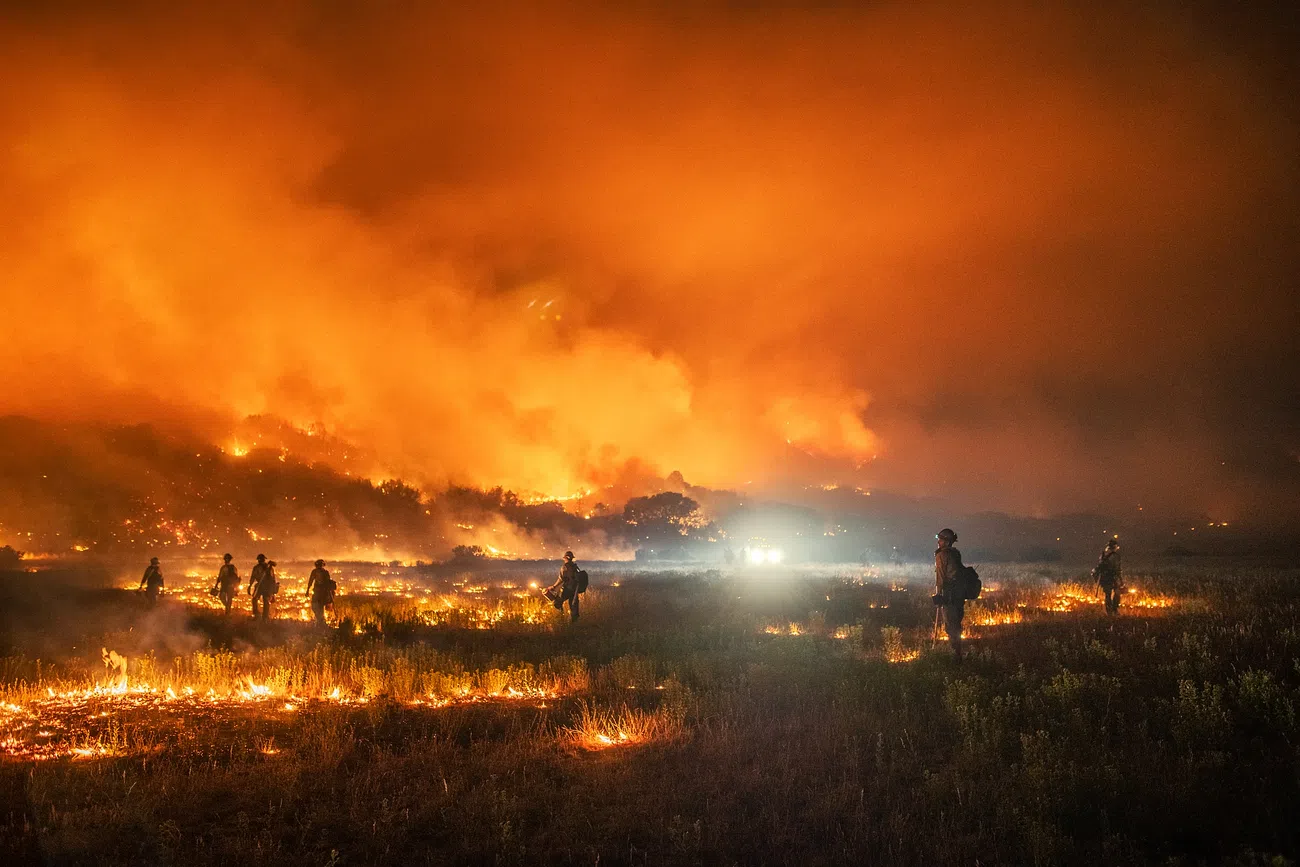
Think of it, if you will, as the orange-sky scenario. I’m sure you remember when New York City’s skyline went orange thanks to the smoke from hundreds of wildfires then burning across Canada that drifted our way. And though it’s hardly even considered news anymore, as of August 25th, nearly three months later, there were still 1,033 active wildfires scorching that country, 656 of them “out of control.” Consider that and then try to get your mind around a planet capable of producing such a phenomenon!
What’s different today is that, while those particular orange skies may have been over parts of the eastern United States, what lay behind them wasn’t just an all-American but a global story of decline.
Nature’s War of Revenge
Let me imagine for a moment that I was on Maui in early August as that first hint of smoke entered my house (not, of course, that I have a house on that island). What followed was a fire of unprecedented severity, fueled by fierce winds from a relatively distant hurricane and invasive grasses dried by a “severe drought.” That fire then burst into the town of Lahaina and burnt it to the ground, a catastrophe that caused more than 100 known deaths and left hundreds more missing.
I want to say that it was a fire “beyond compare,” especially in Hawaii where, for most of its history, as Elizabeth Kolbert recently reminded us, “fire simply wasn’t part of the islands’ ecology.” But honestly, when it comes to climate disasters, you can’t say “beyond compare” about much of anything anymore. Not on this planet, not now. Yes, climate change — the heat and lack of moisture — had dried out that island’s largely alien greenery, making it ever more combustible. There was also that hurricane, admittedly hundreds of miles away but directing brutal fire-spreading winds Maui’s way. And for context, consider that, since the 1950s, the average temperature of Hawaii has risen by about two degrees and summers have become increasingly brutal in terms of heat.
Still, the fire that destroyed Lahaina — 2,700 structures simply wiped out — was the deadliest in the United States in more than a century. But count on one thing: 100 years from now, if there still is a United States and another terrible fire occurs, no one will be saying that it was the deadliest in “more than a century.” However sad it may be to write, ever more horrific fires are now the definition of our future.
In the end, in fact, it doesn’t matter whether we’re talking about Hawaii or Iran, Algeria or Greece, China or Spain, Phoenix, Arizona, or the island of Sardinia. Across the planet, horrifying “natural” (though under the circumstances, they should be considered distinctly unnatural) fire, flood, and heat records were set this summer. Both June and July were the hottest versions of those months ever and 2023 is clearly rushing toward its own global heat record. So, mourn for Maui now. After all, a decade, no less a century, from now, nothing that happened this summer will be remembered as the planet’s ongoing crisis only breaks yet more records and grows ever more severe. Even today, when it comes to heat, nothing — not even emperor penguins in Antarctica — is unaffected.
And it’s not just on land (or ice) either. Don’t forget the water. As Bill McKibben noted recently, “In the past hundred and fifty years, we’ve made the ocean soak up, on average, the heat equivalent of a Hiroshima-size nuclear bomb every second and a half; in recent years, that’s increased to five or six Hiroshimas a second.” Imagine that! In other words, Hurricane Idalia, the first (and undoubtedly anything but last) hurricane of Florida’s present storm season, crossed startlingly heated waters that had only recently set records, gaining power from them as it hit the state as a category 4 storm.
War? It was once hell on Earth and — see the conflict in the Ukraine, where there are already almost 500,000 casualties with no end in sight — in so many ways it still is. However, in the end, our wars, barring the use of nuclear weapons, could prove to be next to nothing compared to nature’s war of revenge on humanity. And yet, perhaps the most striking thing about us is that, from the Ukraine to Taiwan, we’re proving remarkably unable to focus on what’s truly new and horrific about life on this planet.
I was born 79 years ago on an Earth plunged into a global war, the second of that century. It would conclude just over a year later after my country discovered a way to end it all. I hardly need to tell you that I’m thinking about the atomic bombings of Hiroshima and Nagasaki and, in the decades that followed, the vast atomic arsenals built up by the two superpowers of that era, the Soviet Union and the United States. As it happens, Russia still has a humongous nuclear arsenal and the U.S., with the second largest on the planet, is planning to put up to $2 trillion into “modernizing” it over the next three decades. Meanwhile, nine countries now possess nuclear weapons — with the capacity of doing to the planet what had once been done to those two Japanese cities.
The possibility that such weaponry could actually be used has, of course, become a news topic because of the Ukraine War. But in 1945, when J. Robert Oppenheimer (of movie fame) was preparing the first test of such a weapon in the New Mexican desert, no one knew that humanity had already discovered another way to do the very same thing to itself, even if in slow motion. From the industrial revolution on, by burning fossil fuels and sending ever greater quantities of greenhouse gases into the atmosphere, we’ve been preparing year by year, decade by decade, century by century, for a different kind of apocalypse. Now, we know — or at least should know — that we’re deeply engaged in what could be a world-ending affair (or minimally an ending of the world as we’ve known it all these centuries).
And these days, thanks to that, all of us are potentially living in Lahaina in some fashion.
Fossil-Fuel-Style Osama Bin Ladens
For the last 22 years, the United States has been fighting a global war on terror that, from Afghanistan to Iraq, Pakistan to Niger, has been a disaster of the first order. So many of our taxpayer dollars have gone into that “war” and ever rising Pentagon and national security state budgets. Meanwhile, the true war of all wars on planet Earth — think of it as a global war of terror — has simply worsened without a significant enough mobilization to truly deal with it. It should be no surprise then that, in 2023, the most greenhouse gases ever are entering the atmosphere.
In such a context, you might imagine that humanity — all of us — would rally around, if not the flag, then the green banner of an ecologically decent planet. And yet, that money pouring into the Pentagon is going into the development of things like AI-run drones for a future possible war with China over the island of Taiwan. And that focus — China seems no less committed to such a future — only ensures that the historically greatest greenhouse gas emitter (the United States) and the greatest one of the present moment (China) will not ally in any meaningful way to fight the true battle humanity faces. In other words, that global war of terror, the one we’ve sparked (so to speak), will only intensify.
In that sense, in launching his invasion of Ukraine, Vladimir Putin’s greatest crime wasn’t simply against the Ukrainians, but against humanity. It was another way to ensure that the global war of terror would grow fiercer and that the Lahainas of the future would burn more intensely. And that’s not just because any form of warfare puts startling amounts of greenhouse gases into the atmosphere. (The U.S. military, in fact, emits more carbon dioxide than whole countries and is the world’s largest institutional emitter of greenhouse gases.) The war Putin launched, while undoubtedly a major greenhouse gas producer, also has taken our attention off the potentially most devastating war on this planet.
Meanwhile, though China leads the world in creating and installing alternative energy systems, it also greenlights, on average, two new coal-powered plants a week and is building six times more of those plants than the rest of the world combined. And don’t forget the major fossil-fuel companies that continue to ravage the planet in search of present and future profits. In 2022, Chevron, ConocoPhillips, Exxon, and Shell saw $1 trillion in sales and all four reported record profits.
Yes, you can certainly find evidence of parts of humanity acting to rein in, if not simply eliminate, fossil fuels, even in places like Texas. It’s not that nothing whatsoever is being done. Joe Biden, for instance, oversaw the passage of the Inflation Reduction Act, which is spurring hundreds of billions of dollars of investments in clean energy (even if he also greenlighted the giant ConocoPhillips Willow project that could extract more than 600 million barrels of oil from an overheating Alaska during the next 30 years).
But in such a moment, the other party in the United States, once known as the Republicans, is now filled with outright climate-change deniers and forceful supporters of the further development of fossil fuels. It seems almost beyond imagining and yet, if polling is to be believed, the man who represents so many of them, Donald Trump, has a genuine chance of ending up back in the White House.
While some of those Trumpublicans may be delusional, the CEOs of the giant oil companies undoubtedly aren’t. They know just what their companies are doing to our world. Thanks to its scientists, the top officials of Exxon, in fact, had a remarkably accurate sense of what kind of damage their products could cause back in — yes! — the 1970s and the company’s response, in part, was to put money into think tanks promoting climate-change denial.
Don’t you wonder what any of those fossil-fuel CEOs will say to their grandkids? I do.
Meanwhile, the global war of terror, which only becomes more destructive by the month, has already put September 11th to shame in Lahaina and elsewhere on this increasingly beleaguered planet of ours. And sadly enough, in that war of nature, we humans are the terrorists and those fossil-fuel company CEOs are our very own Osama bin Ladens.
ZNetwork is funded solely through the generosity of its readers.
Donate