

Humanity is in an existential crisisi. While capitalism is enabling the elite to accumulate capitalii whilst knowing the risk of civilizational collapse, many organizations are fighting to avoid mass extinction. Environmental, indigenous, human rights, and labour groups are chipping away at the hegemony of capitalism, slowly but surelyiii. However, capitalism appears unbreakable. This is exemplified by the erosion of democracy around the worldiv, even in so-called representative democracies. So, what is to be done? How can all the many groups that fight in the struggle for a better life, actually get results, and change the system? The Twenty Theses for Liberationv are the narrative backbone for a material transformation of society away from capitalism. A complementary framework of policies, sourced from people around the world can spark the much-needed revolution.
What is a CSGPC?
A Crowd-Sourced Global Policy Cloud (CSGPC) is a way for the whole of humanity to express what they want their societies to really look like. In the first instance, the CSGPC will be a website, much like any social media platforms are essentially websites with gigantic universes behind them. The CSGPC seeks to inspire a vast number of humans and organizations from around the world. It is a multilingual and democratic virtual platform that showcases a vast collection of popular anti-capitalist demands and policy proposals. Demands that could lay the foundation of a coordinated massive Global Strike against power structures that maintain the hegemony of capital accumulationvi. The Global Strike would be harmonized around the top policies that the CSGPC would have collected from a large number of contributors.
Visitors to the site would be invited to reflect on three questions: What needs to happen for your own life to get better? What needs to happen for your community to get better? What needs to happen for the whole world to get better?
Visitors would be given the choice to see previous answers to these questions from people in their community and from any other community around the world. Once they enter their own answer or pick answers with which they agree, the platform would aggregate the answers into a visual policy cloud, similar to a tag cloud (aka weighted list). As more contributions are added to the platform, the cloud will expand and change in real-time, and the most popular answers will be featured.
A policy cloud may look something like thisvii:
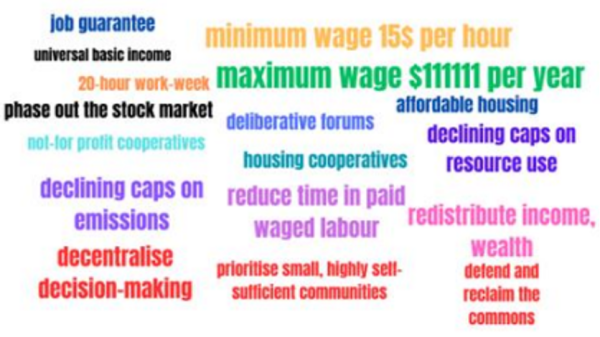 This illustration is a modest and incomplete list of the wide range of possible policies that could emerge from contributions from many people around the world.
What to do with a CSGPC?
We are often faced with difficult questions like the following: Can we revolutionize societies with multiple independent theories of social change? What are the things that unite us all? How can we really change the system?
These questions are difficult in the sense that they have many answers. But this is unsurprising given the extraordinary variety of human experiences including personal life experience, culture, ideology, political affiliations, religion, and philosophy. This makes the invention of a single slogan for a world revolution rather difficult. From Workers of the world, unite!viii in the 1800s to the We are the 99% of the 2010six, slogans have inspired millions, have persisted, have withered away, as many stories do. This is not a reason for despair, on the contrary. It is merely a manifestation of the impermanence of memory, the everchanging Zeitgeist that permeates the souls and minds of humans alive at a given moment.
Say, for example, that a million people from 195 countries have contributed to the CSGPC. In the top 10 policies, we see a global maximum income of $111,111 per person per year, a global maximum wealth of $10 million per person, the cancellation of debt for countries in the Global South, access to free quality health care everywhere, and restoration of biodiversity. A thousand organizations endorse the CSGPC with the
understanding that they will demand the enactment of those top 10 policies from the governments where they operate. Endorsement would be a clear-cut process where organizations would have legitimacy from their members to embrace the top 10 policies. Each organization would remain true to its theory of change and strategic operations. The CSGPC would be an additional narrative for each endorsing organization to embrace in their public discourse and political action. Even more so, new organizations can be born with the declared purpose to pursue the top policies form the GCGPC. These organizations can be political parties, unions, consumer groups etc.
A few months later, perhaps a few years later, imagine the CSGPC has ten million entries from people around the world. Twenty-five million? Fifty million? What is a reasonable, realistic number when some social media platforms have more than a billion monthly active users? What would motivate people to contribute to a global policy cloud? The Global Protest Trackerx counts that since 2017: over 400 significant antigovernment protests have erupted worldwide, more than 132 countries have experienced significant protests, 23% of significant protests have lasted more than three months, 135 significant economic antigovernment protests have occurred since 2017, with 12 events having between one million and two million participants. Some protests lasted less than one week, others more than four years.
Prophecies about the future are rather difficult, as folks reading both Karl Marx and BlackRock’s statements would venture to opine, so the future of a global policy cloud should not be viewed any differently. There is this persistent desire to see the overhaul of The System, which leads us to pivot our expectations more on future-seeking emotions, such as hope, and rationalizations of future-outcomes discounted into the present: the eradication of poverty, the transition to a sustainable regenerative economy, etc. Therefore, the CSGPC would be an instrument of reified storytelling, analytical tool-kit, and strategic anchoring, all at the same time. What is more powerful, really, than having the declared support of a large population? No hegemonic system can resist massive coordinated pressure from the masses that will voice their demands clearly, consistently and courageously.
States may have a monopoly on violence, corporations may hire private security to defend their assets, and billionaires may attempt to break unions, but they will never be able to contain all the people all the time. The CSGPC builds on the lessons of the Occupy Wall Street Movement that started as a culture-jamming meme and adds layers of hard, unwavering, actionable demands on a global scale, so the status quo cannot beef up excuses that the masses are complaining but they do not know what they want. Now, it will be the time when people will clearly say what they want, in words and with numbers.
The hope for a CSGPC would be to build up towards a Global General Strike. A strike like nothing else from the past, not on a single day, where some humans may not attend due to doctor appointments or due to the need to find water in a refugee camp, but a perpetual general strike, more rooted than the actions of the Occupy Wall Street Movement, and relentless much like traditional labour strikes that establish picket lines. All endorsing organizations and contributing people would participate in this global strike locally at locations where The System is most vulnerable. Groups will decide themselves what those locations are, and they would not be limited to government offices, coal mines, warehouses, banks, insurance companies, oil refineries, or chemical plants.
How would a GCGPC function?
Even if people were to answer the three questions to the best of their abilities the end result may require editing for clarification. A democratic Editorial Team would supervise the collection of public entries and reformulate them for clarity without changing the meaning. The team would comprise 12 volunteers at the launch of the CSGPC, then its membership would change at frequent intervals by accepting new members via qualified sortition (random draw of applicants that have passed a reading and writing minimal test). Decisions within the Editorial Team should follow sociocracy, with roles permuted randomly to avoid hierarchies, groupthink, or influence by personal traits and biases.
Editors would be prompted at random to review submissions from the public. More than one editor would need to accept changes done by another editor, before the submission is added to the policy cloud and posted publicly.
A Technical Team would be accountable for developing and maintaining the platform. Similar to the Editorial Team, they will be selected at first from a pool of volunteers, then changed at frequent intervals through qualified sortition from a pool of volunteers or candidates.
The third and last team would be a Coordinating Team, which would be responsible for everything else: communication with endorsing organizations, public relations, outreach to new organizations to invite them to endorse, and designing statistical tools for research that can be run against the policy cloud database.
If the CSGPC becomes a registered organization, funding should be considered to pay for staff and maintenance. The three teams can be linked to each other via delegates, according to sociocratic principles. There will be no reporting hierarchy between the teams and no single authority or director.
Some Technical Specifications
The legitimacy and strength of the CSGPC would reside in its ability to spark shifts in imaginationxi and build confidence in a fair global distribution of material values for an equitable lifestyle for all humans on Earth that operates within planetary boundariesxii. Therefore, all transactions within the CSGPC should be added to a publicly available blockchain database, which would contain: all submissions from the public, all editing operations, interventions from the editors, queries to the databases, translations into participating languages etc.
The contributors to the CSGPC would essentially be only individuals. Endorsing organizations can certainly invite their members to submit individual entries as well. Validation against bots and spam would be paramount. Cell phone numbers can be used to validate unique individualsxiii, also via verified digital identities where available. Entries could also be accompanied by a request to add demographic data that could be used for statistical analysis. Individuals do not need to be identified by name.
So, the day comes
The CSGPC is up and running. There are millions of contributions. Many organizations are excited and energized to endorse. Everyone is ready. The Global General Strike begins unexpectedly, probably triggered by yet another outrageous event in the world. The establishment is shaking and fights back. Hackers attempt to shut down the CSGPC. The ruling class tries to move assets into fiscal paradises. Markets shake and crumble. The COVID years pale in comparison. But this is the day when things will start happening. Governments will freeze the assets of the rich. Fossil fuel companies will be nationalized and put on a path to be phased out. Meaningful job guarantees will be created all over the world so no one will be left behind without a livelihood. The New Economic System, centered on well-being will become a dream within our grasp and will make the obsolete Old System wither out.
The energy of the people seeded into a virtual policy cloud will grow widely into the world.
i See for example The Climate Book, The Facts and the Solutions, edited by Greta Thunberg, 2023
ii See https://wir2022.wid.world/ and https://www.oxfam.org/en/research/survival-richest iii See https://ejatlas.org/
iv See https://www.eiu.com/n/campaigns/democracy-index-2020/
v https://4liberation.org/
vi The Atlas Movement www.atlasmovement.org has similar global angles, but is not built on crowd-sourced policies. There is significant potential for synergy between a CSGPC and organizations such as the Atlas Movement.
vii Policies are inspired by this paper: Exploring degrowth policy proposals: A systematic mapping with thematic synthesis (2022) by Nick Fitzpatrick, Timothée Parrique, Inês Cosme https://doi.org/10.1016/j.jclepro.2022.132764
viii A political slogan from The Communist Manifesto (1848) by Karl Marx and Friedrich Engels.
ix As seen at the Occupy Wall Street Movement. For more context see Organizing Occupy Wall Street, This is Just Practice (2023),edit. Marisa Holmes x https://carnegieendowment.org/publications/interactive/protest-tracker# see also https://carnegieendowment.org/2023/12/18/protests-in-2023-widespread-citizen-anger continues-with-sources-multiplying-pub-91256
xi See Serge Latouche, Décoloniser l’imaginaire : La Pensée créative contre l’économie de l’absurde (Parangon, 2003)
xii See Measuring the Doughnut: A good life for all is possible within planetary boundaries (2024) by Hauke Schleiser, Malte Schäfer, Harald Desing https://doi.org/10.1016/j.jclepro.2024.141447
xiii According to the International Telecommunication Union (ITU), there were more than 8.58 billion mobile subscriptions in use worldwide in 2022, compared to a global population of 7.95 billion halfway through the year.
ZNetwork is funded solely through the generosity of its readers.
Donate