

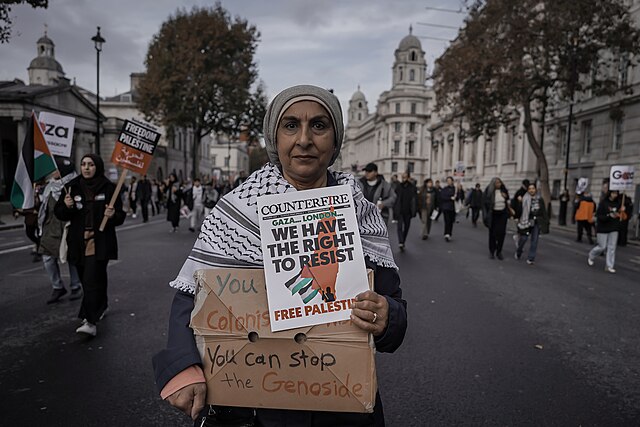
Tensions between Israel, the United States and the international community reached a boiling point on Monday as Israeli troops advanced on the city of Rafah in southern Gaza. The assault forced thousands of already battered and displaced civilians to flee once again from any sort of shelter and safety they had established since losing their homes to Israel’s bombs months ago.
Reem Zidiah, a 23-year-old woman whose home in Gaza City was destroyed by Israeli bombs last year, said her family was forced to evacuate from Tel al-Sultan, an area just west of Rafah. Zidiah and many members of her family — including a cousin with a newborn child — were displaced multiple times before taking up residence in an apartment building that was under construction before the war. Now they are uprooted again, and nowhere in Gaza is safe.
“The situation is very bad, I’m sure you heard about the order to evacuate the east of Rafah, well I’m sheltering a bit further [away], but just today they said that Tel al-Sultan is not safe and maybe there will be a military operation here,” Zidiah said in a text over the weekend. “People here are evacuating, and so are we.”
Attempts to reach Zidiah on Monday and Tuesday were unsuccessful. Despite assurances to the United States that forcing evacuations would keep civilians safe, Israel did not wait for evacuees to leave before commencing military operations in Rafah.
Secretary of State Antony Blinken issued stiff warnings on Sunday and Monday against the Rafah operation and said Israel lacked a “credible plan” to safeguard the estimated 1.4 million civilians in the area. That point was underscored on Monday, when one United Nations security official was killed and another injured as their clearly marked vehicle came under fire en route to a hospital in Rafah. Al Jazeera and other outlets identified the attackers as Israeli forces.
Meanwhile, Israeli protesters ransacked aid trucks bound for Gaza, where people are suffering from disease and dehydration. Israeli forces ordered staff to evacuate the last functioning hospital in Rafah as the health system collapsed and nearly 450,000 people were forcibly displaced to the north, where fighting continues in bombed-out cities. Diplomats frantically reignited negotiations for a ceasefire and the release of hostages held by Hamas in Rafah, a goal that has eluded them for months.
Since Israel’s invasion of Gaza, 35,000 people — mostly civilians — have been killed, including nearly 500 health workers, according to international human rights groups. Human Rights Watch reported that Israeli forces have carried out at least eight strikes on known aid convoys and facilities since October 2023, even though aid groups provided their coordinates and locations to the Israeli military.
“The horrific reality we witness on the ground in Gaza is that Israeli military operations continue to maim and kill civilians and block the provision of lifesaving humanitarian aid,” said Avril Benoît, executive director of Doctors Without Borders, in a statement on Saturday.
While Israeli authorities have taken “some measure” to allow humanitarian aid, Benoît said efforts fall far short of what is needed in a place where 85 percent of population is uprooted from their homes. Many live in makeshift tents without even basics such as food and clean drinking water, and Israel shut down Rafah’s border crossing with Egypt, further blocking the delivery of aid. Human Rights Watch previously accused Israel of using starvation as a weapon of war, a charge Israel has denied.
“This can’t be chalked up to unintended consequences of war; the massive death, destruction, collective punishment, and forced displacement are the result of military and political choices that blatantly disregard civilian lives,” Benoît said.
Despite warnings from the Biden administration, Israeli Prime Minister Benjamin Netanyahu and fellow far right leaders were determined to invade Rafah after rejecting calls for a sustained ceasefire and exchange of hostages and prisoners. Israeli leaders say they must eliminate Hamas’s military capability, a goal that critics say is incompatible with protecting civilians crammed in Rafah and freeing the remaining Israeli hostages in Gaza.
For weeks, Rafah’s fate has driven a wedge between Israel, the U.S and the rest of the world. In a remarkable move, Egypt, which shares borders with Rafah and Israel, said on Sunday it would join South Africa’s case before the International Court of Justice that alleges Israel is orchestrating a genocide in Gaza.
After backing Israel unconditionally for months, the Biden administration has grown frustrated with Netanyahu’s war cabinet as protests against the bloodshed in Gaza rock U.S. campuses. Last week, the White House announced that it would pause at least one shipment of heavy bombs and artillery shells to Israel, a move that human rights groups say does not go nearly far enough.
The State Department also released last week a long-awaited report to Congress on Israel’s use of U.S.-made weapons in Gaza. In what was perhaps the strongest official rebuke of Israel’s handling of the war yet, the report states that it’s “reasonable” to conclude that Israel used U.S. weapons in a fashion “inconsistent” with international law (and thus with U.S. law as well).
Progressive Democrats in Congress have raised concerns about the issue for months, and a recent letter to the White House from unnamed legal staff at multiple federal agencies warns that the U.S. is unlawfully arming Israel despite evidence of war crimes.
The report was quickly criticized as vague and confusing. It blames wartime conditions for a lack of information that would confirm whether U.S. weapons were used in specific strikes that obliterated homes and killed large numbers of civilians. The report claims there is no direct evidence that Israel intentionally targeted civilians or blocked humanitarian aid but concedes that Israel’s military could do a much better job protecting civilians. This careful wording leaves the door open to future U.S. weapons transfers, despite U.S. laws that ban transfers to countries that commit war crimes.
Humanitarian groups with staff on the ground in Gaza slammed the State Department report. Abby Maxman, president of Oxfam America, said on Friday that Israel’s actions have already pushed Gaza into famine.
“Despite what the Biden administration claims in today’s report to Congress, it is clear that Israel is violating international law and obstructing aid into Gaza,” Maxman said in a statement. “In turning a blind eye, the administration is allowing Israel to continue to do so without consequence.”
Benoît agreed, arguing that as Israel’s primary financial and military supporter, the U.S. has responsibility to ensure that the Israel Defense Forces’ conduct complies with international and U.S. law. Despite taking comments from humanitarian groups on the ground, the Biden administration’s analysis of Israel’s war on Gaza was not made in “good faith.”
“Israeli forces have obstructed aid by attacking humanitarian convoys and bombing and raiding hospitals,” Benoît said. “They have forced medical staff to hastily evacuate health care facilities and leave patients behind.”
As civilians flee the assault on Rafah, Benoît said international law requires Israel to protect civilians even if its forces issue evacuation orders.
“Its military offensive currently underway in Rafah threatens to shatter the humanitarian response and destroy the local health system that has already been struggling to cope with overwhelming demands for months,” Benoît said. “A continued military escalation would represent a direct attack on a trapped population, with catastrophic consequences.”
ZNetwork is funded solely through the generosity of its readers.
Donate