
 Book
Book
Review
People Wasn’t Made to Burn: A True Story of Race and Murder in
Review by
The case for the modern state’s monopoly on the legitimate use of violence is well known. We cannot have individuals, families, and other groups running amok in the execution of endless blood feuds, all claiming the right to enforce punishment and exact revenge. That is a formula for barbarism and chaos.
Fine, but are there any justifiable exceptions to the notion that one cannot take justice into one’s own hands? How, for example, is a parent supposed to respond when the state fails to punish or even investigate perpetrators who kill or otherwise terribly harm his or her children? Fold his hands in resignation?
A black
As historian and journalist Joe Allen shows in his powerful new book People Wasn’t Made to Burn, the Hickman tragedy was one of many fire disasters to claim the lives of dozens of black Chicagoans in the years after World War II. The swelling black ghettoes of Chicago’s segregated South and Near West Sides were plagued by overcrowded and 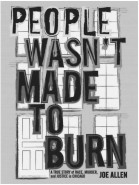 poorly maintained “firetrap” tenements in a time when landlords were known to wield the weapon of arson to discipline and remove tenants. In one of many horrendous episodes, two white arsonists were seen fleeing a large apartment building that housed nearly 300 black tenants on the city’s near
What was distinctive about the Hickman calamity was that Coleman had previously made repeated threats to “burn out” the Hickmans and other tenants who dared to complain about his refusal to treat them with respect. At the coroner’s inquest following the deaths of the Hickman children, a number of tenants from Hickman’s tenement testified that Coleman had promised to use “fire” on them if they did not leave or stop objecting to their poor housing conditions. A coroners’ jury of six white men recommended that the Hickman case be turned over to the Cook County States Attorney for criminal investigation. But neither the state attorney nor the
In the fall of 1946, the Hickmans had gone to the police in a futile effort to have Coleman arrested for negligence and theft of their security deposit. It was a courageous act for recent migrants from the Jim Crow South where blacks understandably viewed law enforcement officials as deadly enemies. In the spring and summer of 1947, as the fire epidemic continued in the ghettoes, the deeply religious and previously outgoing James Hickman became withdrawn and depressed. He was obsessed with images of his dead children. Had God not entrusted him with the sacred task of protecting those children?
Hickman’s mood broke in mid-July. That’s when he decided to kill Coleman with a pistol he had purchased four months before. On the sixth-month anniversary of the fire that devastated his family, Hickman rode a city bus to the Near South Side and shot Coleman repeatedly in front of his house, telling his victim that “God is my secret judge.” Coleman died later that same day.
The
Allen’s well-crafted book isn’t focused only or even primarily on the true-crime story of Coleman and Hickman’s violent actions. The bigger story in People Wasn’t Made to Burn is the inspiring narrative of what followed: a remarkable public and left-led defense campaign that helped Hick- man win his freedom by showing how working poverty, racism, and civic neglect drove the grieving father to defy the government’s monopoly on the legitimate use of violence. Sparked and guided by leftist militants, including an exceptional cast of leaders and supporters from civil rights, labor, religious, literary, journalistic, and artistic circles, the highly effective “Free Jim Hickman” campaign was a major factor in the state’s decision not to put Hickman through a second murder trial after an initial trial ended in a hung jury on December 16, 1947.
This is an important book. It brings to life a key moment in the forgotten history of impressive, often left-led and labor-affiliated civil rights protests in the urban U.S. North during the late 1940s, prior to the emergence of the modern Civil Rights Movement in the 1950s and to that movement’s shift to the urban north (Chicago first and above all) in the summer of 1966.
Along the way, Allen skillfully uses the Hickman story to provide a number of short, deftly fashioned and highly readable introductions to interrelated aspects of
Z
Paul Street is the author of many books, including Racial Oppression in the Global Metropolis: A Living Black
 Music
Music
Review
Eleven Eleven, a New CD From Dave Alvin
Review by John Zavesky
Dave Alvin,
Eleven Eleven’s songs explore love, loss, friendship, and defeat with a brevity and accuracy worthy of Hemingway. The deaths of former musicians and friends Chris Gaffney and Amy Farris, figure into two of the albums songs, “Run Conejo Run” and “Black Rose of Texas.”
 across the borderline. It’s a favor for a friend.” And then warns, “Now let me kiss you goodbye. And if anything should happen please remember you’ll always be mine.” This is not to say that
It is the hard-won truths and victories of the working class
Z
John Zavesky is a freelance writer whose articles have appeared in the Los Angeles Times, the Press/Enterprise, Z Magazine, and the San Diego Union, as well as other periodicals. He is currently working on a crime novel.
 Film
Film
Review
Crossing the American Crises: From Collapse To Action, A Documentary Film by Sílvia Leindecker and Michael Fox (PM Press/Estreito Meios Productions)
Review by Ben Dangl
When the worst financial crisis since the Great Depression hit the 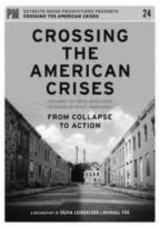 lapse To Action, a film full of desperation, hope, and solutions.
Leindecker and Fox are the makers of the earlier documentary Beyond Elections: Redefining Democracy in the Americas, and Fox was an editor of the book Venezuela Speaks!: Voices From The Grassroots. Like these earlier works, Crossing the American Crises highlights the voices of people participating in grassroots activism and everyday struggles for a better world.
The first stop of their trip is
The next visit is to the Rosebud Lakota Indian Reservation in
After stops in
In
Fox asks Green what he thinks about the government bailout, the major issue of the day. Green tells him, “It’s ironic that it only took [the government] two weeks to issue a $700 billion check. It took them three years after Katrina and this is what you see.” He pointed to the empty lots, saying the names of the families that used to live there. “So basically every house, every family that’s gone actually was a family that should be here now. And if they would have been given the money in two weeks like the way they did in Congress, the way they did in Wall Street, then every last one of these families would have rebuilt their houses and this whole Gulf Coast area would have been rebuilt because everybody in the Gulf Coast is basically like the people down here: family first.”
Crossing the American Crises then turns to the hope people felt in the election of Barack Obama in 2008. Yet after the election, the camera cuts to a stream of grim economic news and stories of people struggling to make ends meet. One college graduate appearing in the film went through 109 job interviews before finally finding a very low-paying position at Staples. A homeless man on the
On a cold, snowy street corner in
So what is to be done with all of this bleak news from the American crises? That leads to the second part of the film: action. Crossing the American Crises goes on to include many solutions to these economic and social problems, focusing on inspiring stories of grassroots alternatives and responses.
There is the Vermont Workers’ Center fighting for affordable healthcare for all, the Green Worker Cooperative in the Bronx that sells recycled building materials, the Santa Fe Alliance in
These groups are largely led by the people who are impacted the most by these various crises. Organizers are meeting these challenges in states across the country. “Organizing is the key,” JoAnn Watson from the Detroit Council tells a boisterous crowd at the U.S. Social Forum in her city.
Alongside these stories of hopeful organizing is a vision for a better world. “The people have to act through their own organizations to implement their vision of what life should be like,” explains Kathleeen Cleaver, a law professor at
That’s a central message of this film. When the politicians, banks, bosses and economy fail to work for the people, it’s the people that have to form the backbone of movements for economic justice, peace, equality, and rights. In the midst of these crises, those movements are already thriving across the
As Robert Green from the Lower 9th Ward says, “Basically, we need to start taking back our government, taking back our taxes, start taking back our control from our elected officials because they’re not putting us first.”
Such insight from people across the country makes Crossing the American Crises an impressive film that captures the spirit of
Z
Benjamin Dangl is the author of the new book Dancing with Dynamite: Social Movements and States in
