
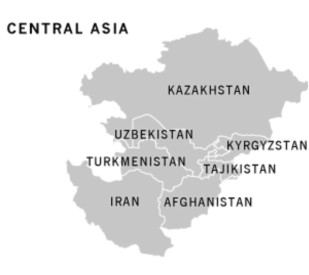
 Despite the projected 2014 “drawdown” of most of its troops from Afghanistan, the U.S. is not about to exit strategically vital and resource-rich Central Asia. The Afghan war and occupation created whole new sets of unparalleled opportunities and possibilities for increased U.S. influence across the “post-Soviet space” often referred to as “the ’Stans.” Propelled by the war-driven expediencies of “Operation Enduring Freedom,” broader strategic ambitions, and a heavy dose of imperial hubris and arrogance, Washington sought and bought support from the repressive and corrupt regimes in Uzbekistan, Tajikistan, Kyrgyzstan, Kazakhstan, and Turkmenistan.
In turn, it gained varying degrees of previously unimagined regional access, not about to be relinquished. It also, in the process, planted seeds of future instability in a region already simmering with potential conflicts.
The Strategic Tinderbox
With the Caspian Sea to the west, the vast Central Asia steppes to the north and mountains to the east and south, a region half the size of the lower 48 United States, sits at the strategic pivot where Russia, China, South Asia and Iran come together. That alone informs U.S. “national interest.”
The area’s former Soviet republics had their independence thrust on them with the dissolution of the Soviet Union in 1991. The old system’s disintegration set loose massive dislocations as state subsidies for industry, health care, education, and social protections collapsed or disappeared entirely while socialized property was looted and privatized.
 In the process, the region increasingly became a tinderbox mix of endemically corrupt authoritarian states lorded over by a “new class” of ex-Soviet officials and ascendant entrepreneurs, those best positioned to grab control of formerly state-run enterprises, assets, and the levers of power.
Each of the fledgling states started out on a different footing, with varying levels of development and resources. Sprawling Kazakhstan, suddenly the ninth largest country in the world, with its inestimable wealth in oil, uranium, and other strategic minerals, immediately dwarfed its southerly neighbors Tajikistan and Kyrgyzstan, currently two of the poorest orphans of the ex-Soviet space. Turkmenistan, with vast stores of natural gas, rapidly became a closed society while Uzbekistan, with the largest population and military in the region, would look to rival Kazakhstan as the dominant regional power.
The diverse area is characterized by often-disputed porous borders, peoples divided by those boundaries, interstate rivalries, and percolating conflicts over water rights and other resources. Ascendant nationalisms, ethnic antagonisms, and an ongoing revival of long-suppressed Muslim identities also contribute to simmering social and political tensions. At times flaring into open conflict, those tensions have been exacerbated by increasingly vast economic disparities between rich and poor, glaringly visible in the contrasts between the region’s major cities with their post-Soviet nouveau riche and the continuing impoverishment of the countryside.
Expanding economic and social chasms have been compounded by endemic “misgovernance, oligarchic rule through patronage systems rife with corruption, nepotism, and the criminalization of the state,” involving the symbiotic role of organized crime syndicates in politics. In the case of Tajikistan and Kyrgyzstan, the morphing of “crime bosses” into “political bosses” now seated in parliaments and heading key ministries and agencies.
In impoverished Tajikistan, for instance, half the population lives on less than $2 a day while remittances sent home by nearly half of the country’s male workforce laboring in Russia provide the country’s largest source of GDP. But the capital, Dushanbe, is “awash with cash, construction, and flashy cars,” the visible results of a huge “shadow economy” largely rooted in the massive drug traffic passing through the country from Afghanistan to Russia.
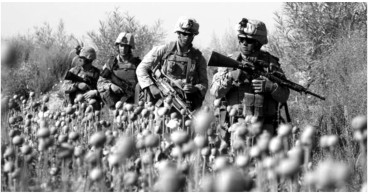
According to a 2012 United Nations Office on Drugs and Crime (UNODC) report, some 90 metric tons of Afghan heroin and 30 to 40 more tons of raw opium passed across the region in 2009-10. Netting an estimated $1.4 billion profit that year alone and involving the paid-for complicity of state actors at all levels, the heroin traffic courses its way through every country in the region. Tajikistan, Kyrgyzstan, Turkmenistan have been classified as “narco-states” where the state representatives from top to bottom are implicated in the trade, corrupted by it.
The ’Stans also have their share of radicalized Islamist insurgent groups, most notably the now regionally dispersed Islamic Movement of Uzbekistan (IMU), often accused of being responsible for the drug trade by the region’s corrupt regimes—complicit themselves. Attributed by some to be the result of decades of war and occupation in Afghanistan and a broader transnational Islamic revival, the various insurgencies, limited in scope, have been propelled more so by indigenous inequities and state intolerance and repression.
 Adding to the tinderbox mix, the specter of succession crises and resultant instability currently looms over the region. Party chiefs of their respective republics at the close of the Soviet era and in power since, neither Kazakhstan’s “Leader of the Nation” Nursultan Nazarbayev, nor the brutal “Hero of Uzbekistan,” President Islam Karimov, now both in their mid-1970s, have shown any sign of relinquishing supreme authority.
Their neighboring autocrat, Emomalii Rahmon, said to run Tajikistan’s “near-failed” state for his own and his family’s profit since he consolidated power following a mid-1990s civil war, is not about to step down, as well. Nor is Turkmenistan’s increasingly authoritarian Gurbanguly Berdimuhamedow, successor to the country’s initial post- Soviet dictator, Saparmurat Niyazov, who died in 2006.
Human Rights Abuses
To one degree or another, all the region’s states have long been cited for their widespread human rights abuses and ceaseless repression of dissent and political opposition. Arguing that economic development must come before openness, transparency and “good governance,” elites across the region have come to view democracy as a gateway to instability.
The 2013 Human Rights Watch (HRW) report on Kazakhstan noted that its human rights record had “seriously deteriorated” in 2012. Freedom House, Transparency International, Reporters Without Borders, Amnesty International, and others including the U.S. State Department, have long chronicled the Nazarbayev regime as a serial abuser of basic rights and freedoms. Its 2013 HRW report described Uzbekistan as a country with an “atrocious” human rights record; a nation where horrific torture remains “endemic” and freedom of expression is severely limited. The survey noted an intensified crackdown on civil society activists, political opponents, and journalists, as well as persecution of religious groups not registered with the state.
The Karimov regime, of late an increasingly close U.S. ally, has consistently banned all opposition political parties, severely restricted freedom of expression, forced international human rights monitors and NGOs out of the country, and takes as many as two million children out of school to work, along with their families, as forced labor during the annual cotton harvest. Thousands of dissidents have been jailed and many hundreds have been killed, some of them literally boiled alive.
Significantly, this year’s HRW Uzbekistan appraisal pointed out that, “Despite the government’s persistent refusal to address concerns about its abysmal human rights record, the United States and European Union continued to advance closer relations with Tashkent in 2012, seeking cooperation with the war in Afghanistan.”
HRW described Turkmenistan as one of the most repressive and closed countries in the world. While pointing to “some small, positive steps on human rights in Kyrgyzstan and Tajikistan,” it noted that their poor records had not really improved despite government pledges to tackle the problem of torture and other abuses. Described as “near failed states” honeycombed with corruption, both have provided the prime transit routes for those massive amounts of Afghan heroin and opium headed northward.
While not speaking directly to the broader regional impacts of “Operation Enduring Freedom,” HRW’s Europe and Central Asia director, Hugh Williamson, noted how, “…the EU and the U.S. have largely muted their public concern over the appalling rights records of all Central Asian governments at exactly the time when victims of government repression needed them to speak out on human rights.”
Importantly, the point has not so much been the fact that the U.S. and its allies have been barely audible regarding the abuse of human and political rights. More so, by rewarding those assisting with the Afghan war and occupation, the U.S. has certainly had a direct hand in aiding, abetting and furthering the region-wide corruption, nepotism, ongoing repression and assaults on basic rights.
The Strategic Goal
While the cooperation of the ’Stans became crucial for the prosecution of the war to the south, U.S. attention to the region has never solely or simply been about Afghanistan.
Underway before September 11, the U.S. is now enmeshed in a new “Great Game” in Central Asia remotely evocative of the 19th century one that pitted imperial Russia and Great Britain against each other for control of the “Eurasian core.” Its main competitors include Russia, vying to maintain influence in its historic underbelly, and an ascendant China, already the dominant “outside” economic developer and investor in the region.
Both Russia and China have maintained varying but extending economic, military, and political ties to the region. Viewing the area as part of its “sphere of influence,” Russia has maintained an ongoing military presence, at times in close proximity to U.S. operations in Kygyryzstan, Tajikistan, and Kazakhstan. With their own distinctive stakes in the game, the ’Stans have joined in as well. Each has worked to maximize its own “bargaining power” by playing off the interests of the major contenders.
Writing in 1998, at a time when the U.S. was still the world’s unchallenged superpower and well before the “War on Terror,” imperial strategist Zbigniew Brzezinski could speak of the vital importance of Eurasia as “the globe’s central arena,” an area “of decisive importance to America’s global primacy and to America’s historical legacy.”
The former National Security Advisor argued that the U.S. must strategically focus on the region “to prevent the emergence of a hostile coalition that could eventually seek to challenge America’s primacy.” The most immediate task, he asserted, was “to make certain that no state or combination of states gains the capacity to expel the United States from Eurasia or even to diminish significantly its decisive arbitration role…” (Brzezinski, The Grand Chessboard: American Primacy And Its Geostrategic Imperatives, 1998).
With the Afghan war in full swing four years later, in February 2002 then-Secretary of State Colin Powell could tell the House International Relations Committee that the United States “will have a continuing interest and presence in Central Asia of a kind that we could not have dreamed of before.” Since then, statements regarding the importance of the region, either from State Department officials or from think tank specialists and policymakers, have remained on message.
In December 2009, George Krol, at the time a State Department hand on South and Central Asian Affairs and presently the U.S. ambassador to Uzbekistan, told the Senate Foreign Relations Committee (SFRC) that the Obama administration did not view the region as “a forgotten backwater” peripheral to national concerns, but as one “at the fulcrum of key U.S. security, economic, and political interests.”
A December 2011 staff report for the SFRC, chaired at the time by the current Secretary of State John Kerry, articulated a clear set of U.S. regional priorities. The report on “Central Asia and the Transition in Afghanistan” pointedly stated that the ’Stans would continue to play a critical role, post-2014, in the U.S. strategy for the far wider area extending westward across the Caspian and Caucuses, eastward to China and to Pakistan and India in the southeast.
In his remarks marking the release of that report, Kerry noted that, “Central Asia matters;” that its countries were critical not only to the outcome in Afghanistan but to regional stability: “As we reassure our partners that our relationships and engagement in Afghanistan will continue after the military transition in 2014, we should underscore that we have long-term strategic interests in the broader region…. As the United States enters a new phase of engagement in Afghanistan, we must lay the foundation for a long-term strategy that sustains our security gains and protects U.S. interests…”
CAddressing post-2014 security concerns and “fear” of “abandonment” articulated by the area’s regimes, the staff report also asserted that, “Washington should repeatedly stress that its engagement is not ending” and that the U.S. “will protect [its] long-term interests in the region.”
Underlining those U.S. strategic interests, the report referenced Russia’s historic connections to Central Asia, past and present, and its recurring “encirclement” concerns with a U.S. presence in its “backyard.” It pointed out how China also was “leery” of U.S. bases and an extended presence on its borders.
The report noted, in passing, how the United States in its efforts to build region-wide political support and cooperation for the Afghan war, had been “forced to rely on highly corrupt, authoritarian governments in countries whose populations are suspicious of [our] intentions.” It did not go into what that has meant for the present or the implications for enduring U.S. operations.
Eurasian Atlanticism
In specific regard to Central Asia, a November 2010 report from the Atlantic Council (ACUS) laid out U.S. concerns and strategic interest in the region. The highly influential think tank for the “Atlantic community” (i.e., the U.S. and its major European allies) at the time was chaired by Chuck Hagel, the future Secretary of Defense. Hagel also headed the Council’s “Eurasian Task Force” that issued the paper. (He concurrently was a member of the board of directors of Chevron Corporation, at the time Kazakhstan’s largest direct foreign investor.)
Released in advance of a December 2010 Organization for Security and Cooperation in Europe (OSCE) summit in Astana, Kazakhstan (hosted, incidentally, by that country’s autocrat, Nursultan Nazarbayev), the ACUS paper called for President Obama to take advantage of the upcoming conference “to plant the flag of the United States in Central Asia.”
The report began by stating that, “an arc of potential disorder and instability looms over Central Asia.” Nevertheless viewing the region as one “important to U.S. national security interests” where the “transatlantic community [sic], the Far East and South Asia come together,” it called for a “new approach” that “should feature sustained engagement to promote an attractive long-term vision.”
Interestingly, the ACUS study candidly pointed out that the “military/Afghanistan component” of U.S. engagement in Central Asia had “overwhelmed other parts of the American agenda.” In the view of the ACUS authors, “the nonmilitary aspects of U.S. engagement in the region [had] languished—or at least were seen to diminish in local eyes.”
That, ACUS suggested, had enabled a climate where demands for improvements in democratic and human rights had come to be seen as “politically threatening and humiliating” by those very same oligarchs assisting the “war on terror” campaign further to the south.
Along similar lines, a preliminary draft of Obama’s National Security Strategy 2013, while noting the “new international environment in the aftermath of the “Arab Spring,” prioritized the need to protect “critical global strategic interests.” It noted that “supporting greater human rights and democracy, while an ultimate aim, nonetheless must be balanced with how our [sic] actions may lead to uncertainty.”
While some regional observers have suggested that Obama’s 2011 “Asia/Pacific pivot”—shift in the geopolitical center of gravity away from the Atlantic towards the Pacific and ascendant China—will reduce the strategic importance of Central Asia, others have argued that the concern with China has given the region added importance as a “western flank” in the military “repositioning” aimed at containing the rising power.
Antebellum
The initial U.S. footholds in Central Asia came soon after the Soviet Union’s collapse as Washington moved immediately to recognize the newly independent states. As the State Department opened consulates and embassies across the region long closed to U.S. interests, international financial institutions such as the U.S.-centered World Bank, the International Monetary Fund, and, subsequently, the Asian Development Bank and the European Bank for Reconstruction and Development followed suit.
With their sights primarily set on the potential returns from largely untapped natural resources unevenly dispersed among the ’Stans, U.S.-based multinationals and direct foreign investors simultaneously clamored for access wherever they could—especially in oil- and mineral-rich Kazakhstan, and, initially, in phenomenally gas-rich but largely closed-off Turkmenistan.
Under purview of the State Department, various small scale “security assistance” programs coordinated through military attaches at the various embassies were initiated throughout the decade, as well.
By 1995-1996, for example, Kyrgyz, Tajik, and Uzbek soldiers were participating in military maneuvers in Louisiana and North Carolina under the auspices of an expanding NATO “Partners for Peace” (PfP) program. Other PfP maneuvers under U.S. supervision took place in Uzbekistan and Kazakhstan in 1997. Targeting hypothetical “dissident elements,” that exercise in “force integration” and “interoperability,” involved Kazakh, Uzbek, and Kyrgyz paratroops trained at Fort Bragg, North Carolina as well as some 500 soldiers from the U.S. 82nd Airborne Division.
The overall U.S. presence, especially on the military end, deepened exponentially after September 11. With the coming of the Afghan invasion that October, the U.S. sought and literally bought varying degrees of logistical support for “Operation Enduring Freedom” from the region’s dictatorships.
The Pentagon quickly secured regional overflight rights or refueling agreements from all the ’Stans and “transit center” air bases for Afghanistan-bound troops and weaponry such as the one inaugurated in October 2001 at Karshi-Kanabad (aka, K2 or “Camp Stronghold Freedom” by its U.S. occupants) near Uzbekistan’s Afghan border.
In March of that year, Bush and supreme leader Karimov signed a broader strategic cooperation agreement calling for a partnership in the “war on terrorism” and deepened ties between U.S. and Uzbek military and security agencies.
Importantly, as part of the K2 deal, Washington turned a blind eye to the steady increase in political jailings that those very same security services were carrying out in the name of “counterterrorism.” The Bush administration, as part of its practice of “extraordinary rendition,” meanwhile ordered dozens of terrorist suspects shipped to Uzbekistan with the full knowledge that Karimov’s police state routinely employed unimaginable torture.
An additional regional “air transit hub” at Manas outside Kyrgyzstan’s capital, Bishkek, acquired major logistical importance in 2005, after Karimov evicted the U.S. from K2 following mild criticism from Washington in the aftermath of the May massacre of upwards of 800 protesters at Andijan.
Manas soon became the “premier air mobility hub” for Afghan operations—the main entry and exit point for coalition troops. (In 2011 alone, some 580,000 troops went to and from Afghanistan via the base.)
Initial rent for use of the Kyrgyz airfield started out at $2 million plus and additional $17,000 for each flight landing and taking off from the base in 2001. The rent went up to $17.4 million in 2005 following the closure of K2. Bizhkek then upped the rent $63 million in 2009.
The latter deal, negotiated between the U.S. and the kleptocratic Kurmanbek Bakiyev regime, also included an additional $117 million “aid package” to the government with $36 million earmarked for airport improvements, $21 million for ostensible “drug interdiction” and counter terrorism efforts, and $20 million for “economic development.”
Much of that made its way into Bakiyev family overseas accounts. (As the head of several firms subcontracted to provide Russian-sourced jet fuel for the U.S. military aircraft at the base in the mid-2000s, Bakiyev’s son, Maxim, aka. “the Prince,” siphoned off unknown sums from the $2-3 billion doled out by the Pentagon for the vital fuel.)
“Securitization”
Accelerating after September 11, a high percentage of U.S. military assistance came under the rubric of “security cooperation.” It went most notably to the training and equipping of domestic special forces units and national police, but also included direct materiel transfers, “military-to-military” joint exercises, and funds for “retooling”—the replacement of Soviet-era equipment and systems upgrades.
In pursuit of such assistance, and playing into U.S. strategic ambitions and the massive logistical demands of 12 years of war and occupation, the region’s regimes developed their own particular “War on Terror” gambits.
Chief among them has been an over-exaggerated threat of an Islamist insurgent “spillover” from Afghanistan. That “specter” of Islamist insurgency and “extremism” has been used both as an effective hook for procuring U.S. aid, primarily military assistance, and as a way of justifying the relentless repression of political opponents, critical journalists, and human rights activists.
In turn, those on the U.S. side promoting the continuation of “partnering relationships” with the region’s regimes have reiterated such claims, highly disputed, to thwart public scrutiny and Congressional strictures on the flow of military assistance to Karimov’s Uzbekistan, Rahmon’s Tajikistan and elsewhere.
As a result, U.S. assistance and training earmarked for “counterterrorism” and “security” has been used to bolster existing regimes against internal opposition and criticism from those promoting democracy and civil society, regularly classified as “terrorists” or “extremists” bent on “regime change.”
As regional “war on terror” cooperation increased, the State Department sought and received “national security” waivers from Congressionally-imposed restrictions on military funding and assistance to serial human rights violators such as the Uzbek, Tajik, and Kazakh regimes. The Bush administration and Congress also acted to speed up the fulfillment processes for funding and military transfers.
The Obama administration followed suit. As the New York Times phrased it in mid-2009 in regard to Kyrgyzstan, “…the Obama administration has emphasized pragmatic concerns over human rights in dealings with autocratic leaders in Central Asia.” In January 2012, the White House sought and received a waiver from a Congressional ban prohibiting military assistance to Uzbekistan, in place since 2004 due to the Karimov regime’s horrific human rights record. (Islam Karimov, it should be recalled, acquired an infamous reputation for boiling political dissidents alive.)
Fueling the region’s endemic corruption, unknown sums of military assistance came to be channelled through often unaccountable “opaque” Pentagon funding streams outside Congressional and public purview as U.S. “security priorities” increasingly trumped human rights concerns.
A 2010 Open Society study on aid to regional militaries and police between 1999 and 2009 showed that the Department of Defense (DOD) established so many new military and police assistance programs during the decade that it outdistanced the Department of State (DOS) as the traditional funding source of U.S. military assistance.
Significantly, the study pointed out that DOD gained “unusual autonomy” in distributing its assistance—that a succession of leading generals at U.S. Central Command (CENTCOM) had charge of unknown hundreds of millions of dollars of what they, the commanders, referred to as “walking around money” dispensed “almost at their discretion” for training and equipment.
The report’s author, Lora Lumpe, pointed out that, “Nobody really knows how much military aid the U.S. government is giving the Central Asian states” and that actual amounts of total assistance dispersed through CENTCOM remained classified.
The Pentagon also developed a parallel system of “security cooperation.” While the State Department continued to maintain some authority over funding to the region’s regular armed forces with their largely conscript base, CENTCOM moved to training and equipping “special forces,” comprised of national police and intelligence unit successors of the Soviet-era KGB.
Such special units came to have “dual use”—for “counterterrorism,” however defined by regimes brooking no opposition and for “Praetorian Guard” units protecting the likes of Kyrgyzstan’s Kurmanbek Bakiyev and Tajikistan’s Emomali Rahmon. (In the case of Bakiyev, the personal security unit commanded by his brother, elements of which received U.S. training, proved inadequate as he was ousted by a popular uprising in April 2010.)
In addition, U.S.-provided equipment has also been used by the regional oligarchs to suppress demonstrations and strikes. In December 2011 in Kazakhstan, for example, state security forces deployed U.S.-provided Humvees as they attacked and gunned down striking oil workers, killing at least 15, in the Caspian region company town of Zhanaozen. Writing in 2012 of the Afghan war’s “other regional casualty,” Central Asia analyst Alexander Cooley aptly framed the issue of U.S. “security” assistance”: “A fuller reflection on the last 11 years should include the perverse twist about how in its almost single-minded effort to promote state-building, political tolerance, and good governance in Afghanistan, just next door the West [sic] has left a trail of repression, graft and unfulfilled commitments to Central Asia’s fledgling civil society.”
The Northern Distribution Network
U.S. assistance to the ’Stans fell off in 2003 as the Bush administration turned its “War on Terror” attentions toward attacking and occupying Iraq. Levels spiked again in 2009 as the new Obama administration fixed its sights on the “right war” in Afghanistan and the Pentagon revved up its “Afghan surge.”
That escalation heightened and accentuated the importance of the Northern Distribution Network (NDN), primarily a matrix of overland truck and rail routes shuttling “non-lethal” materiel and provisions southward to the occupation army.
Initial NDN routes came about as insurgent attacks on truck caravans coming from Pakistan stepped up in mid-2008. They came to follow various lengthy paths, such as the one extending from the Baltic port at Riga, Latvia, through Russia (a “frenemy, after all, in regard to the “war on terror”), and down through Kazakhstan and Karimov’s Uzbekistan to Afghanistan. Another would pass from the Georgian Black Sea port of Poti by ferry and rail to Baku, Azerbaijan, across the Caspian Sea to Kazakhstan and southward. Also originating in the Baltic, an additional route came to enter Afghanistan via Tajikistan.
The Network took on increased importance in 2011 when over-the-road convoys from Karachi came under increasing attacks by Pakistani militants in retaliation for mounting U.S. drone strikes. Then, in November of that year, Islamabad closed the supply route entirely in protest over air strikes on its territory that killed 24 of its soldiers.
With the Pakistani route shut down through July 2012, the ’tans soon came to handle all overland shipments. Uzbekistan—the “frontline state” with the best railroads in the region (in large part initially constructed by the Soviets during their 1980s Afghan War) and a U.S.-facilitated rail link running from the “Hairaton Gate” border crossing at Termez to Mazar-e-Sharif in north central Afghanistan—came to handle upwards of 90 percent of the cargo traversing the Network.
The NDN clearly came at a highly inflated price. The first routes in 2008-2009 immediately more than doubled what it had cost to transport supplies through Pakistan. By 2012, the cost increased another two and a half times.
In February 2012, the DoD estimated that it cost $17,500 per shipping container to transit the network. At an average of 750 containers per week, that amounted to a weekly outlay of $13.125 million, $682.5 million per year. By mid-2013, over a 100,000 cargo containers had passed through the complex. On top of that, the DoD paid each regime undisclosed flat sum “transit fees” for “use of the infrastructure.”
To assure uninterrupted NDN flow, the U.S. Central Command stepped up its dispersal of unaccountable “walk around money” and additional cash through numerous DoD agencies and programs. A good part of that went to commercial carriers and private construction companies with insider connections to the ruling oligarchs. Related contracts regularly received “national security” waivers from Congressionally mandated “Buy American” stipulations requiring the Pentagon to purchase goods and services from U.S. firms.
Pentagon funds also ended up going to venal regime middlemen and local lesser officials extorting regular bribes from truckers along the routes—“the cost of doing business” in order to assure the movement of vital fuel and other materiel to its occupation army.
Money and materiel aside, regimes along the route have exacted other benefits. In exchange for their cooperation and access, the State Department under Hillary Clinton, then-Senator John Kerry, and other Congressional leaders continued to mute, if not totally silence, their criticism in regard to the repressive practices, abysmal human rights records, and rife corruption across the region.
For example, when the Defense Budget Authorization Act passed by Congress in December 2011 removed restrictions on military funding to Uzbekistan, in place since 2004, Clinton asserted that there had been “progress” on human rights and political freedoms. Central Asia analyst Jonathan Kucera tactfully noted that her claim was “not a realistic assessment of the situation.”
Offering a similar claim of improvements, the 2011 Kerry Senate Foreign Relations Committee report on Central Asia contended that Uzbekistan would require “a careful balancing of priorities, given its central role in supporting the Northern Distribution Network….”
The report noted “significant human rights concerns, including torture in pre-trial detention facilities, imprisonment of human rights defenders, forced child labor in the cotton fields, and government restrictions on religious freedom….” It, nevertheless, maintained that it was “in the United States’ interest to engage with such admittedly authoritarian countries on the full range of bi-lateral priorities, including security, good governance, human rights, trade, and investment.” “Security” remained the top priority.
The NDN’s U.S. planners initially expressed hopes that the web of military transport routes would encourage regional economic growth by stimulating broader regional trade. Asking if ordinary Central Asian citizens were benefitting from the Network trade, a critical 2012 study found that, “…the NDN is not performing in practice as was expected in theory. There is little evidence to suggest that the NDN is increasing regional cooperation, and in some cases, it may be causing rises in border fees. Indirectly, the NDN also appears to be stimulating corruption in Central Asia. It has done little to improve the efficiency of regional trade, and its revenues flow overwhelmingly to opaque state coffers rather than to ordinary citizens.”
The 2010 UN investigation pointed out that most of the drug seizures made on Uzbekistan’s rail network (a minuscule percentage of the amounts shipped) arrived via Tajikistan. A detailed 2009 report on the drug traffic flowing across the U.S.-built $37 million, Army Corps of Engineers designed “Friendship Bridge” crossing the Panj River between Tajikistan and Afghanistan, chronicled the complicity of corrupt Rahmon regime officials in the trade.
As Kucera put it, “It stands to reason that making transportation easier would make illicit trafficking easier—especially in countries where border officials are notoriously corrupt. Why go through the trouble to cart the drugs by pack animal through remote, unguarded border areas when you can bribe the border officials on a much faster a highway or railroad?”
Regardless, with 2014 fast approaching, the Pentagon is looking to remove thousands of vehicles and other equipment of every description brought in over the course of the 12-year Afghan occupation. Attuned to increasing such “reverse transit” demands and the fact that the NDN cash bonanza will be coming to an end, the various regimes have jacked up transit fees and other costs paid out by the Pentagon cash cow.
Karimov’s Uzbekistan, a prime beneficiary of NDN/ DoD open spigots, has already increased transit fees for rail shipments to and from Afghanistan by 150 percent. Karimov’s people have also been engaged in discussions regarding the amounts and types of war materiel—vehicles and helicopters, night vision goggles, etc., to be left behind as yet another form of compensation.
The NDN has laid the foundation for what Obama’s Secretary of State Hillary Clinton pronounced in July 2011 as a “New Silk Road Initiative (NSRI)—the construction of a trans-regional east-west matrix of roads, railways, electric grids, pipelines, and assorted commercial ventures intended to economically integrate greater Central Asia, between the five ’Stans, Afghanistan, Pakistan, and India. As part of the NSRI, the State Department has proposed the resumption of the TAPI pipeline project—a natural gasline running from Turkmenistan, Afghanistan and Pakistan to India—long delayed by Afghan instability.
NSRI proponents have argued that it will bring longer-term stability to Afghanistan and the broader region. Planners have also viewed the network, with its east-west and southerly transport corridors and pipelines, as a way to wean the largely landlocked ’Stans away from their long-standing dependency on Russia-routed trade and further integrate the region to “the West.” The project has also been viewed as a counter to Chinese economic influence, already well advanced, across the region.
After Afghanistan?
The success of the NSRI is far from assured. While the exact course and direction for U.S. involvement in Central Asia is unclear, most observers assume that the region, post- 2014, will garner far less U.S. attention once the Afghanistan drawdown concludes.
Revenues from the NDN and basing agreements have not been unsubstantial, especially in Tajikistan and Kyrgyzstan, but U.S. largesse is expected to decline dramatically. In tandem with all the preexisting social tensions and national rivalries already in play, the impending decline of “war on terror” economy cash flows will likely assist in increasing instability across the region.
Inter-state rivalries and tensions are likely to increase as the construction of hydroelectric dams in resource-poor Tajikistan and Kyrgyzstan threaten the water supply need for Uzbekistan’s cotton cash crop. (Uzbekistan has already threatened war if Tajikistan proceeds with its Rogun Dam.)
Succession struggles are anticipated with the passing from the scene of Kazakhstan’s Nazarbayev, Karimov in Uzbekistan, and Rahmon in Tajikistan while a wave of democratization or at best, “good governance,” is unlikely. If prior patterns hold, with their contempt for “good governance” and distrust for democracy, whatever cliques remain in power will more than likely resort to the same modalities of repression against all dissent. Internal disputes along class, ethnic, and religious lines will likely intensify and overshadow any threat of some “spillover” from Afghanistan, even if the Taliban was to take control in Kabul once again. Defense Department strategists in the meantime have developed longer, post-2014 designs for future “military-to-military” relations across the region.
Pentagon planners have consistently cited the U.S. “transit center” at Manas as a model “lily pad”—a “reduced footprint,” regionally-oriented base, part of an updated “forward basing” strategy and newly restructured “global defense posture.” With its lease not renewed by the current Bishkek regime, the base is scheduled to close down in mid-2014.
That conceivably could change since the Pentagon payments for access to the airfield currently are the second largest formal contributor to the country’s GDP. Regardless, discussions of opening other regional logistical air hubs either in Kazakhstan, Uzbekistan or as far away as Rumania have been ongoing.
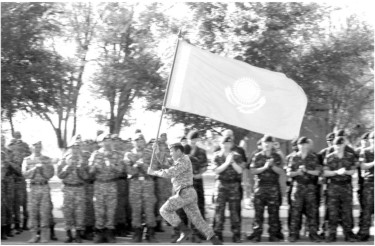
As part of its developing “forward partnering” strategy —a combination of continued but scaled-back U.S. “forward force projection” and increased “interoperability” with allied “regional stabilizers”—the Pentagon throughout the course of the Afghan war has continued to hold major joint maneuvers with regional forces, NATO allies, and U.S. troops, most notably the annual Operation Steppe Eagle held in Kazakhstan on nine occasions through 2013. Such maneuvers are not about to end.
In what has amounted to a spree of bribery and unprecedented grand scale graft, unknown amounts of Pentagon “walk around money” and other U.S. assistance has gone to the region’s authoritarian regimes as compensation for their cooperation. The results have been manifold as injections of war chest cash and credits have also gone to line the pockets of ruling oligarchs, their well-connected cronies, and other “rent takers.”
Unevenly distributed and largely siphoned upwards and abroad, the vast amounts of military and other forms of aid have assisted in widening preexisting social and economic chasms, the key sources of insecurity and resentment. Much of the funding, doled out for “security assistance,” in turn has gone to bolster repression rather than democratization.
Enabling the corruption and ongoing human rights abuses endemic to the region, U.S. operations have actually benefitted the few at the expense of the many and thereby made all but guaranteed future instability and increased the likelihood of blowbacks yet to come after Afghanistan.
Z
Allen Ruff is an historian and investigative researcher. His primary work centers on opposition to U.S. “grand strategy” and interventions in the Middle East, Central Asia, and elsewhere. He hosts a weekly a public affairs program on WORT, 89.9 FM in Madison, Wisconsin and blogs at allenruff.blogspot.com.
