

Argentina defaulted on its foreign debt in December 2001. Its example (along with Iceland’s and Ecuador’s) offer important lessons for Greece which looks poised to default on debt owed to the IMF. Naturally the corporate press can’t help but lie about Argentina’s example.
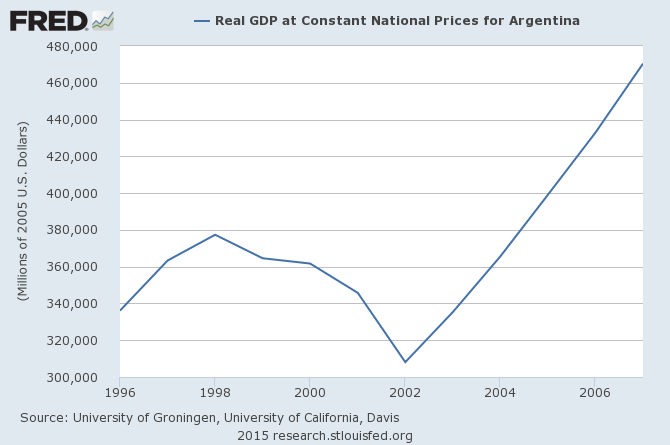
The article by Zeke Turner says “It took more than five years for Argentina’s economy to return to the size it was in 2001.”
As Dean Baker shows here, it took about 2 years, until the end of 2003, for real GDP in Argentina to reach its 2001 level.
I repeat: 2 years, not 5. That’s quite a whopper by Zeke Turner and his Poltico editors.
GDP per capita took about year longer than that (still only 3 years, not 5) to surpass its 2001 level according to IMF data.
Turner also quotes a former Argentinian negotiator with the IMF during the 2002-2005 period making vague disparaging remarks about the Syriza government in Greece:
“If they manage the fiscal equation well, they can go back to growth very fast, but I doubt they do it,” said Nielsen. “With the spirit they have shown, the government of Tsipras, I doubt that they’re going to have a good fiscal policy.”
Given the whopper about GDP, and the fact that no effort is made to explain why Neilson said that, I strongly suspect more shoddy journalism is involved with that quote.
UPDATED 6/28/2015
Politico editor replies
Hi,Saw your blog post on our Argentina story. According to the World Bank, using current US$, Argentina’s GDP in 2001 was $250 billion, a level it passed again only in 2007.Regards,Jan Cienski
Hi Jan
Using current US $ is not how anyone would measure GDP to asses living standards in Argentina.According to IMFArgentina’s GDP adjusted for purchasing-power-parity PPP (current international dollars)recovered its 2001 value by 2003You should correct your articleJoe
But the story mentioned nothing about living standards. It’s the overall size of GDP, and the World Bank figures show clearly that the economy only regained its 2001 size by 2007.There’s absolutely nothing wrong with the article.Regards,Jan
Yeah rightLiving standards as captured by GDP are irrelevant to assessing Argentina’s economy.Sorry you don’t see anything wrong with that.May I post this exchange of ours? I think many people would find it enlightening.
By the way, a friend informs me that the WSJ made a similar mistake in a front page article and corrected it right away.Also , if you look at Canadian GDP in current US dollars, then you’d conclude we had a deep recession in 1997/1998. We didn’t – quite the opposite.Data below shows both Canadian GDP in current US dollars and economic growth
Again, please let me know if I can post our exchange.Joe
There is no problem with posting. The problem is that the article wasn’t about GDP per capita or about living standards, despite your comment: “Yeah, right. Living standards as captured by GDP are irrelevant to assessing Argentina’s economy.” The article was about the length of the recession and the time it took for the Argentine economy to return to its pre-default size. Measuring an economy by current US$ is entirely acceptable (even more in the case of Argentina which before the default pegged the peso to dollar).
Jan
The article states “ The impact was also devastating on ordinary Argentinians. The peso went from being at parity with the U.S. dollar to about a quarter of its pre-crisis value. Inflation soared and the economy contracted. It took more than five years for Argentina’s economy to return to the size it was in 2001. “Again “ devastating on ordinary Argentinians ” .So by that you meant nothing about living standards?That makes no sense at all.You say “ The article was about the length of the recession”By your logic Canada had a bad recession in 1997/1998. In fact, it didn’t have a recession at all. The economy was growing rapidly even though GDP, measured in curent US dollars had fallen.You guys don;t clarify that you basing your claim on GDP at current US dollars.At a bare minimum you should amend the article to explicitly say that you were referring to Argentina’s GDP in current US dollars.Joe
ZNetwork is funded solely through the generosity of its readers.
Donate