
Comparing Capitalism & ParEcon Ownership Relations
What do people own? In particular, who or what owns the tools and equipment used to produce goods for society…and what implications do the economy’s ownership norms have for economic and social life? This page briefly compares the Capitalist and Pareconist approach to ownership of means of production.
Next Entry: Comparing Regarding Decisions
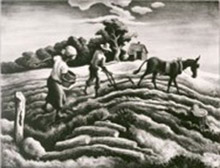
“Planting” by Thomas Hart Benton |

“Kiss” by Klimt |
Introducing Capitalist OwnershipIn a capitalist economy, individuals own not only their own private personal clothing and other personal possessions, but also means of production such as the tools found in factories and even the factories themselves. This ownership is heavily skewed so that 1% of the population owns almost all productive property, another 19% or thereabouts owns some, and 80% owns essentially none. Ownership of productive tools is a critical factor in all sides of economic life. Ownership conveys rights of control and of accruing surpluses to owners. |
Introducing ParEcon OwnershipIn a parecon, individuals own their own private personal clothing and other personal possessions…of course…but means of production are socially “owned,” not personally owned. More accurately, one might say no one owns them, or one might say that everyone owns an exactly equal share of every item of productive property. In any event, in a parecon ownership of productive tools is moot. It has zero implications for control or distribution of income or wealth. |
Evaluating Capitalist OwnershipPrivate ownership in capitalism, one of its centrally defining features, creates a class division between capitalists and non-owning classes. It leads to vast differentials in wealth and income as well as in power –those who own property earn profits which can be gargantuan. In contrast, others work for a living. Owners command and control huge swaths of economic life via corporations they have ownership of or share in ownership of. Those who don’t own either eke out a degree of command and control capacity via their job responsibilities, or, far more often, simply follow orders. Ownership does instill effective incentives to accrue property, on the one hand, and to use owned property to generate profits, on the other. This incentive works in promoting property seeking, that is, but what it promotes as guiding norm of decision making and evaluation is the further centralization of power and wealth in few hands, on the one hand, and on the other the orientation of economic life toward maximizing profit for the few, rather than toward the collective betterment of the many. Profit maximization can be enhanced, at times, by producing items that are more demanded, but can also be enhanced by cutting costs, imposing costs on others, compelling consumption even against user interests, etc. |
Evaluating ParEcon OwnershipThe ownership features of parecon are inconsequential in effects on production and consumption relations. They are neutral vis-a-vis income, power, class, and essentially everything else. They are absent, in essence. You can think of it as if no one owns any means of production or as if each person owns an identical share of every item that is a means of production, where that ownership conveys neither rights nor responsibilities. Remuneration and decision making power and responsibility come from other factors, entirely. Whatever parecon’s virtues or debits regarding income, wealth, power, decision making, class relations and other dimensions may be…ownership doesn’t play a role. |
