Comparing Capitalism and Parecon

Comparing Capitalism & ParEcon Regarding Innovations

How are innovations pursued, decided on, and implemented? Is there sufficient incentive to undertake innovations, are the right innovations enacted, and so on. This page compares Capitalist and Parecon implications for Economic Innovations.

Next Entry: Comparing Regarding Income

Picture

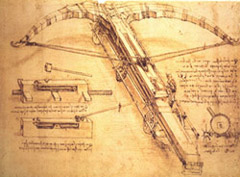
Crossbow sketch
by Leonardo DaVinci

Picture

“Baile En Tehauntepac”
by Diego Rivera

Introducing Capitalist
Regarding Innovations

In a capitalist economy, the drive to innovate is in turn driven by desire for profits and market share, as well as by geopolitical military domination — in cases of large economies. Much innovation therefore occurs. We get steadily more refined advertising and packaging to cajole otherwise unnecessary consumption. We get better means of dumping pollution without people realizing it has occurred until it is too late for them or their children. We get new workplace technologies to extract more labor while imposing greater subordination and fragmentation. We get more effective weapons with which to blow up people and cities, that we can then innovatively rebuild.

Capitalist innovation occurs via investment which is paid for by large corporations and financial institutions. The decision to undertake study and experiment to discover new innovations and then implement them occurs, therefore, when the highest levels of capitalists deem proposals worth pursuing. Thus, we typically get the kind of results noted above.

Introducing ParEcon
Regarding Innovations

In a parecon, innovation is undertaken by workers whose job is to explore options and discover new ways of operating, producing, arranging, etc. They propose projects which the participatory planning system (instead of venture capitalists and banks) accept or reject as part of the economy’s annually operations. The guiding criteria of innovations are, as in general, to meet needs and develop potentials consistent with enlarging solidarity, diversity, equity, and self management. The amount of attention given to innovating is determined, like everything else, by popular choice and individual inclination. Innovation is conceived and carried out by workers organized in balanced job complexes as is all production.

So in a parecon there is more or less innovation in accord with more or less desire to innovate and more or less success in proposing worthy innovations. Predictably there will be a steady stream of innovations to improve society’s average job complex, which benefits everyone, and to increase output per outlay of human energy, which also benefits everyone, as well as to expand knowledge and culture, to meet needs, develop potentials, etc.

Evaluating Capitalist Regarding Innovations

In a parecon, innovation is undertaken by workers whose job is to explore options and discover new ways of operating, producing, arranging, etc. They propose projects which the participatory planning system (instead of venture capitalists and banks) accept or reject as part of the economy’s annually operations. The guiding criteria of innovations are, as in general, to meet needs and develop potentials consistent with enlarging solidarity, diversity, equity, and self management. The amount of attention given to innovating is determined, like everything else, by popular choice and individual inclination. Innovation is conceived and carried out by workers organized in balanced job complexes as is all production.

So in a parecon there is more or less innovation in accord with more or less desire to innovate and more or less success in proposing worthy innovations. Predictably there will be a steady stream of innovations to improve society’s average job complex, which benefits everyone, and to increase output per outlay of human energy, which also benefits everyone, as well as to expand knowledge and culture, to meet needs, develop potentials, etc.

Evaluating ParEcon Regarding Innovations

If one wants innovations that are oriented in the first place to meet human needs and develop human potentials, and if one wants them carried out in a manner consistent with justice and equity, and if one wants them to implement the will of populations with each member having appropriate input — then parecon innovation is quite impressive for its focus and scale.

Ā Next Entry: Comparing Regarding Income

Ā 

Subscribe

All the latest from Z, directly to your inbox.

Institute for Social and Cultural Communications, Inc. is a 501(c)3 non-profit.

Our EIN# is #22-2959506. Your donation is tax-deductible to the extent allowable by law.

We do not accept funding from advertising or corporate sponsors.Ā  We rely on donors like you to do our work.

ZNetwork: Left News, Analysis, Vision & Strategy

This is your article this month.

We’re glad you keep coming back. If Z’s work has informed, challenged, or inspired you, that’s no accident: there are no paywalls, no ads, and no billionaire owners here, and there never will be. Independent media survives because readers choose to support it.

Billionaires fund their own media. We fund ours. Help us reach 1,000 sustaining donors:

Number of donors680
Our goal1,000

Sustainers at $9/month or more receive the digital Z Magazine.

Already a sustainer? Click here and we won’t ask again. Thank you!

Your reading count is stored only in your browser and is never sent to us.

Sound is muted by default.Ā  Tap šŸ”Š for the full experience

CRITICAL ACTION

Critical Action is a longtime friend of Z and a music and storytelling project grounded in liberation, solidarity, and resistance to authoritarian power. Through music, narrative, and multimedia, the project engages the same political realities and movement traditions that guide and motivate Z’s work.

If this project resonates with you, you can learn more about it and find ways to support the work using the link below.

Independent media is not disappearing because the ideas are weak.

It is disappearing because platforms reward speed, outrage, and algorithmic visibility over thoughtful analysis.

More than 100,000 people read Z every month, free of paywalls, ads, and billionaire owners. It takes fewer than 1 in 100 of them to fund all of it: 1,000 donors who keep Z independent, for everyone, and build what comes next.

Number of donors680
Our goal1,000

Sustainers at $9/month or more receive the digital Z Magazine.

Subscribe

Join the Z Community – receive event invites, announcements, a Weekly Digest, and opportunities to engage.