


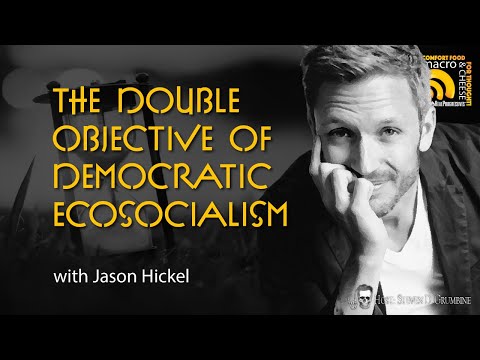
The title of this week’s episode is taken from an article to be published in September’s Monthly Review. The author, Jason Hickel, talks to Steve about the topic in his third visit to the podcast.
Before we look at the double objective of ecosocialism we must analyze the double crisis we’re facing – ecological and social. Both are caused by the same underlying issue: the capitalist mode of production. Capitalism creates an almost perfect circuit that begins and ends with commodification and enclosure. Well, actually, it ends with massive profits… and that double crisis we mentioned.
With essential goods and services outside our control, we have no bargaining power when it comes to the cost of living. We are helpless in the face of artificial scarcity and price-gouging. Faced with the high price of necessities we are forced to work longer and harder in order to simply survive. And of course, the more we need to work, the less control we have over our wages. The capitalist class makes out at both ends.
There are at least two undeniable problems with this system. It wreaks havoc on the environment and is inconsistent with democracy, if you care about that sort of thing. “This is where our analysis has to ultimately lead, and the underlying pathology is basically that capitalism is fundamentally not democratic.” Even those of us who live in the US, Europe, or other countries with nominally democratic electoral systems have no illusions about their undemocratic nature. “More importantly, when it comes to the system of production, which all of us are engaged in every day, on which our livelihoods and our existence depends, not even the shallowest illusion of democracy is allowed to enter.”
After identifying the quagmire, Jason and Steve talk about a solution. Jason lays out the necessary policies that ecosocialism should provide: universal public services, a public works program, and the job guarantee. Jason even suggests the possibility of post-capitalist firms and describes how they might operate in such a system.
We can’t have a Jason Hickel episode without a discussion of degrowth and whether that concept applies to the exploitation of the Global South. Nor is there a means of achieving our goals without domestic and international class solidarity. “We can’t underestimate the scale of the struggle that is really involved here. I think we have to take inspiration from successful social movements that have occurred in the past. There’s this amazing line from Thomas Sankara, the revolutionary leader of Burkina Faso that goes ‘we are the heirs of the world’s revolutions’. Pretty much every good thing that we have is the result of revolutionary forces that fought to bring that to be. Everything from literally the minimum wage, as pitiful as it is, to the weekends, to whatever admittedly meager forms of democracy we get to exercise. These are all the benefits of revolutionary movements that have at least won some concessions in the past, and in some cases against extraordinary odds.”
Dr. Jason Hickel is an economic anthropologist, author, and a Fellow of the Royal Society of Arts. He is Professor at the Institute for Environmental Science and Technology at the Autonomous University of Barcelona, Visiting Senior Fellow at the International Inequalities Institute at the London School of Economics, and Chair Professor of Global Justice and the Environment at the University of Oslo. Health. Jason’s research focuses on global political economy, inequality, and ecological economics, which are the subjects of his two most recent books: The Divide: A Brief Guide to Global Inequality and its Solutions (Penguin, 2017), and Less is More: How Degrowth Will Save the World (Penguin, 2020), which was listed by the Financial Times and New Scientist as a book of the year.


Jason Hickel is an author and Professor at the Institute for Environmental Science & Technology (ICTA-UAB) at the Autonomous University of Barcelona. He is also a Visiting Professor at the International Inequalities Institute at the London School of Economics, and a Fellow of the Royal Society of Arts. He serves on the Climate and Macroeconomics Roundtable of the US National Academy of Sciences, the advisory board of the Green New Deal for Europe, the Rodney Commission on Reparations and Redistributive Justice, and the Lancet Commission on Sustainable Health. Jason's research focuses on political economy, inequality, and ecological economics, which are the subjects of his two most recent books: The Divide: A Brief Guide to Global Inequality and its Solutions (Penguin, 2017), and Less is More: How Degrowth Will Save the World (Penguin, 2020), which was listed by the Financial Times and New Scientist as a book of the year.
ZNetwork is funded solely through the generosity of its readers.
Donate




