

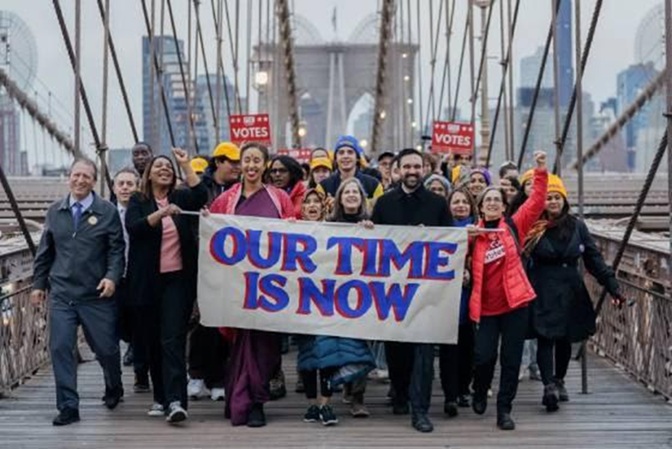
On Thursday, Mayor Zohran Mamdani signed an executive order creating the Mayor’s Office of Worker Power (MOWP), the nation’s first municipal agency built to help workers organize.
Tony Perlstein will run the MOWP, reporting to Deputy Mayor for Economic Justice Julie Su. A former longshoreman and union organizer born and raised in New York, Perlstein served as an organizing director for the United Auto Workers, where he helped lead a national campaign to lift pay and protect jobs from automation.
As part of its mandate, the MOWP will regularly bring union leaders and rank-and-file members together to discuss worker issues and organizing drives. It also aims to reach unorganized workers, like immigrants and gig drivers, and connect them to worker centers and other resources. The office plans to hold public hearings, teach workers what protections they already have, and steer them toward organizations that can help.
Mamdani spoke about the new office with Jacobin’s Spencer Snyder.
Spencer Snyder
Tell me a little bit about the Office of Worker Power.
Zohran Mamdani
This is a first-of-its-kind office in the country, and we’re setting it up to help workers organize in an economy where more and more is stacked against them. This is a way we can help workers fight for the kinds of protections workers won in the past that we now celebrate as just a part of life. Like the weekend.
Spencer Snyder
How did the idea come about? Is this something you were thinking about on the campaign trail?
Zohran Mamdani
On the campaign, we talked about the cost-of-living crisis in this city and the need for an affordability agenda. Workers feel that every day. This office is born of our belief that we can make the nation’s most expensive city affordable. It’s also informed by the success of our Mayor’s Office to Protect Tenants and how it’s delivered for tenants across the city. Now we have the opportunity to do the same for workers.
Spencer Snyder
What kinds of issues is this office meant to address?
Zohran Mamdani
At the heart of it is the fact that what used to create a middle-class life no longer does. Many workers are grappling with the emptiness of the promise that working nine to five can be enough to live in this city. They’re having to take on two or three jobs. They’re having to engage with a gig economy that is actively growing while also failing to provide a dignified life for so many of the people who participate in it.
What we’re going to have in this office is a commitment to assisting workers wherever and however they want to organize — and to doing that in more languages than just English.
Spencer Snyder
How do you hope this office will affect the work landscape in the city more broadly?
Zohran Mamdani
I hope it will help workers not only understand the power they have but build more of that power. We’ve seen that when workers come together, it’s something that benefits everybody across the city and across this country. We want to make sure that we at city hall are using every tool at our disposal to help workers do exactly that.
Spencer Snyder
Can you tell me about the public hearings?
Zohran Mamdani
One of the many things this office is going to do is hold public hearings and conduct research, to bring out into the open a lot of the struggles that workers are facing privately. The point is to start a conversation that isn’t just public but that also provides the information workers need in order to organize.
Spencer Snyder
Why would someone come to this office?
Zohran Mamdani
Someone might come to this office because they’re a worker and they want to better their own conditions, or the conditions of those around them, and they’re not sure where to go next. In New York City, it’s very hard to know who you should call about any of these issues. Now we’re saying you will soon be able to go to nyc.gov/workerpower and finally get the kind of information you need, so that you know what rights you already have available to you and what rights you can win.
We’ve seen this with tenants when we’ve held “Rental Ripoff” hearings. Tenants finally had an avenue, no matter what borough they call home, to come forward and say, “These are the ways in which I’m facing struggles in the housing market today.” That then informed the policies we’ve been putting forward over the last few months.
Spencer Snyder
What would the ideal outcome be for a worker who comes to the office and says they want to start organizing?
Zohran Mamdani
To me, it’s that a worker leaves the office with a better understanding of the rights they already have, and the ways in which they can win the rights they deserve. It’s hard enough to survive in this city without the added responsibility of knowing what is often an arcane landscape of laws and regulations. Now city government will be there to say, “This is the landscape as it exists today, and these are the tools you have at your disposal to win the landscape of tomorrow.”
Spencer Snyder
To what extent does this office go beyond being an educational resource?
Zohran Mamdani
I’ll go back to the Mayor’s Office to Protect Tenants. In that office, we inform tenants of the rights they have, but we also assist tenants when they express interest in setting up a tenant union. And we’ve spoken to tenants and had their testimony provide us with the foundation of new policy.
One example coming out of the “Rental Ripoff” hearings: on October 1, for the first time in New York City history, we are going to investigate every single heat complaint registered with the city. That’s a direct result of tenants coming forward and speaking about the pernicious effects of not having accountability for this specific kind of housing violation. To me, that’s a clear model of what can come from finally creating a part of city government whose job is not just to work with workers but also to help them organize for themselves.
ZNetwork is funded solely through the generosity of its readers.
Donate




