

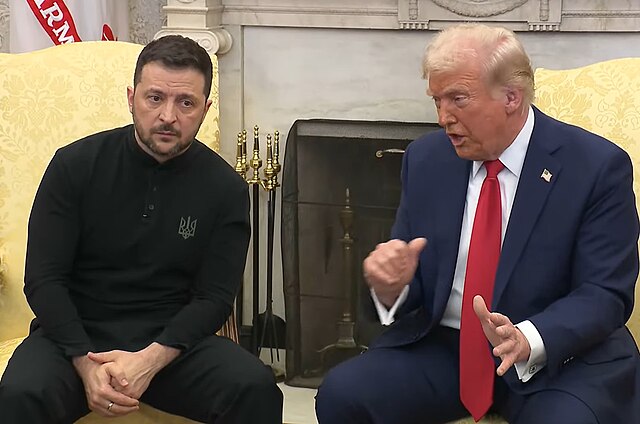
The last time Ukrainian President Volodymyr Zelensky visited the White House earlier this year, he was berated by Donald Trump.
On Monday, he returned with European leaders by his side. He emerged with some signs of progress on a peace deal to end Russia’s war against Ukraine.
The presence of the European leaders no doubt had a great impact on the meeting. After Trump’s recent summit with Russian President Vladimir Putin in Alaska, they were concerned he was aligning the United States with the Russian position by supporting Putin’s maximalist demands.
We see from Trump’s statements over the last couple of months, the only pullback from his erratic pronouncements, largely based on Russian disinformation, seems to come when a body politic around him brings him back to a more realistic and informed position. So, this show of European unity was very important.
Security guarantees remain vital
There was considerable progress on one critical part of the negotiations: security guarantees for Ukraine.
It is significant that the US is to be involved in future security guarantees. It was not that long ago Trump was placing all the responsibility on Europe. So, this signals a positive development.
I listened to the briefing Zelensky gave outside the White House in Ukrainian for Ukrainian journalists. He explained it will take time to sort out the details of any future arrangement, as many countries would be involved in Ukraine’s future security guarantees, each with different capabilities to assist. Some would help Ukraine finance their security needs, others could provide military assistance.
Zelensky also emphasised that funding and assistance for the Ukrainian military will be a part of any future security arrangement. This would involve strategic partnerships in development and production, as well as procurement.
Zelensky made a point of this at a news conference in Brussels prior to Monday’s meeting. It is a priority for Ukraine to have a military strong enough to defend itself from future Russian attacks.
Reports also indicate the security guarantees would involve Ukraine buying around US$90 billion (A$138 billion) of US military equipment through its European allies. Zelensky also suggested the possibility of the US buying Ukrainian-made drones in the future.
According to NATO Secretary General Mark Rutte, there was also discussion about an Article 5-type security guarantee for Ukraine, referring to the part of the NATO treaty that enshrines the principle of collective defence for all members.
However, contrary to popular belief, NATO’s Article 5 does not actually commit members of the alliance to full military intervention if any one member is attacked. It allows NATO states to decide what type of support, if any, to provide. This would not be enough for Ukraine.
Ukraine has already seen the result of a failed security arrangement. In the Budapest Memorandum of 1994, the United States, the United Kingdom and Russia guaranteed to respect Ukraine’s borders and territorial integrity in exchange for Ukraine giving up the third-largest nuclear arsenal in the world.
However, look what happened. Russia invaded in 2014 without any serious consequences, and then launched a full-scale invasion in 2022.
Given this, any future security guarantee for Ukraine will need to be rigorous. Ukrainians are very cognisant of this.
Loss of Ukrainian territory
Prior to his Alaska summit with Trump, I would have said Putin is not interested in any kind of deal. We saw how in previous meetings in Istanbul, Russia sent low-level delegations, not authorised to make any decisions at all.
However, I think the scenario has changed because, unfortunately, in Alaska, Trump aligned himself with Putin in supporting Russia’s maximalist demands. It’s highly likely Putin now believes he has an advocate for those demands in the White House.
This could mean Putin now perceives there is a realistic chance Russia could secure Donbas, the regions of Donetsk and Luhansk.
I don’t believe Ukraine would ever agree to any formal or legal recognition of a Russian annexation of Crimea or any of the other four regions that Russia now partly occupies – Donetsk, Luhansk, Kherson and Zaporizhzhia.
Zelensky has been adamant Ukraine would not cede territory to Russia in any peace deal. And he alone cannot make such a decision. Changing any borders would need a referendum and a change to the constitution. This would not be easy to do. For one thing, it’s a very unpopular move. And Ukrainians living in Russian-occupied territory would not be given a free and fair vote.
Putin’s war against Ukraine is an attempt at illegally appropriating very valuable land. In Alaska, he demanded Russia essentially be gifted the entire regions of Donetsk and Luhansk, including land not currently occupied by the Russian military.
This land has extensive Ukrainian military fortifications. Giving up this territory would leave Ukraine completely exposed to future Russian invasions – the country would effectively have no military protection along its eastern border regions. This would put Russia in a very advantageous position in future plans to regroup and attack again.
Even if Zelensky felt compelled to agree to some kind of temporary occupation and a frozen conflict along the current front lines, I don’t believe Ukraine could give up any land still under Ukrainian control.
In a recent Gallup poll, 69% of Ukrainians favoured a negotiated settlement to the war as soon as possible. In my view, this reflects the fact the United States, under the Trump administration, is proving to be an unreliable partner.
A settlement that rewards Russia for its genocidal war against Ukraine would set a very dangerous precedent, not only for the future of Ukraine but for Europe and the rest of the world.
At recent negotiations between the two sides in Istanbul, the head of the Russian delegation said “Russia is prepared to fight forever”.
That has not changed, no matter what niceties have occurred between Trump and Putin. They are prepared to continue to fight.
ZNetwork is funded solely through the generosity of its readers.
Donate




