


I sit here at my desk, looking out the window – and see someone walking through the parking lot. This is the most ordinary of moments. I shrug quietly. Life goes on.
My impulse is to stop writing the column here. That’s it. Nothing more to say. Life is totally fine and civilized and I’m here in the middle of it, growing old but giving no thought whatsoever to the darkness that lurks at humanity’s margins. Sure, the news covers that stuff, but what do I care? Things are fine where I live.
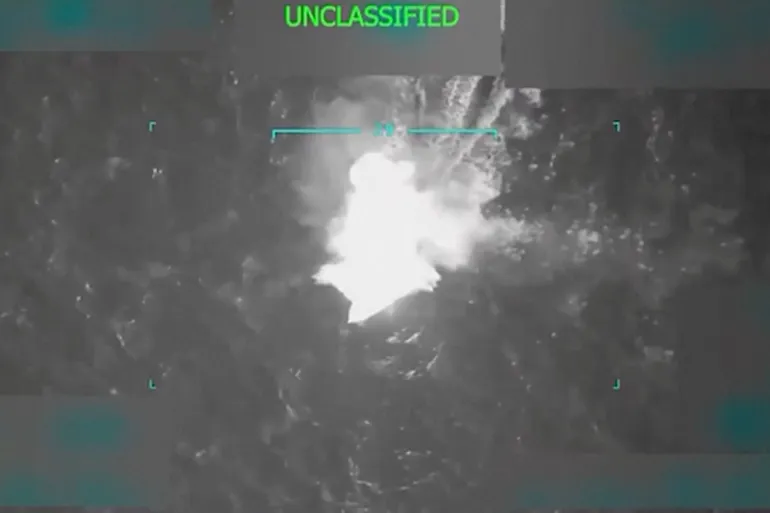
But the darkness tugs. I read the news. I know that hell consumes parts of the planet and certain lives have no safety – no value – whatsoever. Here’s a recent New York Times headline, as ordinary as the fact that someone was walking through the parking lot outside my window:
“U.S. Military Kills Another 6 People in 5th Caribbean Strike, Trump Says.”
Well, so what? They were transporting drugs. “The military has now killed 27 people as if they were enemy soldiers in a war zone and not criminal suspects. . . .”
Minor news, right? But consider the complexity of the context that emerges from these words. The story is critical of Trump for bombing boats and claiming without evidence that they were transporting drugs meant to be sold to Americans. But there’s a quiet assumption here. By making the point that this was not a war zone, the story quietly leaves the assumption hanging that if it were a war zone – and the boat had been carrying officially declared American enemies – well, that would be a different matter.
War itself is unchallenged and accepted – certainly by the mainstream media (whatever is left of it). And also by the collective American, and perhaps global, norm. And here’s the problem. War is a fifty-fifty deal: There’s a good side and a bad side. And if you’re on the good side, the war you wage is just. That means you have the moral leeway to kill whomever you want . . . excuse me, “must.” This includes children.
But “permission to kill” is psychologically – indeed, spiritually – complex. It requires a further step, one that lets us off the hook from our own inner moral sensibility: We’re all humans. We are deeply alike. We are one.
The way around this emotional difficulty is simple: dehumanize the enemy! It happens virtually automatically, as soon as a particular group is declared the enemy, i.e., “them.” But it requires linguistic assistance: The bad folks must be given a name. and when they are, the name explodes in significance. Ka-boom! Now it’s a weapon. Anyone assigned that name is instantly dehumanized. Language is the initial weapon of war, and is an indispensable tool of those who wage it.
Indeed, dehumanization exists almost as though it’s part of who we are. I believe with all my heart that it is not part of the human DNA, but it sure seems to act like it is. To dehumanize a group of people who are different from us simplifies life enormously. Even if we don’t go to war with them, we free ourselves from having to try to understand them. We can just dismiss them.
Welcome to racism. Welcome to ethnicity. Welcome to borders, both political and religious. Welcome to us vs. them – the hole in the human heart.
In my lifetime, here in the USA – in the wake of World War II – the primary way to dehumanize someone, at home as well as abroad, was to declare them a communist. The term had instant power. Every leftist was a commie. They were taking over Hollywood, not to mention Washington. They were under our beds! Because of the existence of nuclear weapons, America’s powers-that-be wisely avoided going to war with the Soviet Union or China, but we nonetheless had the wherewithal to create the military industrial complex here at home and engage in proxy wars, killing a few million people and, oh yeah, intensifying our long-term, unacknowledged war on Planet Earth itself.
Another dehumanization term that emerged from those wars was “collateral damage” – a unique form of dehumanization. Those who were collateral damage were not necessarily our enemies, just people in the vicinity of the just war we were waging. They were merely in the way. But the term did its job. It took the humanity away from anyone our bombs unintentionally eliminated and turned them into scrap metal at a junkyard.
After the Soviet Union collapsed, however . . . uh oh, now what? The communists were done with, but we still needed an enemy! Governing is so much harder without one. Enter the terrorists, our primo enemy of the last couple decades and a word with enormous potency. For instance, anyone who criticizes Israel for killing 70,000 Palestinians (or far, far more than that) is both pro-terrorist and anti-Semitic. The flotilla trying to bring food to Gaza is a terrorist operation.
And then, closer to home, we have the “illegals” – aliens, wetbacks – who are not just fleeing poverty and crossing the border into the USA, but invading it. Looks like we’ve got another war on our hands, folks.
I’m not worried about the guy I saw walking through the parking lot a little while ago, but what if he looked like an invader? Hey, ICE . . .
Robert Koehler, syndicated by PeaceVoice.


Robert Koehler is an award-winning, Chicago-based journalist and nationally syndicated writer. Koehler has been the recipient of multiple awards for writing and journalism from organizations including the National Newspaper Association, Suburban Newspapers of America, and the Chicago Headline Club.
ZNetwork is funded solely through the generosity of its readers.
Donate




