


Fifteen years ago, during President Obama’s first term, we co-founded RootsAction as an online progressive group challenging not only Republicans but also the corporatism and militarism of the Democratic Party. RootsAction supported Bernie Sanders for president in 2016 and 2020. Two years before the 2024 election disaster that returned Donald Trump to the White House, RootsAction launched the Don’t Run Joe campaign, with the warning that the renomination of Joe Biden by Democrats “would be a tragic mistake.”
Despite polls showing as early as 2022 that strong majorities of Democrats wanted a 2024 nominee other than Biden, the “Don’t Run Joe” message went unheeded until Biden’s debate debacle in June 2024. By then, it was too late for the open primary process needed to produce a ticket that could inspire activists – and defeat the fascistic faux-populism of Trump.
Like the 2024 victory of the twice-impeached, repeatedly indicted Trump, his 2016 win was avoidable. Tad Devine makes the case in his new book, “How the Democrats Screwed Bernie.” Devine had been a top strategist for mainstream Democrats for decades before he joined Bernie’s first presidential campaign.
One lesson we’ve learned over the last 15 years is that it’s a big mistake for activists to sit back and expect the Democratic Party establishment to serve up candidates who can mobilize voters and win elections. That establishment failed us in winnable presidential elections in 2000, 2004, 2016 and 2024. Devine, who knows the mechanisms inside and out, says the dollar-dominated process is often rigged against outsider “candidates who connect with voters, who understand voter anxieties” – and these genuinely populist candidates “are more likely to succeed in general elections than those who rely primarily on insider muscle.”
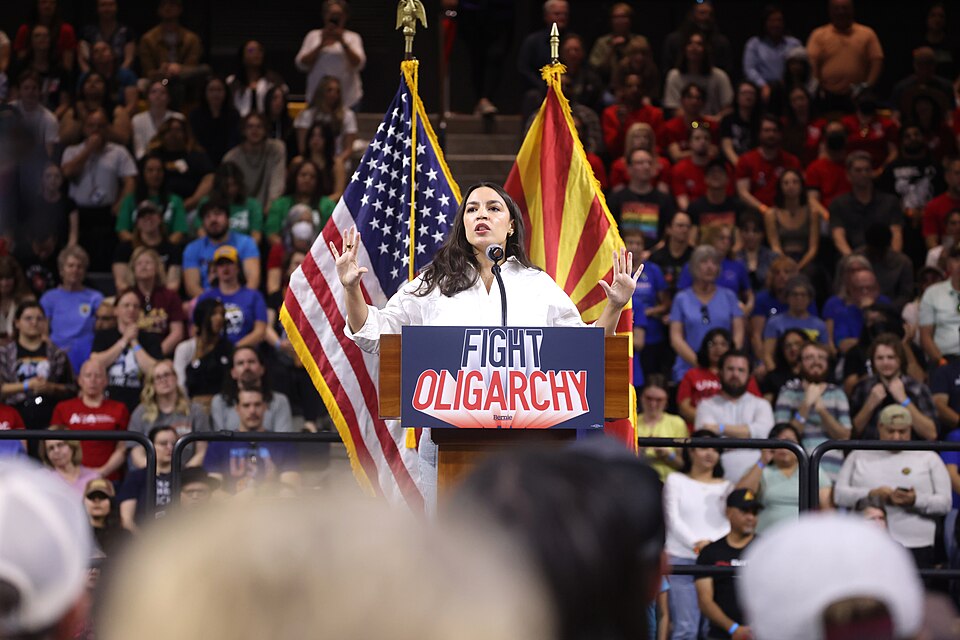
This week, RootsAction teamed up with Progressive Democrats of America to announce that we will jointly launch, just after the November midterm elections, a campaign urging Reps. Ro Khanna and Alexandria Ocasio-Cortez to run for the 2028 Democratic presidential nomination. “The voices of Khanna and/or AOC are needed in the presidential campaign to ensure that voters hear serious solutions,” the campaign’s petition says. “Without a progressive populist advocate atop the ticket, the Democratic response would be woefully underwhelming – enabling right-wing demagoguery to push voter unrest in dangerous and divisive directions.”
The petition statement adds that the presence of Khanna and/or AOC in the presidential race “is crucial to foster debate on healthcare, jobs, AI, militarism and the U.S. relationship with Israel, along with many other issues important to a wide range of voters.”
Congressman Khanna – whose name recognition has grown recently because of his legislative battles to release the Epstein files and to end the Iran War, and his detention in the occupied West Bank by Israeli settlers – represents our country’s wealthiest district and much of Silicon Valley. He wants to increase taxes on the rich. He calls himself “a progressive capitalist.”
Congresswoman Ocasio-Cortez entered the House with great fanfare after a 2018 Democratic primary victory over one of the party’s top leaders on Capitol Hill (Joe Crowley, now a corporate lobbyist) representing a working-class, Latino-majority district in New York City. She led the effort to bring the jobs-creating Green New Deal proposal to Congress. She calls herself “a democratic socialist.”
While there is a difference in how these two politicians label themselves, most voters will be much more interested in whether each will address the needs of the working class and fight the greed of the billionaires. Both are direct political descendants of Bernie Sanders – AOC was active in the 2016 Bernie campaign, which inspired her to run for Congress, and she regularly joined Bernie last year at Fighting Oligarchy rallies; Khanna was a surrogate and national co-chair in Bernie’s 2020 presidential campaign.
RootsAction’s coalition partner in this initiative, Progressive Democrats of America, has a history of major success in candidate recruitment. In late 2013, PDA launched the “Run, Bernie, Run” movement, which drafted Sen. Sanders to seek the Democratic nomination in 2016 – a campaign that elevated the national conversation and helped spark today’s progressive upsurge.
The RunRoRunAOC.org petition argues that either Khanna or Ocasio-Cortez – or both of them – need to be in the presidential race. If both enter it, the organizations behind this recruitment initiative are not worried that the two will somehow “split the progressive vote.” As shown by the historic wave of insurgent victories in this year’s Democratic primaries, the party’s electoral base is largely and increasingly progressive. It’s not a small sliver of voters. And a progressive bloc of delegates at the party’s national convention in August 2028 would be all to the good, pushing for popular policies such as taxing the rich, resisting Big Tech’s AI data centers, abolishing ICE, green jobs initiatives, enhanced Medicare for All, cutting the military budget and stopping the weapons flow to Israel.
During last year’s New York City mayoral campaign – which, thankfully, employed ranked-choice voting – two progressive candidates actually ran as a duo in the Democratic primary: Zohran Mamdani and Brad Lander. Mamdani became mayor thanks significantly to Lander, and now Lander is heading to Congress thanks in part to Mamdani’s endorsement and support. In other races, progressives have run in tandem in crowded fields, maintaining a non-aggression strategy while bolstering each other’s positions.
We should remember that in the early months of the 2019-2020 Democratic presidential race – before a fraught personal split between Sen. Elizabeth Warren and Bernie – the presence of the two previously friendly candidates raising similar issues of inequality and corporate greed had actually moved the whole Democratic debate in a notably more progressive direction.
Despite millions of dollars flooding into the campaign coffers of corporatist Democratic candidates from special interests representing AI, crypto and Israel, and despite assists to those candidates from corporate media, the 2026 Democratic primaries have produced an unprecedented wave of victories by underfunded progressive candidates. These insurgent successes have occurred at local and statewide levels.
It will soon be time for progressives to focus on the national level.
Leaving the 2028 presidential nominating process to the money-drenched party elites – with their record of electoral defeats, governance failures and betrayals – would be a recipe for disaster.


Jeff B. Cohen is an American journalist, media critic, professor, and the founder of Fairness and Accuracy in Reporting, a media watchdog group in the US. He is a retired associate professor of journalism at Ithaca College, where he was an endowed chair and founding Director of the Park Center for Independent Media.
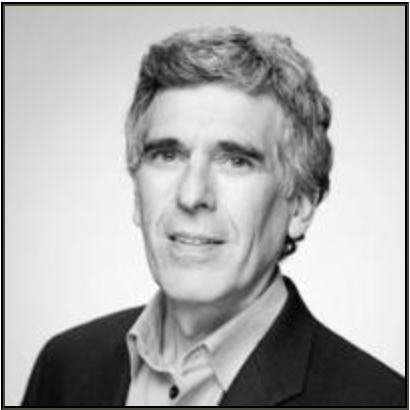
Norman Solomon is the national director of RootsAction.org and executive director of the Institute for Public Accuracy. The paperback edition of his latest book, War Made Invisible: How America Hides the Human Toll of Its Military Machine, includes an afterword about the Gaza war.
ZNetwork is funded solely through the generosity of its readers.
Donate




