


Club Deportivo Palestino, a football team, play in a uniform of white, green and red. Their stadium flies Palestinian flags and their social sports club boasts an open-air pool in the shape of pre-1948 Palestine. But this football team does not play in Palestine, or even the Middle East. Better known as Palestino, they actually play in Chile’s top football league, the Primera División de Chile.
Chile is home to the largest population of Palestinians outside of the Middle East. This Palestinian diaspora, which currently stands at just under 500,000 people, has helped shape nearly a century of Chilean policy towards Palestine. At the heart of this community, Palestino has not only served as a rallying point for the diaspora, but also an instrument of cultural exchange and diplomacy.
The first wave of Palestinian immigrants to arrive in Chile began in the 1850s, as people fled the Crimean war. A second wave of refugees arrived before and during the first world war, as from 1909 the Ottoman empire extended compulsory military service to include young Christian and Jewish men. Many fled from conscription, while families whose sons were forced into service lost their breadwinners and fell into poverty, and so chose to leave Palestine.
The final major period of immigration from Palestine to Chile came following the Nakba in 1948, when 700,000 Palestinians were forced from their homes. Most migrants arrived at the port of Buenos Aires before travelling across Argentina and entering into Chile over the Andes on mules.

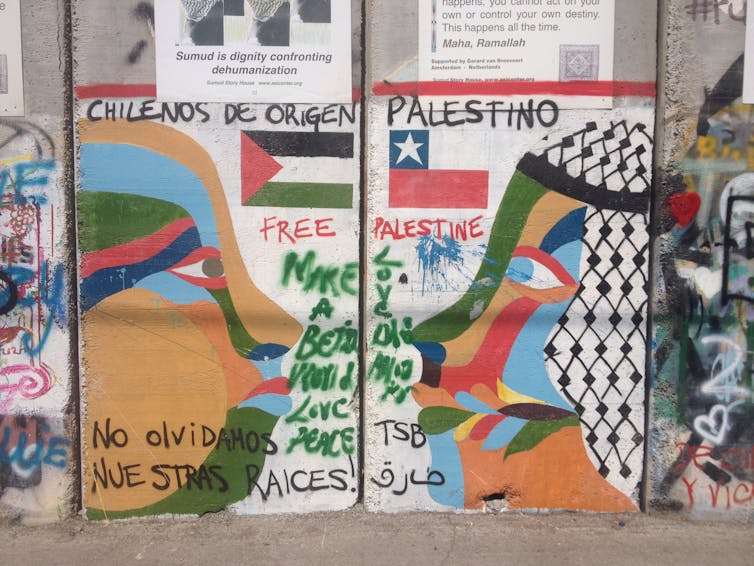
These new Chilean-Palestinians faced fierce racism. Palestinians in Chile were often referred to derogatorily as turcos (Turks), along with all those who had fled the Ottoman empire. As successive generations of Chilean-Palestinians flourished economically, they continued to face prejudice – even by other diaspora communities in Chile.
As Chile’s Palestinian diaspora grew in both numbers and wealth, they set up a series of community institutions including Palestino. The team was actually founded in 1916 in Chile’s capital, Santiago, as an amateur squad. But it was only in 1952 that Palestino went professional. The club’s current stadium, La Cisterna, was inaugurated in 1988 and continues to be a cultural centre for the Palestinian community.
Palestino is not the only professional football club in Chile that has been founded by diaspora communities. Audux Italiano was founded by Italians in 1910, and Club Unión Espoñola was founded by Spaniards in 1897. Since 1933, the three clubs have competed in annual derby matches known as the Clásico de Colonias (Classic of the Colonies).
However, only Palestino has wielded such political influence in both Chile and its homeland.
Shaping Chilean policy
This Palestinian diaspora has shaped Chilean policy towards Palestine, often uniting the left and right wings of Chilean politics. In 1947, Chile abstained from the UN vote to partition Palestine. And under conservative president Sebastian Piñera, Chile recognised the state of Palestine in 2011.
In 2019, during his second term in office, Piñera was criticised by Israel for visiting the Jewish holy site, Temple Mount, with a group of Palestinian officials. In 2022, Chile’s current left-wing president, Gabriel Boric, announced plans to open a Chilean embassy in Palestine.
Palestino itself has also helped build relationships with generations of Palestinian politicians and football fans alike. In 2003, Yasser Arafat, the then president of the State of Palestine, sent a letter from the Gaza Strip in support of the club as it faced bankruptcy.
And in 2015, ahead of the match in which Palestino qualified for the Copa Libertadores (South America’s premier continental competition), the current president of the State of Palestine, Mahmoud Abbas, wrote to the club. He would write to the club again in 2018 ahead of Chile’s annual cup competition, the Copa Chile.
Palestino has also extended its support to the club’s fans in Palestine. Since 2010, the football club’s largest sponsor has been the Bank of Palestine – part of the bank’s efforts to strengthen its relationships with the Palestinian diaspora. As part of these efforts, the Bank of Palestine sponsored a tour of the West Bank for the team’s lower divisions in 2013.
In 2019, for two matches against the infamous Argentinian side, Club Atlético River Plate, Palestino had giant screens installed in the West Bank city of Ramallah so that Palestinian fans could watch the game.


However, the history of Palestino has not been without controversy. In 2014, the club was fined by the Chilean Football Federation after its kit for the new season included a map of pre-1948 Palestine in the place of squad numbers. Chile’s Jewish community and the Israeli government complained, and Palestino eventually removed the maps from their kit.
But Palestino remains vocal and unwavering in its support for the Palestinian State and, more often than not, the Chilean State stands beside them.
There is an old Chilean saying that claims every town in the country must have three things: a priest, a policeman and a Palestinian. This powerful and historic community has shaped not only sporting but also political history in both Chile and Palestine.
As the war in Gaza continues, Palestino’s football matches have become a site for solidarity, mourning and defiant celebration of the Chilean-Palestinian identity.
ZNetwork is funded solely through the generosity of its readers.
Donate




