

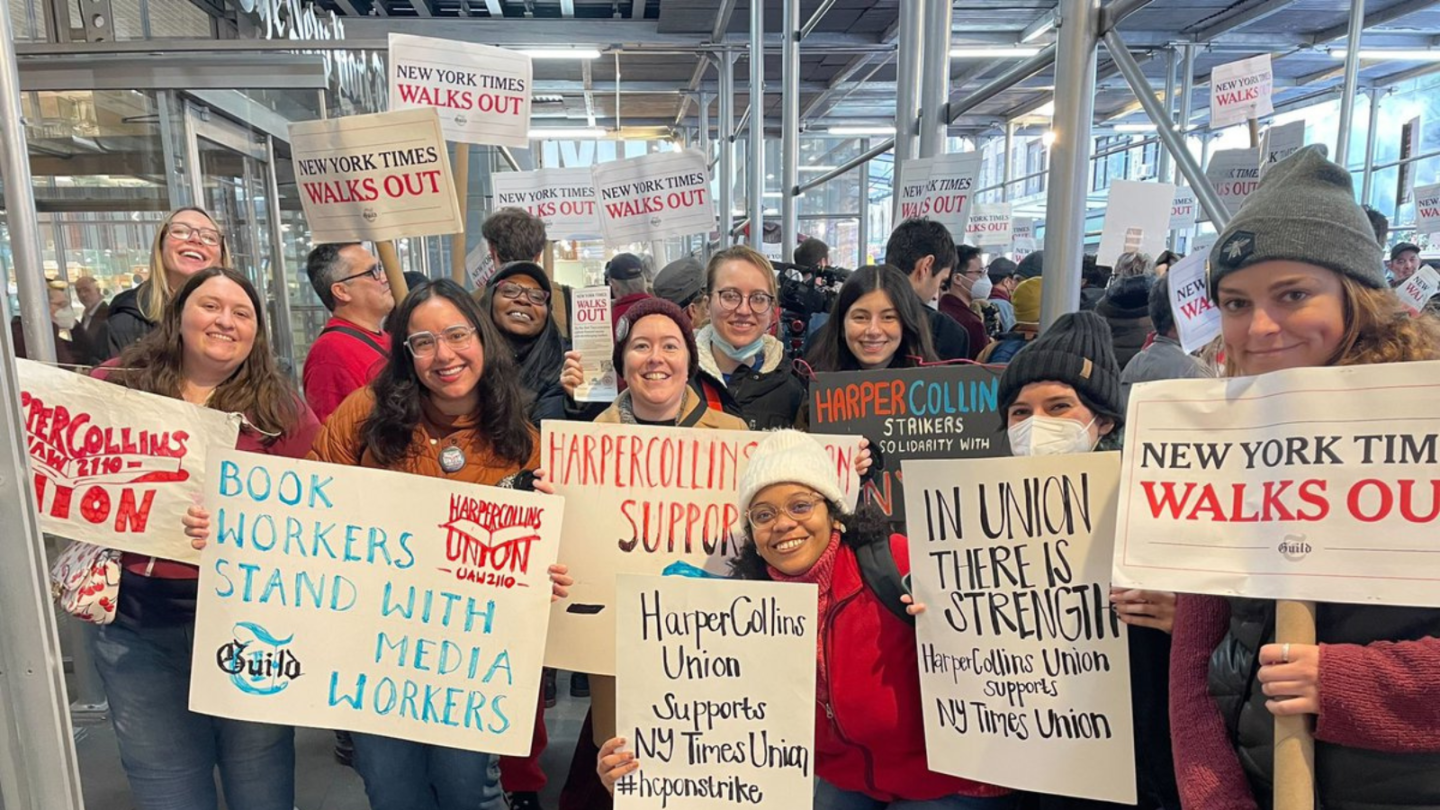
With the air getting colder and the holidays approaching, it feels like a perfect time to curl up with a good book. But instead of cozying up for a well-deserved break, hundreds of publishing workers in New York City have been braving the cold and walking the picket line.
The HarperCollins Union, which represents more than 250 employees, has been on strike since November 10. HarperCollins is the only one of the Big Five publishers (which also include Simon & Schuster, Penguin Random House, Hachette Book Group, and Macmillan) with a unionized workforce, which it’s had for more than 80 years.
There are a number of university presses and smaller publishers who have unionized in recent years, and a small crop of unionized bookstores (including the Strand and McNally Jackson) in New York City. But the HarperCollins Union, with its decades of history and big-fish status, is the only one of its kind for now. The challenges its workers face are endemic throughout the publishing industry, which has long relied on workers’ passion for books to offset low pay and crushing schedules.
While some are working to change the status quo, the industry also remains glaringly lacking in racial diversity. Workers of color who lack the financial support that their more privileged peers enjoy can’t sustain themselves with low-paying jobs and are therefore pushed out. These wider concerns are reflected in the union’s demands. The HarperCollins Union’s major ask is a raise in wages that would hike the company’s salary minimum to just $50,000.
As striker Rye White wrote in a strike dispatch for n+1, the workers are also fighting to win a greater commitment to diversity from the publisher, as well as union security, an agreement which would require all eligible workers to join the union, and which was originally present in the contract prior to the 1980s (today roughly 6% of the company remains in the union).
Their last union contract expired in April 2021, and the workers entered negotiations with the company in December of that year. The HarperCollins Union went out on a one-day warning strike on July 20 to demand “fair wages, stronger diversity commitments, and union rights.” Nearly a month later, its members have made little headway.
The last time the company saw a strike was 1974, when workers walked out for 17 days to win a new contract. As of December 5, the current strike has surpassed that record, and the picket line is still running daily outside of HarperCollins’s offices on 195 Broadway. “The union’s position is clear: If this industry wants to retain the love and passion it runs on, something (the corporate powers that be) has gotta give (us more money),” White wrote.
Management has shown no signs of budging. In fact, as unit chair Laura Harshberger, a senior production editor for HarperCollins Children’s Books, told Fast Company, it seems as though they have no intention of meeting their workers at the bargaining table. “What we’ve been hearing from the inside is that Brian Murray [Harper’s CEO] is hoping that our strike fund runs out of money soon and that we’ll be desperate to return to work with no changes to our contract,” she said.
A HarperCollins spokesperson said in a statement, “HarperCollins has agreed to a number of proposals that the United Auto Workers Union is seeking to include in a new contract [the union is affiliated with the United Auto Workers Local 2110]. We are disappointed an agreement has not been reached and will continue to negotiate in good faith.”
However, no new bargaining sessions have been scheduled, and the two parties remain at an impasse. The strikers say that they have not heard from the company since November 23. The publisher’s most recent acknowledgement came in the form of a December 6 open letter to authors and literary agents that painted the union’s demands as unreasonable, accused them of “misrepresenting” the situation, and emphasized its stance against union security. The union notes that HarperCollins reported record-setting profits in the past two years.
The workers—who aren’t getting paid their salary while on strike—so far have depended on a strike fund to cover their bills, and donations from supporters have helped keep the strike going. “We are still fundraising and ready to go as long as it takes to get the contract we deserve,” Harshberger said. For now, one imagines that the HarperCollins offices are feeling pretty empty in their absence, especially the editorial, sales, publicity, design, legal, and marketing departments where the union’s more than 250 members work.
Public shows of support have also helped boost worker morale. HarperCollins authors like Ibram X. Kendi, Barbara Kingsolver, and Padma Lakshmi have all sent solidarity statements (and sometimes pizza) to the picket line, while others say they plan to march with the workers in person later this month.
In November, more than 150 literary agents from top firms signed an open letter in support of the strikers and pledged not to submit any new books to HarperCollins until the strike is resolved. “A successful HarperCollins, and a successful publishing industry, relies on our friends on the picket line, and so we stand in solidarity with them and ask that HarperCollins return to the bargaining table and grant them a fair contract. In the meantime, we will omit HarperCollins editors from our submission lists,” the letter read in part.
For now, the strike continues, and the workers have made it clear that they will keep fighting until they win. As book lovers themselves, they know how important it is to make the publishing industry a better, more equitable, more sustainable place, and the HarperCollins Union is determined to play its part in getting there.
“We are fighting for the bare minimum—a living wage for all workers—and yet the C-suite class is treating us like we are asking for the moon, that we are selfish and greedy,” Harshberger said. “We know the reality. We deserve to be paid a living wage and for our labor to be valued fairly.”
ZNetwork is funded solely through the generosity of its readers.
Donate
