


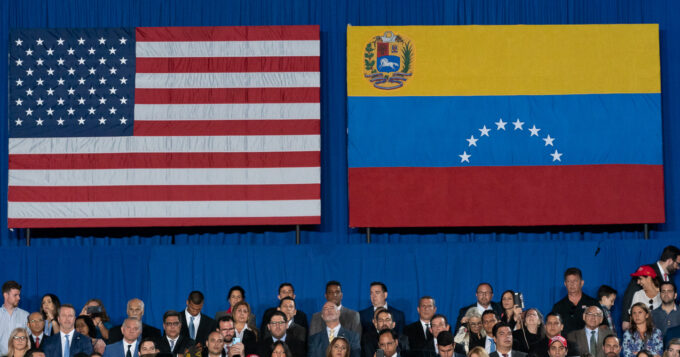
Every time Venezuela’s Bolivarian Revolution is faced with renewed threats to its survival, a stratum of US-based intellectuals is always ready with ‘left’ critiques that deliberately obscure the permanent imperialist siege against the country.
In the six weeks since the disputed July 28 elections, Venezuela has once again seen deadly violence, ramped-up US-led intervention including further sanctions, as well as defensive maneuvers from the Maduro government and allied popular movements.
Writing for New Left Review and The Nation, respectively, Gabriel Hetland and Alejandro Velasco present the contentious post-electoral panorama as the result of essentially endogenous factors – namely, Maduro’s ‘increasingly neoliberal, and even rightwing, policies,’ including ‘austerity, corruption, repression, and dollarization’ – in which US hybrid warfare is at best epiphenomenal. They urge the international left to ‘resis[t] apologism for Maduro’ and accept the victory of a fascist-led opposition movement.
Both academics are no strangers to this opportunistic exercise in methodological nationalism. Back in 2017 and 2019, as the Trump administration and its local neocolonial allies dramatically escalated the regime-change offensive to ‘maximum pressure,’ Velasco as NACLA (North American Congress on Latin America) executive editor published Hetland’s articles bashing the Maduro government’s ‘authoritarianism’ and assigning it equal, if not principal, blame for the crisis. Steve Ellner has characterised this position as the ‘plague on both your houses’ approach.
Hetland’s and Velasco’s articles belong to a broader genre of deeply disingenuous ‘left’ critique emanating from the global North, which has periodically attacked Southern governments and anti-systemic movements targeted by Washington, including Libya, Syria, Lebanon, Iran, Yemen, Zimbabwe, China, Cuba, Bolivia, Brazil, Nicaragua, among others.
Imperialism as afterthought
Velasco is quite transparent in downplaying the political and economic impact of US sanctions:
To be sure, US sanctions have exacerbated Venezuela’s crisis. But they are not its cause nor do they explain why sectors loyal to the government for 25 years turned away from it at the polls. Instead it is the combination of austerity, corruption, repression, and dollarization under Maduro, all of it hitting Chavismo’s historic bases of support, that for the first time swung the presidency to the opposition.
Such minimisation is abjectly dishonest, as even stridently anti-Chavista economist Francisco Rodríguez – hardly a man of the left – estimates that
approximately half of the decline in GDP observed in Venezuela between 2012 and 2020 can be attributed to politically-induced causes, including economic sanctions, the loss of access to external funding sources, and the politically induced toxification of relations with the Venezuelan economy.
This admittedly conservative estimate does not, moreover, consider the impact of post-2014 Obama sanctions, including the designation of Venezuela as an ‘unusual and extraordinary threat,’ which at the time Rodríguez equated with a de facto financial embargo on the country. Hetland likewise fails to interrogate the politically overdetermining character of US economic warfare, only to later admit on social media that he ‘forgot’ to mention that ‘sanctions are an egregious violation of an election being “free and fair.”’
This apparent afterthought is precisely the crux of the issue: Venezuelans went to the polls on July 28 with an imperialist pistol pressed firmly against their skulls. Any analysis of the latest election, let alone the history of post-Chávez period, that fails to properly account for how US imperialism has conditioned and sharpened every aspect of the Bolivarian Revolution’s internal contradictions is fundamentally misleading. Still, for Velasco and Hetland, such context is essentially parenthetical, with little bearing on the election itself.
It is true that the Maduro government has since 2018 implemented an orthodox economic liberalisation package premised on benefits for private capital alongside freezing wages, credit and public spending in order to curb inflation and attract investment. Though these policies have delivered sustained, if modest, economic recovery and lowered inflation to decade-lows, they have also deepened social inequalities, and alongside high-profile corruption scandals, brewed popular resentment over old and newly amassed fortunes.
The Maduro government’s embrace of economic liberalisation indeed represents an ideological retreat. But it only came about after years of incessant US-led hybrid warfare – ranging from media disinformation and financing of NGOs to insurrectionary street violence (guarimbas) and murderous sanctions – aimed at blocking pathways for revolutionary advance and chipping away at Venezuelan expanded state organs, especially the social missions and communal councils, that helped anchor the government and ruling party among the racialised working masses.
Put bluntly, the Maduro administration is running a war economy, devoid of instruments for sustained planning and repeatedly forced to pick from a menu of ‘bad’ options effectively circumscribed by sanctions designed to inflict collective punishment and undermine national sovereignty. The country’s energy sector offers clear examples, such as US transnational Chevron taking over operations and sales in joint ventures despite being a minority partner. Recent natural gas deals likewise evidence Caracas’ weak bargaining position, with state oil company PDVSA denied stakes and reduced to merely collecting taxes and royalties in deals with foreign partners. To present the government’s economic policies in a vacuum, or otherwise downplay the world-systemic context that overdetermines them, is beyond deceptive.
Fascism and the Chavista grassroots
It is the height of political duplicity to pretend that the consummation of the imperialist regime change campaign would be at all conducive to the revitalisation of Chavismo, or the Venezuelan left more generally. Rather, this position belies the whitewashing of the fascist menace represented by Maria Corina Machado, who has been quite open about her agenda of exterminating Chavismo.
Hetland and Velasco stress the largely ‘spontaneous’ character of the post-electoral protests that broke out in many popular areas, but they are silent regarding the renewed political violence targeting Chavista activists, including the assassination of two local leaders – Isabel Gil, 74, and Mayauris Silva, 49, ominously recalling the 2014 and 2017 guarimbas.
Venezuelan social movements rightly regard this threat as existential and continue to firmly stand with the Maduro government, notwithstanding their internal critiques of its contradictions and missteps, as well as ever-present tensions with state institutions.
Elections are, in the words of El Panal 2021 Commune spokesperson Robert Longa, ‘just one tactical moment in our broader struggle’ to forge new territorialised relations of production and popular self-governance as the foundation for socialist transition. In the face of a white supremacist empire that increasingly resolves its crises through genocidal war, ‘Maduro is safeguarding peace, which is crucial for the communes to accumulate force and advance toward emancipation.’ For the organised bases of Chavismo, the only path forward at present is to continue building up their capacities with the aim of shifting the overall direction of the revolution in a more radical direction. The Venezuelan state thus remains a contested field where bottom-up movements wield a level of influence that they would never have under a right-wing government.
Over the past six years, Venezuelan rural movements, with a long history of struggles for land, have achieved significant gains in the Venezuelan countryside. The 2018 ‘Admirable March’ saw hundreds of campesinos and revolutionary allies march for more than 400 kilometres to demand answers from the Venezuelan state in a mobilisation that sparked enthusiasm and solidarity across Chavismo. As a result, the National Land Institute has addressed more than 90 percent of the land disputes raised by the organisers in favor of small peasant collectives. Though the campesino movement protests that certain state policies including privatised access to inputs and machinery benefits agribusinesses, regular demonstrations have secured favorable government responses in terms of securing fuel supplies and setting fair crop prices for small-scale producers.
Popular power organisations have also made strides amid highly adverse conditions to open up greater political space, as more recently evidenced by the appointment of Ángel Prado as Communes Minister. Prado is the first ever communard minister, bringing with him a wealth of organising experience as a key leader of the flagship El Maizal Commune and of the Communard Union. He has openly talked about grassroots movements playing a bigger role in shaping economic policy and promoted the state funding of democratically-chosen local projects. Though the space occupied by popular power remains undoubtedly limited, their militancy and clarity regarding the present challenges show that Chávez’s socialist horizon has hardly vanished.
Internationalist responsibility
Yet rather than support these really-existing grassroots revolutionary forces against US imperialism, US-based academics like Hetland and Velasco make abstract calls for ‘resisting apologism for Maduro’ and ‘defending the people who were once Chavismo’s core.’ They demand the Maduro government cede power to a fascist-led opposition hellbent on Chavismo’s annihilation, potentially endangering the lives of thousands of Chavista organisers like Gil and Silva.
But they predictably place no demands on the US Empire, ‘the greatest purveyor of violence’ against the Venezuelan people and the peoples of the global South as a whole. Their animus is instead reserved for a besieged leader of a state strategically aligned with anti-systemic international actors from Cuba and Zimbabwe to Palestine and Iran. Regardless of its retreats and concessions, and the necessary debate surrounding how far they should go, the Maduro administration is nonetheless immeasurably more democratic than the fascist regime in Washington currently engaged in a colonial holocaust in Gaza on top of countless other crimes against working people across the globe.
Just as in Libya, Syria, and today in Palestine and Lebanon, there is no middle ground between US imperialism and the counter-systemic states and movements that are targeted for destruction.
The choice for the international left is clear.

ZNetwork is funded solely through the generosity of its readers.
Donate




