

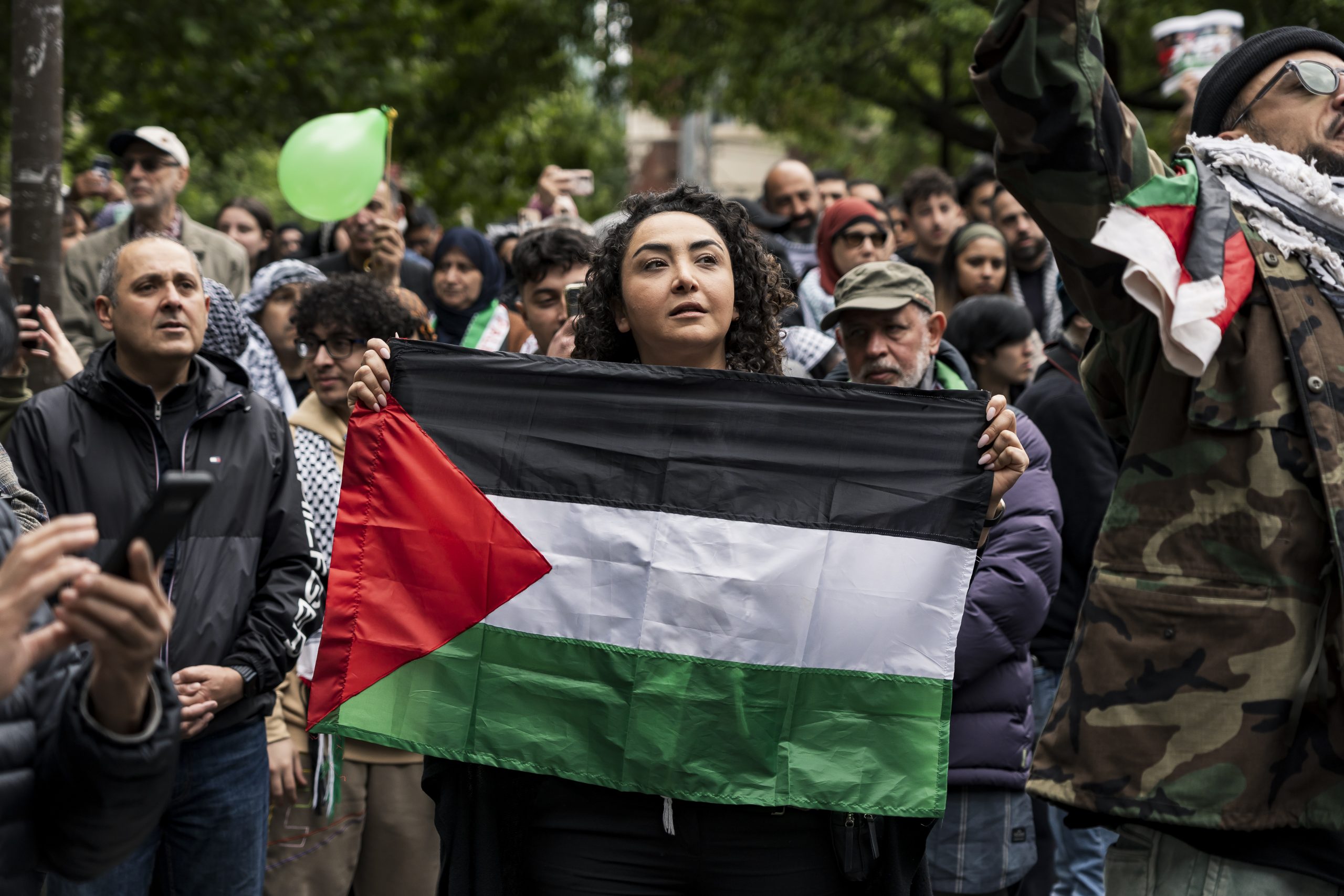
It is horribly uncanny to witness how much of my world—my white, progressive world filled with nonprofit professionals and Unitarian Universalists and people who marched against President Trump—seems completely unaffected by the genocidal violence in Gaza. Violence sponsored and abetted by our government, ongoing and live-streamed daily to our devices.
I guess that’s how genocidal violence works—through the collective will of enough people to stick to business as usual amid the horror. But I didn’t foresee how painful it would be to watch it happen in my communities, or how much I would hold on to the hope that not everyone in those communities wants to be turning away like this.
I started writing this essay in January in response to the New Year’s resolution discourse I was encountering. I know—I really do know—that people can focus on many things at once. That talking on social media about your meal planning goals and mindfulness practice doesn’t necessarily mean you’re not also talking off-line about calling your representatives and banner drops. But something about the relentless *inwardness* of the goals felt chilling. Like there was almost a determination to build a world where half-marathon training and better house-cleaning habits could blot out the devastation our bombs were continuing to visit on Gazan lives and homes.
This impression has been strengthened by what feels like a gradual drop-off of any mention at all of Gaza in the daily flow of conversation. In October and November, it at least came up sometimes, in stilted, raw fragments and uneasy emotional navigation. But now that the violence is truly entrenched—now that the US has solidified its role as chief bankroller of this massive project of brutality and collective punishment—even those conversations seem eclipsed by the swelling urgency of our private worlds.
There are of course lots of societal forces pushing us into this inward-facing posture, and resisting those forces isn’t simple. Life in late-stage capitalism is engineered to make collective action feel complicated and stressful. It isn’t lost on me as I think about where I might try to get this essay published that I would have literally dozens more options—legacy publications, women’s magazines, all sorts of the cheerful content hubs that we encounter daily—if I were writing about family meals or sleep hygiene or salary negotiations.
But I want to talk about white progressives and Gaza.
Because, to me, the seemingly boundless energy that we have for career goals and vacation planning and finding the ideal educational environment for our children feels deeply, deeply misaligned with the times we’re living in.
Misaligned with the times and misaligned with the progressive values that we tell ourselves are an important part of us.
As I try to understand the mismatch, I wonder whether white progressivism just isn’t strong enough to withstand discomfort. Whether the white progressive is just a new, soft-focus iteration of Martin Luther King Jr.’s white moderate “who is more devoted to order than justice; who prefers a negative peace which is the absence of tension to a positive peace which is the presence of justice.”
There is a lot of tension in speaking out on stances not universally shared in our social and professional circles. I feel it too and have been surprised by how much energy it has taken to overcome my conflict-avoidant tendencies even as I have committed to being loud and open in my support for a devastated Palestine.
I always imagined opposing genocide (and as a child with some white hero fantasies, I imagined it a lot!) would feel comfortably and easily righteous rather than ridden with discomfort and self-doubt. I did not imagine that people I have long considered allies in the struggle to make a better world would be shouting that my calls to end collective punishment are harmful, even evil.
But we can’t allow social discomfort to overwhelm our opposition to a terrible wrong. And we can’t retreat from our moral obligations into the comfort of maximizing our families’ individual success and happiness. That’s how genocide prospers.
I have been wondering lately, in my more despairing moments, whether there is any principle at all that white progressive people would be willing to put themselves in the way of sustained discomfort and risk for. I think it’s a good question to ask yourself: if this violence in Palestine—and the direct implication of Americans in its commission—doesn’t rise to your “red line” of requiring you to overcome your discomfort and take action, is there any extremity of civilian death caused by our government that would compel you to forcefully object?
Or is there any level of creeping fascism and antitrans violence that would compel you to forcefully object? To drop other balls and regularly devote time and energy to objecting? (And here I pause to weigh discomfort again—will my neighbors and family friends write me off as a crank and discard my invitation to engagement if I describe the consolidation of state power at the expense of individual rights as “fascism”? I don’t know, but I’ll lean in to the discomfort because I believe it’s the most apt word.)
Because of course the questions this global crisis raises—what, if anything, does white progressivism demand of its adherents? How can we live the political commitments we purport to have? Does the distribution of our energy and care reflect our values?—aren’t only or even primarily about Gaza. That’s just where they are most starkly, painfully apparent right now.
It’s not easy to let go of the urgency of inward-facing preoccupations. Our culture (and don’t let anyone tell you that affluent white progressives don’t have a shared culture) can, perversely, make it feel wrong to take time and energy away from maximizing our families’ “success.” I have some ideas about good ways to resist those teachings and embrace the joy of advocating collectively. (I really believe it generates joy, even when it is on a topic as painful and earth-shattering as ongoing genocide.) Your local friend or colleague who goes to all the protests probably has ideas too. Ask us! I don’t know any organizers or activists who wouldn’t feel honored to serve as a resource to someone wanting to join the struggle but uncertain about where to start.
I don’t think that anyone will emerge from this genocide unchanged, at least not anyone with the relative societal power of comfortable white progressives. I think a lot of people hope that they can, but I have to believe that we can’t watch in HD as our government funds and supports a genocide without being altered forever.
I’m writing this invitation to action because I want the inevitable change that’s coming for us to be something that we—and generations of our descendants—can live with.
Anne Kosseff-Jones is a writer and editor based in Minneapolis who is fumbling to move her life into better alignment with her values.
ZNetwork is funded solely through the generosity of its readers.
Donate





1 Comment
I taught World History for over 25 years as an adjunct. I am a gentile but I always admired Jewish culture, their support of labor, civil rights and basically their trying to keep the predators far from the prey. I have studied their history extensively for decades. Zionism is one of the many late 19th century settler-colonial ethno-state variants popular at the time and is not integral at all to Judaism. So any critique of Zionism and it’s state project, Israel, is a criticism of the Israeli state itself and not of Jews in general, some of whom also object to the persecution of the Palestinians. Much is said about Israeli right to self-defense. However, the Israelis, with the help of English and later US colonial powers, especially since 1948 have been the invaders with the residing Palestinians being pushed off their land. The UN recognizes an invaded nation’s right to self defense which historically makes claims of self defense more plausible coming from the Palestinians. Israel is essentially a giant US military base in the oil and gas filled middle east. That accounts for the US government’s solicitous tolerance for whatever Israel does as long as they keep an eye on Iran and others deemed as not a player. Some pro-Israeli chatter on the internet rages at the hypocrisy of people from genocidal blood-drenched countries such as US an UK raising any objection to their genocidal project. However that is a distraction from the issue of real genocide going on now in Palestine. That has to be stopped now. The US has to stop funding and politically enabling it . The fact that justification for slaughter of Palestinians has become mainstream PC talk in PMC-land (professional managerial class) shows how liberalism has been entirely hollowed out morally. There really is no right or left wing in US politics. They are different flavors of the ruling capitalist, settler-colonial imperium. I recommend people extend their learning curve by consulting Noam Chomsky, Michael Hudson, and Norman Finkelstein for starters.